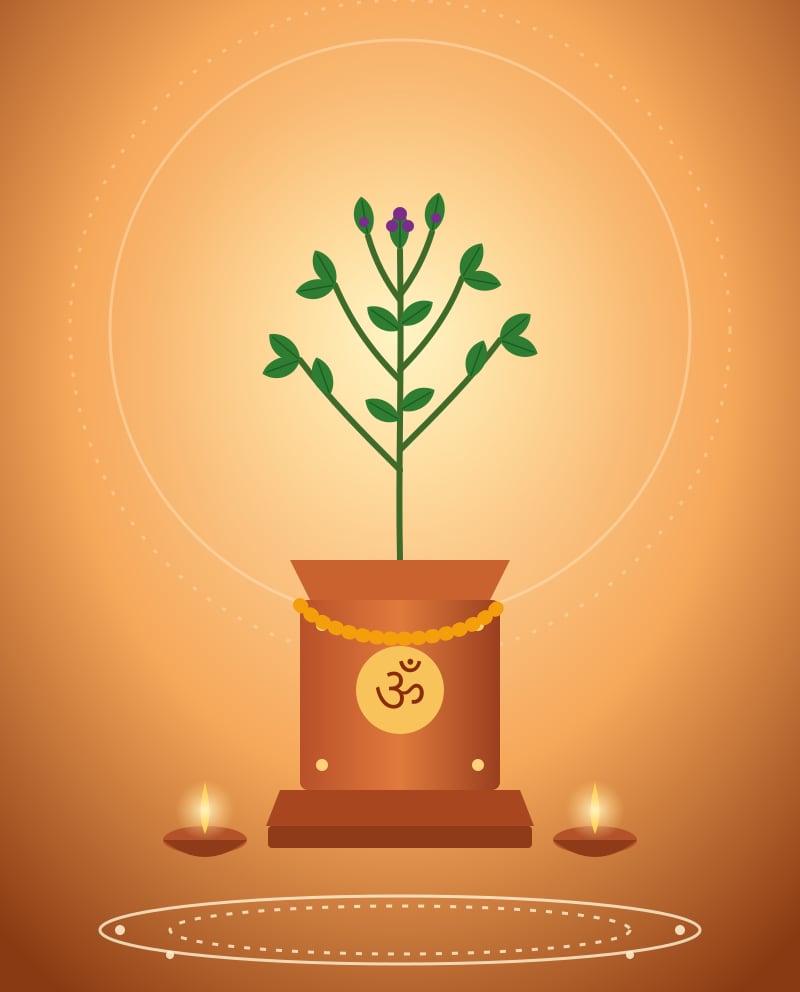
When is Tulsi Vivah?
| Year | Date | Day |
|---|---|---|
| 2026 | 20 November | Friday |
| 2027 | 10 November | Wednesday |
| 2028 | 28 October | Saturday |
Observed on Shukla Ekadashi of Kartik (Prabodhini Ekadashi); some families hold the wedding on Dwadashi. Dates follow the Panchang for New Delhi and can differ by a day in other places — check the Panchang for your city.
What Tulsi Vivah means
Tulsi Vivah is the wedding of the holy basil plant, worshipped as the goddess Tulsi, to Bhagavan Vishnu in the form of the Shaligram stone or as Krishna. It is held at the end of Chaturmas, on or just after Prabodhini (Dev Uthani) Ekadashi — the day Vishnu wakes from four months of yoga-nidra.
Because the gods are 'asleep' during Chaturmas, Hindu weddings are traditionally not held in those months. Tulsi's wedding is the first of the season: once she is married, the wedding season opens. Many couples without daughters perform the kanyadaan of Tulsi as their own, and the ceremony is celebrated with the full joy of a family wedding — songs, haldi, mehndi and sweets.
Tulsi herself is present in almost every Hindu home. She is watered and circled every morning, a lamp is lit before her every evening in Kartik, and no offering to Vishnu or Krishna is complete without a Tulsi leaf. The wedding honours that daily companionship.
The story of Tulsi Vivah
The Padma and Brahmavaivarta Puranas tell versions of the story. Vrinda, a devotee of Vishnu, was married to Jalandhar, a powerful asura born of Shiva's anger. As long as Vrinda's chastity remained unbroken, Jalandhar could not be defeated, and he troubled the devas. To end the war, Vishnu took Jalandhar's form and came to Vrinda; when she realised the deception, Jalandhar had already fallen.
Vrinda cursed Vishnu to become a stone, and he accepted — he is worshipped as the Shaligram from the Gandaki river. Vrinda gave up her body, and from that place the Tulsi plant grew. Vishnu declared that she would be dearer to him than Lakshmi, that she would be worshipped in every home, and that he would marry her every year in the month of Kartik.
Tulsi Vivah puja vidhi, step by step
The wedding can be done simply at home around your own Tulsi plant. Families in Maharashtra and Gujarat often hold it on Dwadashi, and it may be performed on any evening from Ekadashi to Kartik Purnima.
What you need
- A Tulsi plant in a pot or vrindavan, cleaned and decorated
- A Shaligram, a small Vishnu or Krishna image as the groom
- Four sugarcane stalks to build a mandap over the plant
- A red chunri, bangles, bindi, sindoor and a small mangalsutra for Tulsi
- A yellow cloth or dhoti for the groom
- Haldi, kumkum, akshat, flowers and garlands
- Amla, singhara (water chestnut), sweet potato, ber and seasonal fruits
- Diyas, incense, camphor and an aarti thali
- Sweets, panchamrit and the wedding meal
When to do the puja
The puja is done in the evening (pradosh) of Prabodhini Ekadashi or on Dwadashi, after the Ekadashi tithi as followed by your family. Tithi timings change by city and year. See the Panchang for your city.
Steps
- Clean and decorate. Clean the area around the Tulsi, draw a rangoli and tie the four sugarcane stalks over the pot as a wedding mandap, decorated with flowers and mango leaves.
- Wake Vishnu. In the evening, ring bells and blow the conch and recite 'Uttishtha Govinda' to wake the Lord from his sleep. In UP and Bihar women strike a soop (winnowing basket) and sing.
- Dress the bride. Dress Tulsi in the red chunri with bangles, bindi and sindoor. Place the Shaligram or Krishna image beside her, dressed in yellow.
- Sankalp and haldi. Take sankalp, offer haldi and kumkum to both, and tie them together with a thread or a cloth as in a wedding.
- Kanyadaan. The family performing the wedding offers Tulsi in marriage, placing her hand (a branch) with the groom.
- Pheras. Carry the Shaligram around Tulsi seven times while singing mangal geet or the mangalashtak, showering akshat.
- Offerings and aarti. Offer the seasonal fruits, sweets and panchamrit, perform aarti and recite the Tulsi stuti.
- Prasad. Share the prasad and the wedding sweets. Families who kept the Ekadashi fast break it on Dwadashi morning.
Offerings & food: Sugarcane, amla, singhara (water chestnut), sweet potato, ber, panchamrit, kheer, puri, halwa, Tulsi-leaf prasad
Mantras for Tulsi Vivah
Waking Vishnu (Prabodhini Ekadashi)
उत्तिष्ठ गोविन्द त्यज निद्रां जगत्पते ।
त्वयि सुप्ते जगन्नाथ जगत्सुप्तं भवेदिदम् ॥
uttiṣṭha govinda tyaja nidrāṃ jagatpate |
tvayi supte jagannātha jagatsuptaṃ bhavedidam ||
Rise, O Govinda, lord of the world, leave your sleep; while you sleep, O Jagannatha, the whole world sleeps.
Salutation to Tulsi
महाप्रसादजननी सर्वसौभाग्यवर्धिनी ।
आधिव्याधिहरा नित्यं तुलसि त्वं नमोऽस्तु ते ॥
mahāprasādajananī sarvasaubhāgyavardhinī |
ādhivyādhiharā nityaṃ tulasi tvaṃ namo'stu te ||
O Tulsi, mother of the great prasad, who increases all good fortune and always removes the ills of mind and body — I bow to you.
The eight names of Tulsi
वृन्दा वृन्दावनी विश्वपूजिता विश्वपावनी ।
पुष्पसारा नन्दिनी च तुलसी कृष्णजीवनी ॥
vṛndā vṛndāvanī viśvapūjitā viśvapāvanī |
puṣpasārā nandinī ca tulasī kṛṣṇajīvanī ||
Vrinda, Vrindavani, worshipped by the world, purifier of the world, essence of flowers, giver of joy, Tulasi, the life of Krishna — the eight names of Tulsi from her namashtak.
Tulsi Vivah across India
Maharashtra and Gujarat hold full weddings in homes and temples, often on Dwadashi, with mangalashtak and akshata. In Saurashtra, temples at Dwarka and Junagadh hold grand processions. In UP and Bihar, women sing Tulsi vivah geet and wake the deities with a winnowing basket and sugarcane. In Karnataka and Andhra, Uttana Dwadashi has a Tulsi puja with amla branches.
- Maharashtra
- Tulsi Vivah is held from Dwadashi to Kartik Purnima with a full wedding — mangalashtak, antarpat cloth and akshata — and marks the start of the wedding season.
- Gujarat (Saurashtra)
- Grand weddings at Dwarka, Junagadh and village temples, with a procession of the groom (Lalji) and community feasts.
- Uttar Pradesh and Bihar
- Dev Uthani Ekadashi: women draw the feet of the gods with rice paste, cover them with a soop, and wake them with songs and the sound of the basket.
- Karnataka and Andhra Pradesh
- Uttana Dwadashi or Ksheerabdi Dwadashi: a Tulsi puja with an amla branch placed beside the plant, with lamps lit around it.
- Odisha
- The month of Kartik is kept with daily Tulsi worship and lamps; the Panchuka days at the end of the month are especially sacred.
Prayers to recite
Do’s and don’ts
Do
- Water and circle the Tulsi plant daily from this day
- Keep the Ekadashi fast if you can
- Light a diya at the Tulsi every evening of Kartik
Avoid
- Do not pluck Tulsi leaves on Ekadashi or after sunset
- Avoid rice, onion and garlic on the Ekadashi fast
- Do not keep a dried Tulsi plant — replace it with respect
Frequently asked questions
When is Tulsi Vivah in 2026?
Tulsi Vivah 2026 falls on Friday, 20 November 2026 (Shukla Ekadashi of Kartik (Prabodhini Ekadashi); some families hold the wedding on Dwadashi). Dates are for New Delhi and may differ by a day in other places.
Tulsi Vivah 2026 kab hai?
Tulsi Vivah 2026 Friday, 20 November 2026 ko hai. Apne shahar ki sahi tithi ke liye Panchang dekhein.
तुलसी विवाह 2026 कब है?
तुलसी विवाह 2026 शुक्रवार, 20 नवंबर 2026 को है। अपने शहर की सही तिथि और मुहूर्त के लिए पंचांग देखें।
When is Tulsi Vivah in 2027?
Tulsi Vivah 2027 falls on Wednesday, 10 November 2027 (Shukla Ekadashi of Kartik (Prabodhini Ekadashi); some families hold the wedding on Dwadashi). Dates are for New Delhi and may differ by a day in other places.
When is Tulsi Vivah in 2028?
Tulsi Vivah 2028 falls on Saturday, 28 October 2028 (Shukla Ekadashi of Kartik (Prabodhini Ekadashi); some families hold the wedding on Dwadashi). Dates are for New Delhi and may differ by a day in other places.
Why is Tulsi Vivah celebrated?
The ceremonial wedding of the holy Tulsi plant to Bhagavan Vishnu, on the day Vishnu wakes from his four-month yoga-nidra. Chaturmas ends and the Hindu wedding season begins.
How is Tulsi Vivah celebrated?
Clean and decorate the Tulsi vrindavan (planter) — rangoli, flowers, a sugarcane mandap. Dress Tulsi as a bride — red chunri, bangles, bindi, mangalsutra. Place Shaligram or a Krishna idol beside her as the groom. Perform the wedding: sankalp, kanyadaan, and pheras around Tulsi. Offer amla, sugarcane, water chestnut (singhara), sweet potato and seasonal fruits. Wake Vishnu in the evening with conch, bells and the mantra "Uttishtha Govinda". Distribute prasad and light diyas around the home.
What is offered or eaten on Tulsi Vivah?
Sugarcane, amla, singhara (water chestnut), sweet potato, ber, panchamrit, kheer, puri, halwa, Tulsi-leaf prasad
When is Tulsi Vivah held?
On Prabodhini (Dev Uthani) Ekadashi or on the Dwadashi after it, in Kartik Shukla Paksha. Some families hold it on any evening up to Kartik Purnima.
Why is Tulsi married to Shaligram?
According to the Puranas, Vrinda's curse turned Vishnu into the Shaligram stone, and Vishnu promised to marry her, as Tulsi, every year. The wedding honours that promise.
Can Tulsi Vivah be done at home?
Yes. Most families perform it at home around their own Tulsi plant with a Shaligram or Krishna image, a sugarcane mandap, simple offerings and aarti.
Why are weddings held only after Tulsi Vivah?
During Chaturmas, the four months when Vishnu rests, weddings are traditionally avoided. Tulsi's wedding on Dev Uthani Ekadashi is the first of the season, after which marriages begin.
 24 Nov2026
 24 Nov2026
 14 Dec2026
 20 Dec2026