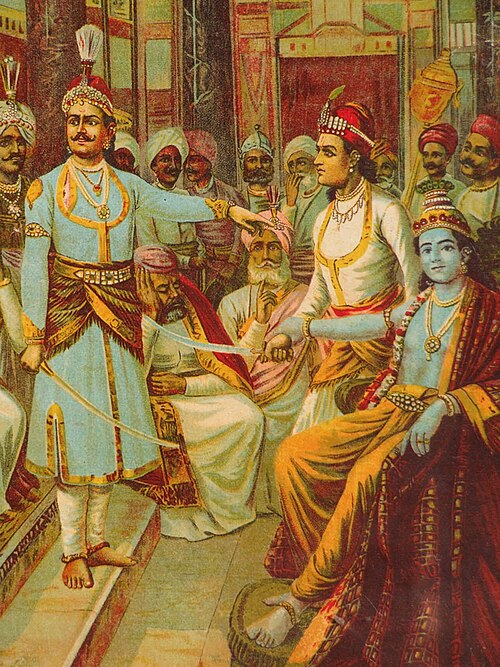
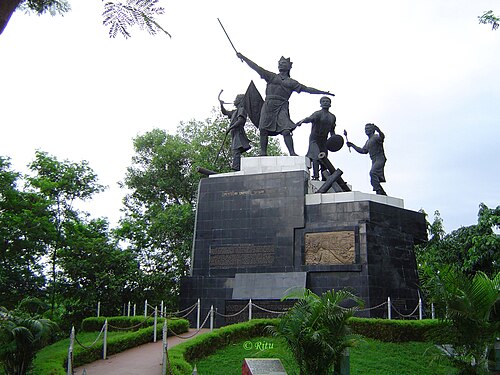
Bhagyachandra, known in Meitei as Ching-Thang Khomba, ruled Manipur in the second half of the 18th century, in a reign broken by war and exile. He was a grandson of King Garib Niwaz (Pamheiba), in whose time Vaishnavism became the faith of the Manipuri court, and he succeeded to a throne threatened by repeated Burmese invasions.
Manipuri tradition holds that the Maha Ras was first performed at Bhagyachandra's court on the full moon of Kartik, with his daughter Bimbavati dancing the part of Radha.Manipuri tradition of the first Ras Lila
He is honoured as Rajarshi, a royal sage, because he joined kingship to deep devotion. A follower of the Gaudiya Vaishnava tradition of Chaitanya Mahaprabhu, he made the worship of Krishna the centre of Manipur's public life and turned it into an art form that has become the state's signature.
Exile and return
Early in his reign Burmese forces overran Manipur, and Bhagyachandra was forced to flee. He found refuge in the Ahom kingdom of Assam under King Rajeswar Singha. A well-known story says that the Ahom court, unsure whether the refugee was truly a king, tested him by asking him to subdue a wild elephant — and that he did so through his faith in Krishna. Whatever the details, he returned with Ahom support and regained his throne, though fighting with Burma continued for years.
Shree Govindajee
According to Manipuri tradition, Krishna appeared to Bhagyachandra in a dream and told him to carve an image from a particular jackfruit tree on the hill of Kaina. The image of Shree Govindajee made from it was installed with great ceremony, traditionally in 1776, and Bhagyachandra is said to have dedicated his kingdom to the deity, ruling as Govinda's servant. The present Shree Govindajee temple, beside the royal palace in Imphal, is the heart of Manipuri Vaishnavism.
Beyond the temple, his reign tied Manipur more closely to the wider Vaishnava world of Bengal and Vrindavan, while keeping Meitei language, music and customs at the centre of worship. That blend of the local and the pan-Indian remains the character of Manipuri devotion.
The Ras Lila
Bhagyachandra's greatest gift was the Ras Lila, the dance-drama of Krishna, Radha and the gopis. Tradition credits him with composing the Maha Ras, the Kunja Ras and the Vasanta Ras, and with designing the distinctive costume — the stiff, mirror-worked cylindrical skirt called potloi and the fine veil — said to have been revealed to him in a vision. The first Maha Ras is traditionally dated to 1779.
The dance joined Vaishnava devotion to older Meitei traditions of movement such as the Lai Haraoba, creating the gentle, flowing style now known worldwide as Manipuri, one of India's classical dances. He is also credited with developing the Nata Sankirtana, the drum-and-song worship that accompanies life events in Manipur.
Last pilgrimage
Late in life Bhagyachandra handed the throne to his son and set out on pilgrimage to the sacred places of Bengal associated with Chaitanya. He died in 1798, away from Manipur, at Murshidabad according to most accounts, while on his journey.
How they are remembered
The Ras Lila is still performed in Manipur on the full moons of autumn and spring, at the Shree Govindajee temple and in village courtyards, much as Bhagyachandra ordained it. In 2013 UNESCO added Manipuri Sankirtana to its list of the Intangible Cultural Heritage of Humanity. Manipur remembers him as the king who made devotion its living art.
Ekatmata Stotra · Stanza 20
Named in Stanza 20 of the Ekatmata Stotra — the painters who made the gods visible.
रवि-वर्मा च भाग्यचन्द्रः चित्रकारौ प्रसिद्धौ।
येषां तूलिकया सन्धीयते देव-सन्निधौ नरः॥
Sources: Wikipedia: Bhagya Chandra · Wikipedia: Manipuri Raas Leela · ich.unesco.org/en/RL/sankirtana-ritual-singing-drumming-and-dancing-of-manipur-00843. Written afresh for The Hindu Book; corrections welcome at [email protected].