According to the Bhagavata Purana and the Harivamsha, Krishna was born at midnight in a prison cell in Mathura to Devaki and Vasudeva, on the eighth day of the dark half of Bhadrapada. Devaki's brother, the tyrant Kamsa, had been told that her eighth child would kill him, and had murdered her other children. Hindus worship Krishna as the eighth avatar of Vishnu — or, for many, as the Supreme Lord himself.
कर्मण्येवाधिकारस्ते मा फलेषु कदाचन“Your right is to action alone, never to its fruits.”Bhagavad Gita 2.47
That night Vasudeva carried the baby across the flooded Yamuna to Gokul, where the cowherd chief Nanda and his wife Yashoda raised him as their own.
Gokul and Vrindavan
The stories of his childhood are among the most loved in India: the baby who killed the demoness Putana, the toddler who ate mud and showed Yashoda the universe in his mouth, the boy who stole butter and danced on the serpent Kaliya, and who lifted Mount Govardhan on his little finger to shelter the people of Braj from Indra's storm. With the flute he called the gopis, above all Radha, to the rasa dance — for the Bhakti poets, the soul's love for God.
Mathura and Dwaraka
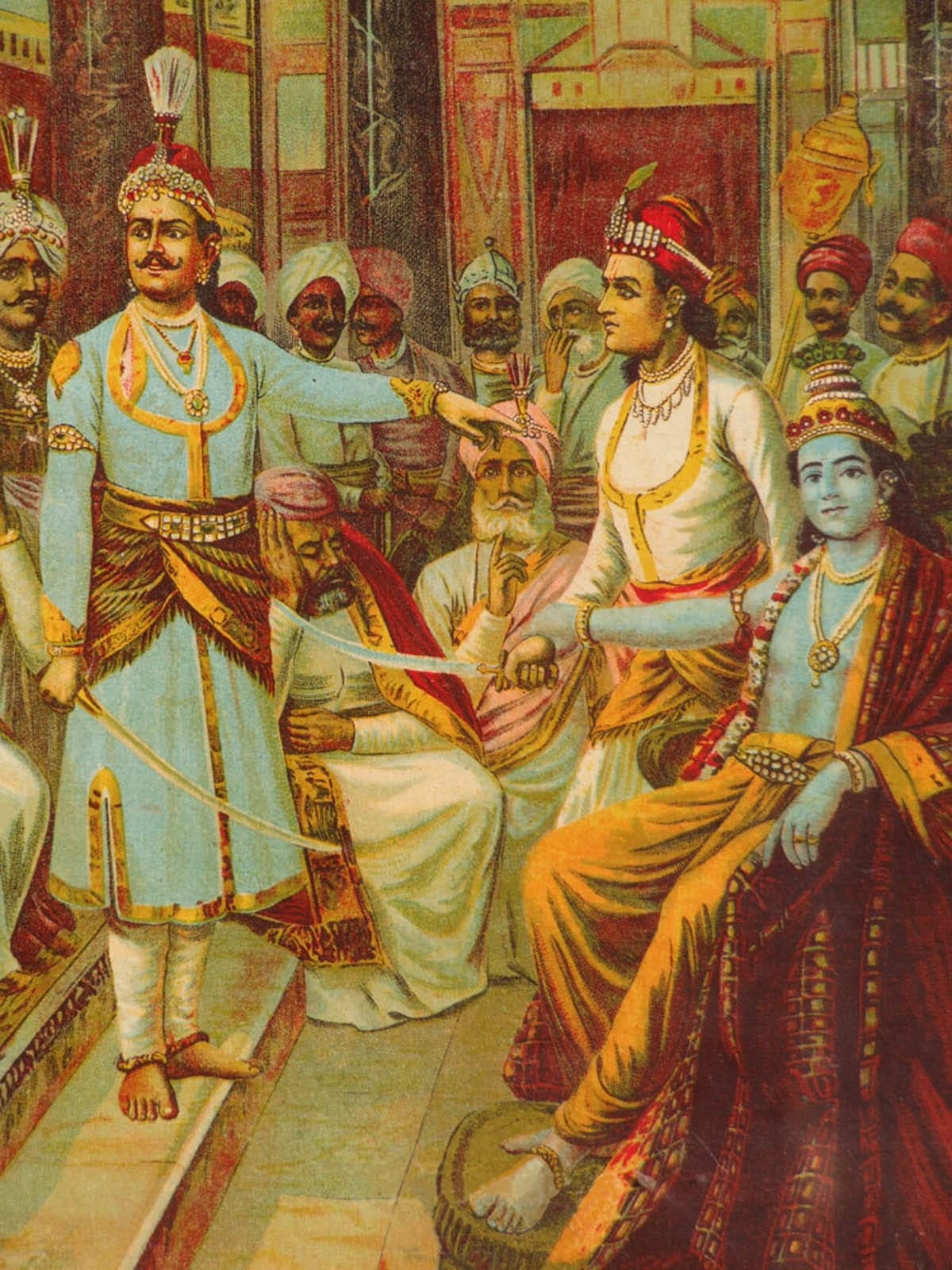
As a youth he returned to Mathura, killed Kamsa and freed his parents. Pressed by repeated attacks from Jarasandha, he led the Yadavas to a new city by the sea, Dwaraka, and married Rukmini and other queens. He was a friend and adviser to his cousins the Pandavas, and protected Draupadi when she was humiliated in the Kaurava court.
The Gita
When war came between the Pandavas and the Kauravas, Krishna refused to bear arms and became Arjuna's charioteer. On the field of Kurukshetra, when Arjuna lost heart at the sight of his kinsmen, Krishna taught him the Bhagavad Gita — on duty without attachment, the immortal Self, and the paths of action, knowledge and devotion. Years after the war, the Mahabharata says, he left the world when struck by a hunter's arrow near Prabhasa.
How they are remembered
Krishna Janmashtami is celebrated at midnight across India, with dahi-handi in Maharashtra. Mathura, Vrindavan, Dwaraka, Puri (as Jagannath), Udupi and Guruvayur are among India's great pilgrim centres, and the Gita is one of the most translated books in the world.
Ekatmata Stotra · Stanza 12
Named in Stanza 12 of the Ekatmata Stotra — ten figures from the great epics.
रामो भरतश्च कृष्णो भीष्मो धर्मपुत्र: तथा।
अर्जुनो मार्कण्डेय: हरिश्चन्द्र: प्रह्लादो नारदस्तथा॥
Sources: Wikipedia: Krishna · Wikipedia: Bhagavad Gita. Written afresh for The Hindu Book; corrections welcome at [email protected].