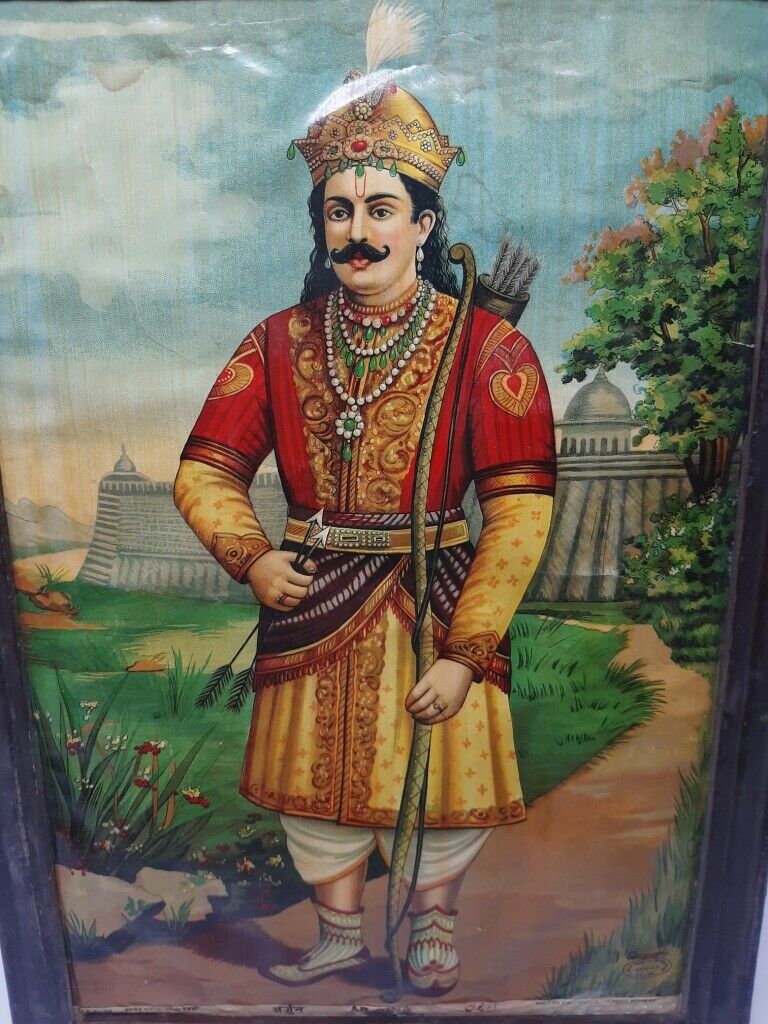
According to the Mahabharata, Arjuna was the third of the Pandavas, born to Kunti by the blessing of Indra, king of the gods. He has many names — Partha (son of Pritha, Kunti), Dhananjaya (winner of wealth), Savyasachi (who shoots with either hand), Gudakesha (conqueror of sleep), Kiriti (the crowned one) — and the Virata Parva has him list ten of them himself.
नष्टो मोहः स्मृतिर्लब्धा त्वत्प्रसादान्मयाच्युत। स्थितोऽस्मि गतसन्देहः करिष्ये वचनं तव॥“My delusion is gone, and by your grace, Achyuta, I have regained my memory. I stand firm, my doubts dispelled. I will do as you say.”Bhagavad Gita 18.73 — Arjuna to Krishna
Under Drona, he became the finest archer among the Kuru princes. The well-loved story of the test of the bird's eye — when Drona asked each pupil what he saw, and only Arjuna replied that he saw nothing but the eye of the target — sums up his single-minded concentration.
Winning Draupadi and the Gandiva
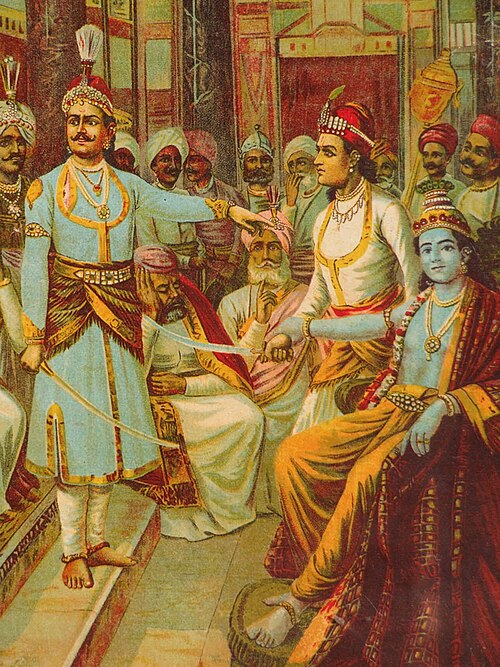
When the Pandavas were living disguised as brahmins, Arjuna won Draupadi at her swayamvara by stringing the great bow and striking the target that the assembled kings could not. Later, with Krishna, he helped Agni consume the Khandava forest; in return the fire god gave him the bow Gandiva, inexhaustible quivers and a chariot with a monkey banner.
During a period of self-imposed exile the Adi Parva describes his marriages to the Naga princess Ulupi, to Chitrangada of Manipura, and to Krishna's sister Subhadra, who became the mother of Abhimanyu.
The Kirata and the gods
In the forest years, the Vana Parva tells, Arjuna went to the Himalayas to win divine weapons. Shiva tested him in the form of a Kirata hunter; they quarrelled over a boar both had shot, fought, and Arjuna could not prevail. Recognising Shiva, he worshipped him and received the Pashupata weapon. The episode inspired Bharavi's Sanskrit poem Kiratarjuniya. Arjuna then spent five years in Indra's heaven learning the use of celestial weapons.
There, the epic says, he declined the advances of the apsara Urvashi, who cursed him to live for a time as a eunuch. He used the curse in the year of disguise, serving at King Virata's court as Brihannala, a dance teacher.
Kurukshetra and the Gita
Before the war, Arjuna chose Krishna, unarmed, as his charioteer, rather than Krishna's army. On the first morning, the Bhishma Parva tells, he asked Krishna to draw the chariot between the two armies. Seeing his grandsire, teacher, cousins and friends arrayed against him, he put down his bow and said he would not fight.
Krishna's reply is the Bhagavad Gita: the teaching of the undying Self, of action without attachment to its fruits, of knowledge, meditation and devotion. He showed Arjuna his universal form. At the end Arjuna declared his doubts dispelled and took up his bow. In the war he brought down Bhishma, killed Jayadratha to avenge Abhimanyu, and defeated Karna.
After the war, the Ashvamedhika Parva tells, Arjuna followed the sacrificial horse of Yudhishthira's Ashvamedha across many kingdoms; in Manipura he was struck down by his own son Babhruvahana and revived by Ulupi with a Naga gem. When Krishna left the world, the Mausala Parva says, Arjuna went to Dvaraka to lead its women and children to safety, and found that his strength and his bow had failed him — a sign, Vyasa told him, that his own time was over.
How they are remembered
Arjuna is remembered above all as the listener of the Gita — the human being in crisis to whom the teaching was given, and so a figure in whom every reader can see themselves. His friendship with Krishna, as Nara beside Narayana, is one of the great bonds of Indian tradition. Gita Jayanti marks the day of that dialogue.
Ekatmata Stotra · Stanza 12
Named in Stanza 12 of the Ekatmata Stotra — ten figures from the great epics.
रामो भरतश्च कृष्णो भीष्मो धर्मपुत्र: तथा।
अर्जुनो मार्कण्डेय: हरिश्चन्द्र: प्रह्लादो नारदस्तथा॥
Sources: Wikipedia: Arjuna · Wikipedia: Bhagavad Gita · sacred-texts.com/hin/maha/index.htm. Written afresh for The Hindu Book; corrections welcome at [email protected].