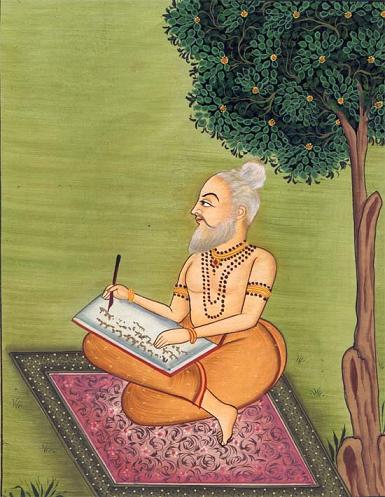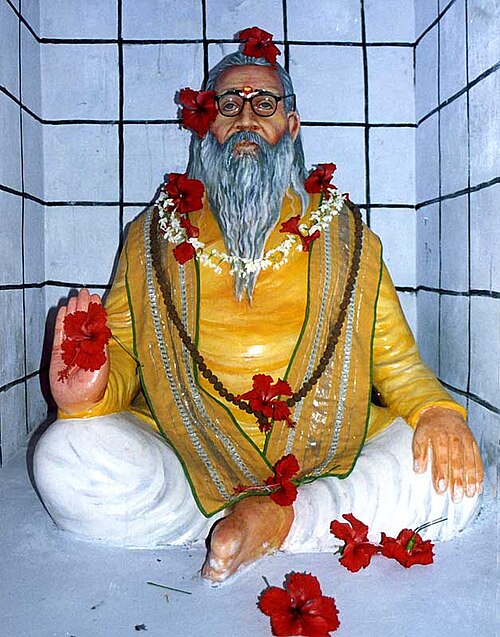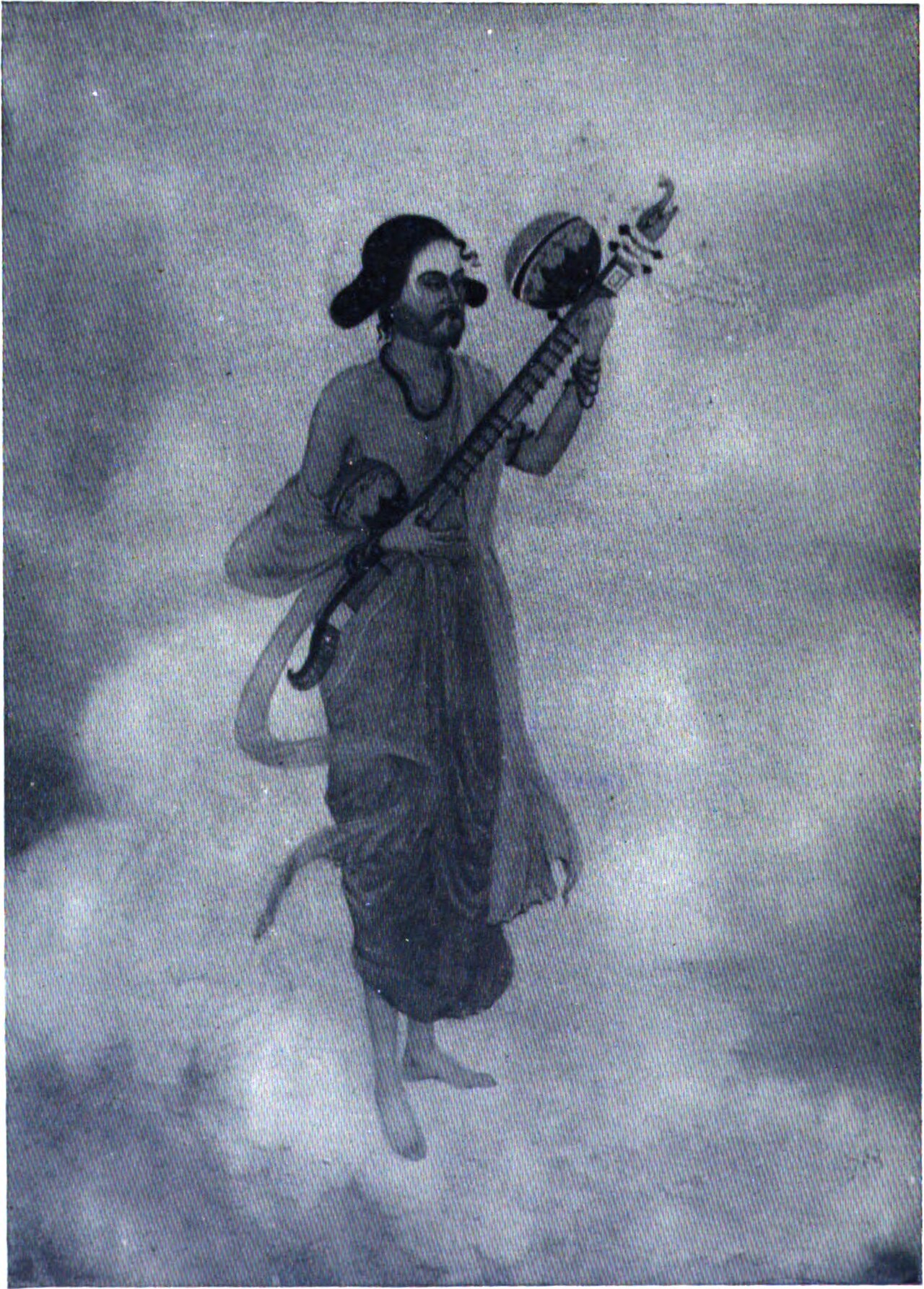
Narada is the most travelled figure in Hindu tradition. Called devarshi — a sage among the gods — he is described in the Puranas as a mind-born son of Brahma who moves freely through heaven, earth and the underworlds, carrying his veena and singing the names of Vishnu. In the Bhagavad Gita (10.26) Krishna says, among the divine sages, I am Narada.
सा त्वस्मिन् परमप्रेमरूपा“That bhakti is of the nature of supreme love for Him.”Narada Bhakti Sutra 2
He appears in almost every great story — bringing news, giving advice, sometimes stirring up trouble that turns out to serve a higher purpose. Popular retellings and films made his "Narayana, Narayana" a household phrase, often with a wink at his mischief; the scriptures see him above all as a teacher of devotion.
A servant's son
The Bhagavata Purana (Book 1) has Narada tell his own story. In a former life he was the son of a maidservant who served a group of wandering sages during the rainy season. Eating their leftovers and listening to their talk of Vishnu, the boy's heart turned to God. After his mother died, he wandered alone and in meditation glimpsed the Lord for a moment; a voice told him he would see Him again in his next life. Reborn from Brahma, he became Narada, free to sing God's glory everywhere.
The one who starts the great works
The Valmiki Ramayana opens with Valmiki asking Narada whether there is anyone alive who is perfectly virtuous. Narada answers by telling him, in brief, the story of Rama — the Samkshepa Ramayana — which Valmiki then expands into the epic.
In the Bhagavata Purana, Narada finds Vyasa dejected even after compiling the Vedas and writing the Mahabharata. He tells Vyasa that his work is incomplete because it has not fully sung the glories of the Lord, and Vyasa then composes the Bhagavata.
Teacher of devotees
When the child Dhruva left home in hurt and anger, the Bhagavata says, Narada met him in the forest and gave him the mantra Om Namo Bhagavate Vasudevaya, with which Dhruva won the vision of Vishnu. It was Narada too who sheltered Prahlada's mother and taught devotion to the child in her womb.
The Chandogya Upanishad (chapter 7) shows him in a humbler light: he goes to the sage Sanatkumara confessing that he has studied all the Vedas, sciences and arts, yet knows only words and not the Self, and asks to be taught.
Sanatkumara leads him step by step from name and speech to the infinite, the bhuma, teaching that happiness lies only in the infinite and never in the small.
Music and teaching
Narada is honoured as a master of music; a treatise on Vedic phonetics and chant, the Naradiya Shiksha, bears his name, as does a legal text, the Narada Smriti. Most beloved is the Narada Bhakti Sutra, a short work of eighty-four aphorisms on devotion that defines bhakti as supreme love for God and remains a foundation text of the bhakti traditions.
In the epics and Puranas he is also the sage whose words set events in motion: he warns, foretells and sometimes provokes — as when he tells Savitri's father that Satyavan has only a year to live.
How they are remembered
Narada is the eternal messenger and the restless devotee — the one who carries news between worlds and turns every story toward God. Narada Jayanti is observed in the month of Jyeshtha, and because of his role as bearer of news, it is also marked by some as a day for journalists.
Ekatmata Stotra · Stanza 12
Named in Stanza 12 of the Ekatmata Stotra — ten figures from the great epics.
रामो भरतश्च कृष्णो भीष्मो धर्मपुत्र: तथा।
अर्जुनो मार्कण्डेय: हरिश्चन्द्र: प्रह्लादो नारदस्तथा॥
Sources: Wikipedia: Narada · Wikipedia: Narada Bhakti Sutra · vedabase.io/en/library/sb/1/5. Written afresh for The Hindu Book; corrections welcome at [email protected].