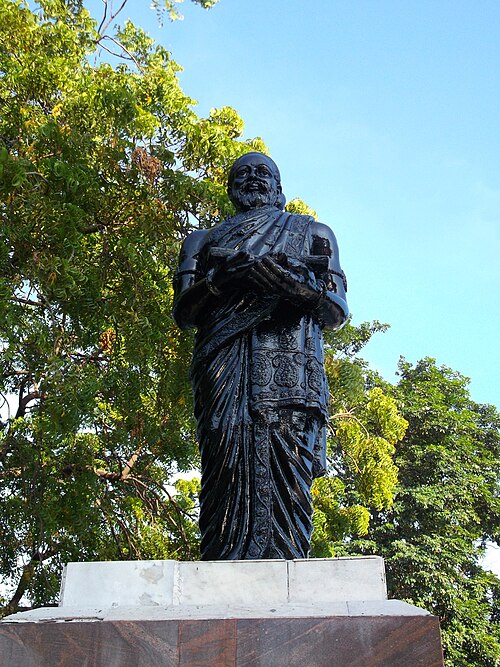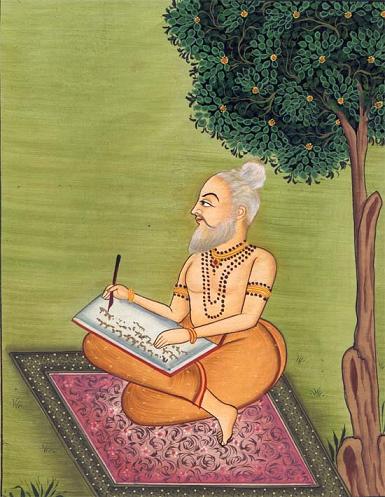
Valmiki is honoured as the Adikavi, the first poet, and his Ramayana as the Adikavya, the first poem. The epic itself tells how it came to be. It opens with Valmiki asking the sage Narada whether there lived anyone in the world who was perfect in virtue, courage and truth; Narada answered by telling him, in brief, the story of Rama.
मा निषाद प्रतिष्ठां त्वमगमः शाश्वतीः समाः। यत्क्रौञ्चमिथुनादेकमवधीः काममोहितम्॥“O hunter, may you find no rest for endless years, for you killed one of this pair of krauncha birds, lost in love.”Valmiki Ramayana, Bala Kanda 2.15 — the first shloka
Little is known of Valmiki as a historical person. Scholars date the core of the Ramayana to roughly the middle of the first millennium BCE, with later additions, especially in its first and last books. The tradition places him in Rama's own lifetime, as a witness to the events he sings.
Grief becomes verse
The Bala Kanda tells how, soon after hearing Narada, Valmiki went to bathe in the Tamasa river with his pupil Bharadvaja. He saw a pair of krauncha birds together, and in that moment a hunter shot the male. As the female cried out over her mate, Valmiki was overcome with pity, and words broke from him in a new, measured form. He was astonished: his shoka, grief, had become shloka, verse.
Then Brahma appeared and told him that this metre had come to him by divine will, and that he should use it to tell the whole story of Rama. Valmiki sat in meditation, saw the events of the story before his inner eye, and composed the epic in seven books.
The opening of the epic is carefully framed. The first sarga is Narada's short summary of Rama's life, and the second is the krauncha episode; only then does the long poem begin. Valmiki thus presents himself both as a listener, who first heard the story, and as a seer, who saw it whole before he sang it.
The bandit Ratnakara
A popular story, found in later texts and regional retellings but not in the Valmiki Ramayana itself, says that Valmiki was once a highway robber named Ratnakara who robbed travellers to feed his family. When he tried to rob Narada, the sage asked whether his family would share in his sins. They would not. Shaken, Ratnakara asked for guidance and was given the name of Rama to repeat — some versions say he could only say mara, which became Rama as he chanted. He meditated so long that an anthill (valmika) grew over him, giving him his name. Different communities tell this story in different ways, and some reject it.
Sita's protector
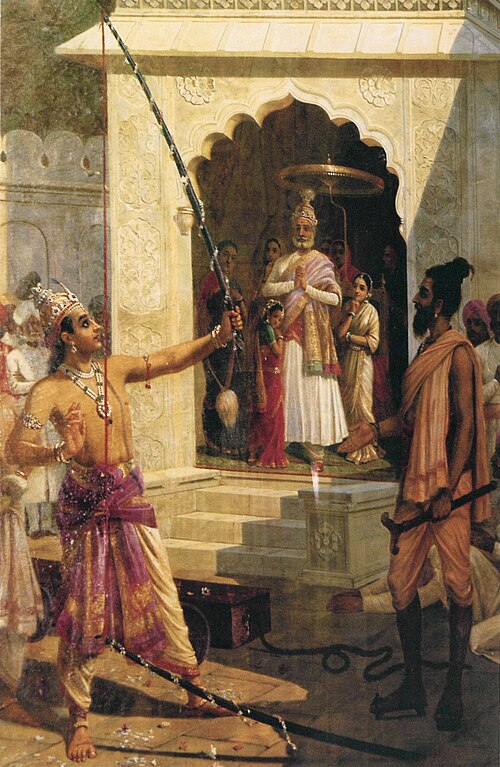
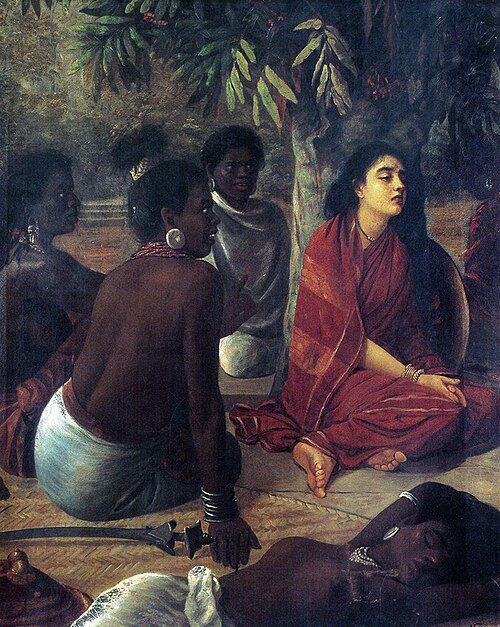
In the Uttara Kanda, Valmiki enters his own story. When Rama, bowing to public doubt, sent the pregnant Sita away, Lakshmana left her near Valmiki's hermitage. The sage took her in and cared for her, and there she gave birth to twin sons, Lava and Kusha. Valmiki raised and taught them, and trained them to sing the Ramayana.
Years later, the twins sang the epic at Rama's horse-sacrifice, and Rama recognised them as his sons. Valmiki brought Sita to the assembly and swore to her purity. The Uttara Kanda's authorship is debated by scholars, but this episode has made Valmiki, for millions, the guardian of Sita's honour.
How they are remembered
Valmiki gave Indian literature its founding poem and its classical metre, the anushtubh shloka. Kalidasa, Bhavabhuti, Kamban and Tulsidas all wrote in his shadow. Valmiki Jayanti is celebrated on Ashvin Purnima, with special devotion by the Valmiki community of North India, who revere him as their spiritual ancestor.
Ekatmata Stotra · Stanza 13
Named in Stanza 13 of the Ekatmata Stotra — eleven devotees, sages and seers.
हनुमान् जनको व्यासो वसिष्ठः शुको बलि: तथा।
दधीचिर्विश्वकर्मा च पृथु: वाल्मीकिरेव च॥
Sources: Wikipedia: Valmiki · Wikipedia: Ramayana · valmiki.iitk.ac.in. Written afresh for The Hindu Book; corrections welcome at [email protected].