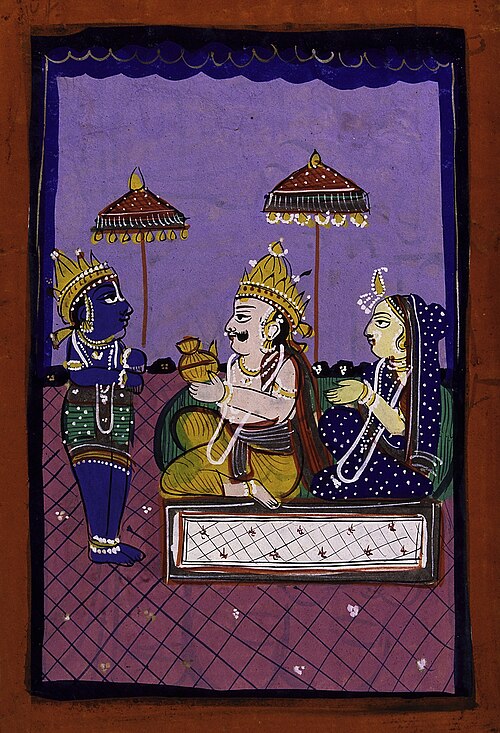
Dadhichi's story has two layers. In the Rig Veda he appears as Dadhyanch, a seer of the Atharvan line, who knew a secret teaching called the madhu-vidya, the "honey doctrine". One Rig Vedic verse already connects him with Indra's victories: Indra, it says, slew his enemies with the bones of Dadhyanch.
इन्द्रो दधीचो अस्थभिर्वृत्राण्यप्रतिष्कुतः। जघान नवतीर्नव॥“Indra, irresistible, with the bones of Dadhyanch struck down the Vritras, ninety times nine.”Rig Veda 1.84.13
In the Mahabharata and the Puranas this grew into the story for which he is remembered: a hermit who, when the gods came begging, gave up his own body for the good of the world. His name became a byword for the highest form of giving, the gift of oneself.
The horse-headed teacher
The Shatapatha Brahmana and the Brihadaranyaka Upanishad tell a strange early story. Indra taught Dadhyanch the madhu-vidya but threatened to cut off his head if he ever passed it on. The divine twin physicians, the Ashvins, wished to learn it. They removed the sage's head, set a horse's head in its place, and through it he taught them; when Indra struck off the horse's head, the Ashvins restored his own. The Rig Veda alludes to this horse-headed teaching in hymns to the Ashvins.
The gods come begging
The Mahabharata's Vana Parva and several Puranas tell the better-known story. The demon Vritra had driven the gods from heaven, and no weapon could harm him. Brahma, or in some versions Vishnu, told Indra that only a weapon made from the bones of the sage Dadhichi could defeat him. Some tellings say Dadhichi's bones held the power of the gods' weapons, which they had left with him for safekeeping and which he had absorbed through his tapas.
Ashamed, the gods went to the hermitage and asked the sage for his body. Dadhichi did not hesitate. He said that the body must be given up one day in any case, and that it was better given for the good of all. He sat in yoga, withdrew his life breath and left his body.
Some later tellings add that the sage first wished to bathe in all the sacred rivers, and that the gods brought the waters of every tirtha to one place for him — which local tradition identifies with the tank at Misrikh, the place of "mixed" waters. Only then did he give himself up, calmly and without complaint.
The thunderbolt
The gods took the bones to Vishvakarma, the divine craftsman, who shaped from them the vajra, Indra's thunderbolt; some accounts add other divine weapons made from the remaining bones. Armed with the vajra, Indra fought Vritra and killed him, releasing the waters the demon had held back and restoring order to the worlds.
The Puranas add that Dadhichi's wife Suvarcha, returning to find her husband gone, was grief-stricken, and that their son Pippalada grew up to become a great sage, whom tradition identifies with the Pippalada who teaches in the Prashna Upanishad. Versions differ in many details, but the core of the sacrifice is the same in all.
How they are remembered
Dadhichi stands for sacrifice for the common good. His name is invoked by organ and body donation drives in India, which call body donation Dadhichi dehdan. A popular account links the shape of the Param Vir Chakra, India's highest gallantry award, to his vajra. Misrikh near Naimisharanya in Uttar Pradesh keeps a tank and temple associated with him.
Ekatmata Stotra · Stanza 13
Named in Stanza 13 of the Ekatmata Stotra — eleven devotees, sages and seers.
हनुमान् जनको व्यासो वसिष्ठः शुको बलि: तथा।
दधीचिर्विश्वकर्मा च पृथु: वाल्मीकिरेव च॥
Sources: Wikipedia: Dadhichi · Wikipedia: Vajra · Wikipedia: Param Vir Chakra. Written afresh for The Hindu Book; corrections welcome at [email protected].