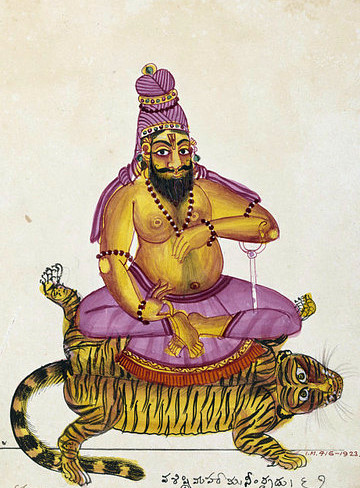
Vasishtha is one of the oldest names in Indian tradition. The seventh book (mandala) of the Rig Veda is ascribed to him and his family, and its hymns praise Indra, Varuna, Agni, Ushas and the Maruts. One famous hymn there, the Mahamrityunjaya mantra to Rudra, is still chanted daily across India. The Vasishtha hymns also record the Battle of the Ten Kings, in which King Sudas, whose priest Vasishtha was, defeated a coalition of rivals.
त्र्यम्बकं यजामहे सुगन्धिं पुष्टिवर्धनम्। उर्वारुकमिव बन्धनान्मृत्योर्मुक्षीय माऽमृतात्॥“We worship the three-eyed one, fragrant, who increases nourishment. As a cucumber is freed from its stalk, may I be freed from death — not from immortality.”Rig Veda 7.59.12, in the mandala ascribed to Vasishtha and his family
Later tradition counts Vasishtha among the saptarishis, the seven great seers, and the Puranas call him a mind-born son of Brahma. His wife Arundhati is honoured as the most faithful of wives; the pair are seen in the night sky as the double star in the Great Bear, which brides are shown on their wedding night.
Guru of the Solar Dynasty
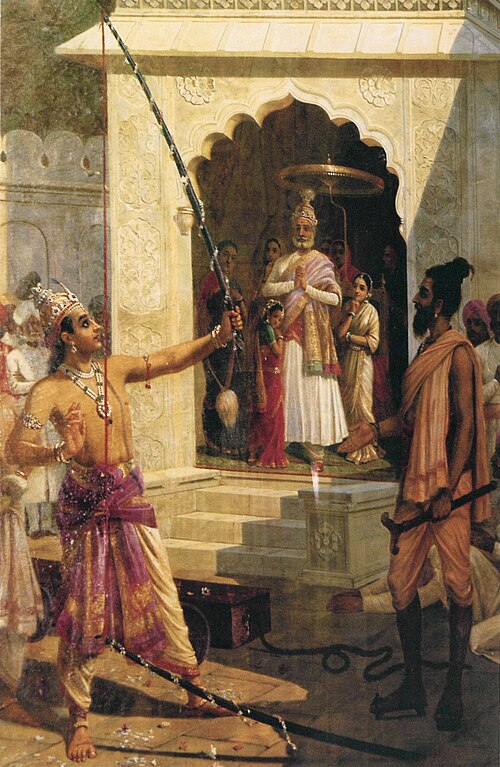
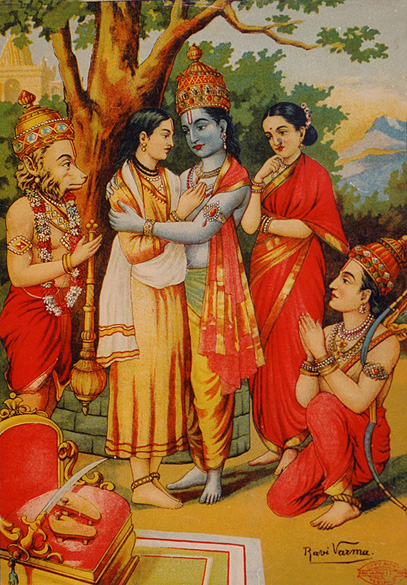
In the Valmiki Ramayana Vasishtha is the purohita of Ayodhya, the counsellor of King Dasharatha. He guides the sacrifice through which Rama and his brothers are born, gives the princes their education, and steadies the court in its darkest hour after Dasharatha's death. When Bharata refuses the throne and goes to Chitrakoot to bring Rama back, Vasishtha goes with him; after Lanka, he crowns Rama king.
In the Ramayana it is Vasishtha who persuades a reluctant Dasharatha to honour Vishvamitra's request and send the boy Rama into the forest to protect the sages' sacrifices, the first step in Rama's journey. Kalidasa's Raghuvamsha tells how King Dilipa served Vasishtha's cow Nandini to win the blessing of a son, Raghu, after whom the dynasty is named.
The rivalry with Vishvamitra
The longest story about Vasishtha concerns King Vishvamitra. The Ramayana's Bala Kanda tells how the king visited Vasishtha's hermitage and saw his wish-fulfilling cow, called Shabala there and Nandini or Kamadhenu in other texts. He demanded her; Vasishtha refused, and the armies the cow produced defeated the king's. Humbled, Vishvamitra gave up his throne for tapas, determined to become a brahmarshi himself.
The Mahabharata and Puranas add that the feud cost Vasishtha his hundred sons, including Shakti, the father of Parashara. Grief-stricken, he tried to end his own life, but the rivers would not drown him. Yet he did not curse in return, and in the end it was Vasishtha's acknowledgement that finally made Vishvamitra a brahmarshi. Versions differ in detail, but all present the contest as one between royal power and the patient power of spiritual discipline.
The Yoga Vasishtha
A long Sanskrit work, the Yoga Vasishtha, is cast as Vasishtha's teaching to a young Rama who has grown disillusioned with the world. Through stories within stories it teaches that the world is a projection of the mind and that freedom comes through self-inquiry and effort. Scholars date the work to the later first millennium CE, long after the Vedic seer, but it has shaped Advaita thought and remains widely read.
Its teaching is framed as an answer to Rama's despair, and it insists that human effort, paurusha, is stronger than fate — a striking message from the mouth of a priestly sage.
How they are remembered
Vasishtha stands for the steady guru beside the throne: the teacher whose authority comes from discipline rather than force. His name is honoured on Rishi Panchami with the other seven seers, the Arundhati star is still pointed out at weddings, and many Brahmin families trace their gotra to him.
Ekatmata Stotra · Stanza 13
Named in Stanza 13 of the Ekatmata Stotra — eleven devotees, sages and seers.
हनुमान् जनको व्यासो वसिष्ठः शुको बलि: तथा।
दधीचिर्विश्वकर्मा च पृथु: वाल्मीकिरेव च॥
Sources: Wikipedia: Vasishtha · Wikipedia: Mandala 7 · Wikipedia: Yoga Vasistha. Written afresh for The Hindu Book; corrections welcome at [email protected].