Arundhati opens the list of great women in the Ekatmata Stotra, and for good reason: in Hindu tradition she is the very image of a marriage that does not waver. She was the wife of Vasishtha, one of the Saptarishi and the family priest of the Ikshvaku kings of Ayodhya. The Bhagavata Purana counts her among the nine daughters of the sage Kardama and Devahuti, given in marriage to the great rishis.
In the Vedic wedding rite, the newly married couple are shown the Pole Star and Arundhati in the night sky, and the bride is asked to be as constant as they are.The Arundhati-darshana custom of the Grihya Sutras
Her name is often explained as "one who does not obstruct" or "one who is never held back" — a woman whose devotion to dharma and to her husband nothing could turn aside. Through her son Shakti, tradition traces the line of Parashara and of Vyasa himself back to Vasishtha's household.
The star beside the Saptarishi
Hindu astronomy names the seven bright stars of the Great Bear the Saptarishi. In the handle, the star known in the West as Mizar is Vasishtha, and the faint companion right beside it, Alcor, is Arundhati. The two appear always together as the constellation wheels around the pole — a picture, for the tradition, of a couple who never part.
Because Alcor is faint, being able to see it was also an old test of good eyesight. A Sanskrit idiom, arundhati-nyaya, uses the same star as a teaching method: one first points to the bright star nearby, then guides the eye to the dim one — moving from the obvious to the subtle.
The bride's vow
The Grihya Sutras, the household manuals of the Vedic schools, describe a rite after the wedding in which the couple go out at night and the husband shows the bride Dhruva, the Pole Star, and Arundhati. Dhruva stands for steadiness, Arundhati for faithfulness. The custom, called Arundhati darshan, is still part of many weddings across India, and the star is named in wedding blessings in several regional languages.
Arundhati in the Mahabharata
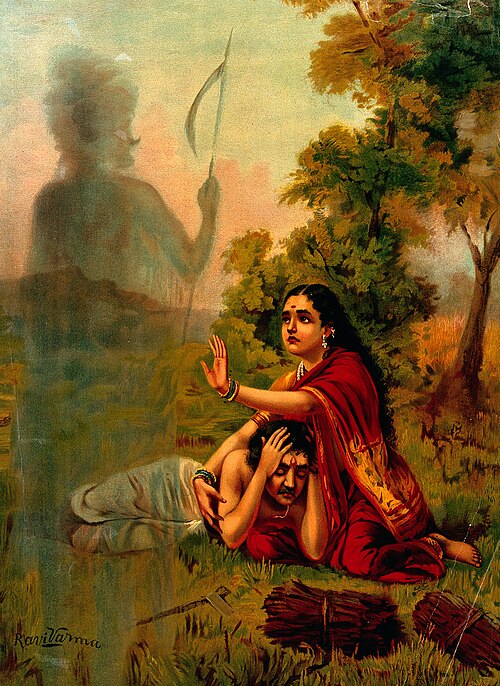
The Mahabharata gives her a quiet strength. The Vana Parva, telling of the birth of Skanda, says that the goddess Svaha, wishing to approach Agni, took on the forms of the wives of six of the seven rishis — but could not take the form of Arundhati, because of the power of her austerity and her devotion to Vasishtha. That is why, the epic explains, only six of the rishis' wives were linked to the infant Skanda as the Krittikas.
The Shalya Parva tells of the tirtha called Badarapachana. During a long drought, Arundhati kept up her austerities, and Shiva came to her in the form of a brahmin asking for food. She set jujube fruits (badara) to cook and, telling him stories, kept at the task for years while the drought lasted; pleased, Shiva blessed the place. The epic places her among the most honoured of women for this patience.
In Ayodhya's story
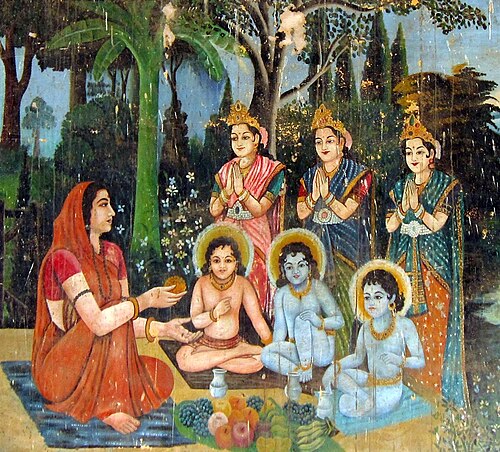
As Vasishtha's wife, Arundhati stands in the background of the Ramayana tradition and of Kalidasa's Raghuvamsha, where King Dilipa and Queen Sudakshina come to Vasishtha's hermitage and are received by the sage and Arundhati together. In later Ramayana retellings she is shown comforting the queens of Ayodhya and blessing Sita. These later works differ in detail, but they agree in showing her as the gracious, steady mother of the hermitage.
How they are remembered
Few figures are remembered so quietly and so constantly. Every wedding where the bride is shown the little star, every Rishi Panchami where the Saptarishi are worshipped together with Arundhati, keeps her memory alive. In the Ekatmata Stotra she leads the line of women — Anasuya, Savitri, Sita and the rest — who stand for the strength that holds a family and a people together.
Ekatmata Stotra · Stanza 10
Named in Stanza 10 of the Ekatmata Stotra — ten women of itihāsa and purāṇa.
अरुन्धती अनसूया च सावित्री जानकी सती।
द्रौपदी कण्णगी गार्गी मीरा दुर्गाश्च वन्दिताः॥
Sources: Wikipedia: Arundhati (Hinduism) · Wikipedia: Mizar and Alcor · Wikipedia: Saptarishi. Written afresh for The Hindu Book; corrections welcome at [email protected].