Anasuya's name means "free from envy" — and in the tradition she is exactly that: a woman of such purity and self-discipline that the gods themselves came to test her. She was the wife of Atri, one of the Saptarishi. The Bhagavata Purana makes her a daughter of the sage Kardama and Devahuti, and so a sister of Arundhati.
In the Valmiki Ramayana, Anasuya gives Sita a divine garland, garments, ornaments and an unguent, promising that they will never fade and that Sita will always shine beside Rama.Valmiki Ramayana, Ayodhya Kanda (closing chapters)
She lived with Atri in a hermitage that tradition places near Chitrakuta, on the Mandakini river, where an Anasuya ashram is still visited by pilgrims. To her and Atri were born, according to the Puranas, three sons who carried portions of the three great gods: Dattatreya of Vishnu, Chandra (Soma) of Brahma, and the fiery sage Durvasa of Shiva.
Meeting Sita
The best-known account of Anasuya is in the Valmiki Ramayana. Near the end of the Ayodhya Kanda, Rama, Sita and Lakshmana reach Atri's hermitage. Atri tells Rama of his wife's power: during a drought of ten years, her austerity brought forth roots and fruits and made the Ganga flow there, and at the request of the gods she once made ten nights pass as one. Rama asks Sita to go to her as to a mother.
The aged Anasuya praises Sita for following her husband into exile and speaks to her of a wife's dharma. Pleased with Sita, she gives her gifts that will never fade, and asks her to tell the story of her marriage. Tulsidas retells the scene at the beginning of the Aranya Kand of the Ramcharitmanas, where Anasuya's teaching to Sita on pativrata dharma became one of the most quoted passages of the poem.
The test of the Trimurti
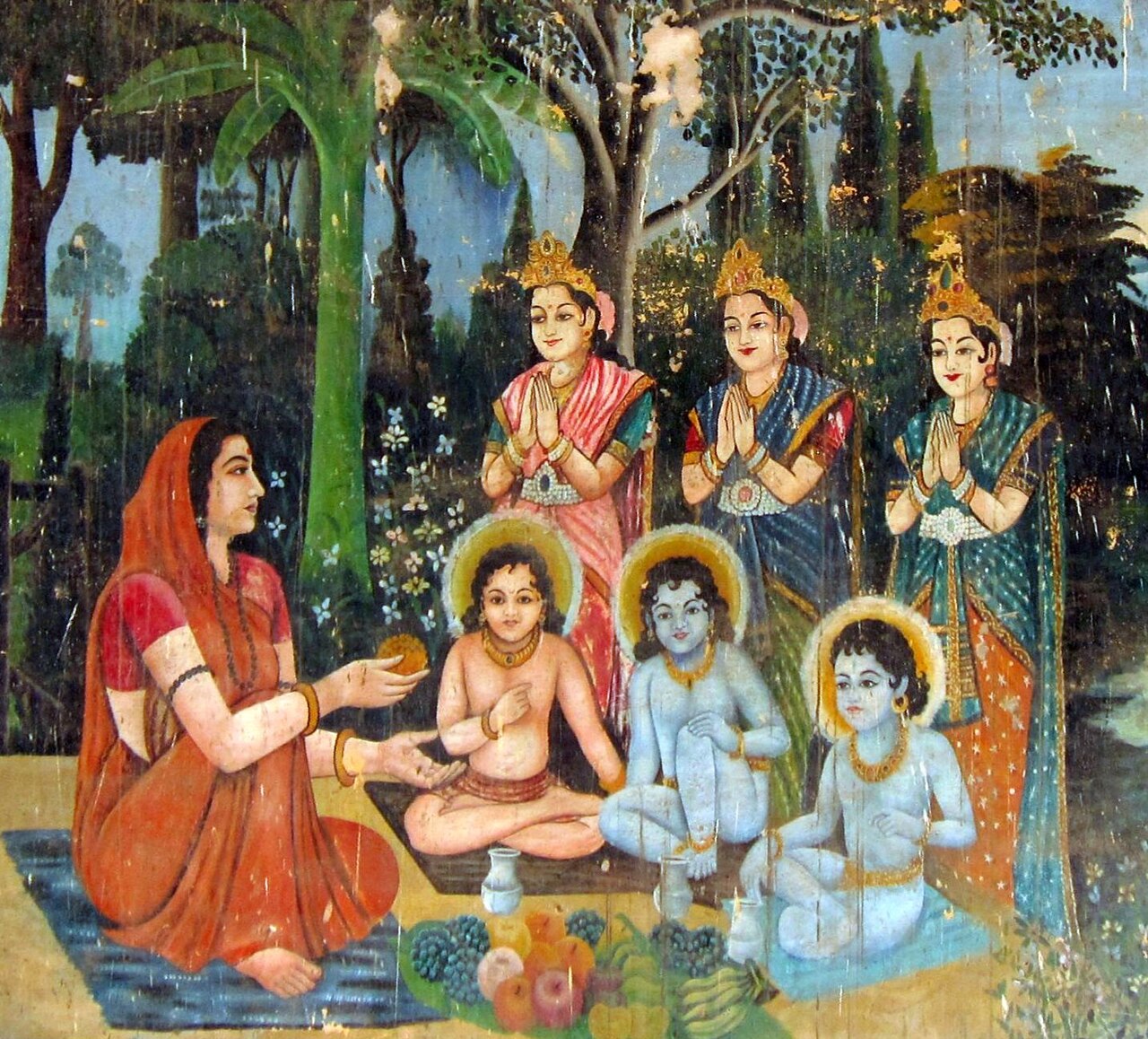
The story most loved in homes and temples is that of the three gods' test. In the popular telling, found in Dattatreya traditions and later devotional works, Brahma, Vishnu and Shiva came to the hermitage disguised as mendicants and asked Anasuya to feed them unclothed. Unwilling to refuse guests or to break her vow, she sprinkled them with water made holy by her devotion, turned them into infants, and fed and nursed them as a mother. Their consorts came to plead for them, and the gods, restored, blessed her with sons who carried their own portions.
The versions differ. The Bhagavata Purana tells it more simply: Atri performed great tapas wishing for a son like the Lord, and the three gods appeared before him together and promised that a portion of each would be born to him and Anasuya. The test story is a later, popular development — but it is the one that made her name a byword for purity across India.
The woman who held back the sun
The Markandeya Purana tells of another episode. The devoted wife of a brahmin named Kaushika, angered when a sage cursed her husband to die at sunrise, declared that the sun would not rise — and it did not, throwing the worlds into disorder. The gods turned to Anasuya, who persuaded the woman to let the sun rise and then restored her husband to life by her own power. The story shows Anasuya not only as pure but as a peacemaker among the devout.
How they are remembered
Anasuya is honoured above all as the mother of Dattatreya, the guru of the Avadhuta tradition, whose birth is celebrated on Datta Jayanti. Her ashram near Chitrakuta remains a place of pilgrimage, and "Sati Anasuya" has been the subject of countless songs, plays and early Indian films. In the Ekatmata Stotra she stands second, beside Arundhati.
Ekatmata Stotra · Stanza 10
Named in Stanza 10 of the Ekatmata Stotra — ten women of itihāsa and purāṇa.
अरुन्धती अनसूया च सावित्री जानकी सती।
द्रौपदी कण्णगी गार्गी मीरा दुर्गाश्च वन्दिताः॥
Sources: Wikipedia: Anasuya · Wikipedia: Atri · Wikipedia: Dattatreya. Written afresh for The Hindu Book; corrections welcome at [email protected].