In the Puranas, Sati is the youngest and dearest daughter of Daksha, the Prajapati, and so is called Dakshayani. From childhood she was devoted to Shiva, the ascetic of the mountains, and she won him by her austerities. Daksha, proud master of the rites, never accepted a son-in-law who smeared himself with ash and lived among cremation grounds.
अथावमानेन पितुः प्रयुक्ता दक्षस्य कन्या भवपूर्वपत्नी। सती सती योगविसृष्टदेहा तां जन्मने शैलवधूं प्रपेदे॥“Wounded by her father's insult, Daksha's daughter — the virtuous Sati, Shiva's first wife — gave up her body by yoga, and came to be born again of the mountain-king's queen.”Kalidasa, Kumarasambhava 1.21
The story is told, with differences, in many texts — among them the Shiva, Vayu, Bhagavata, Kurma and Devi Bhagavata Puranas. An older form of the conflict, the destruction of Daksha's sacrifice by Shiva, appears in the Mahabharata; the details of Sati's death and its aftermath grew fuller in the later Puranas.
Shakta texts such as the Devi Bhagavata see her as the Great Goddess herself, who took birth as Daksha's daughter in answer to his own worship — which makes his later contempt all the more tragic.
Daksha's yajna
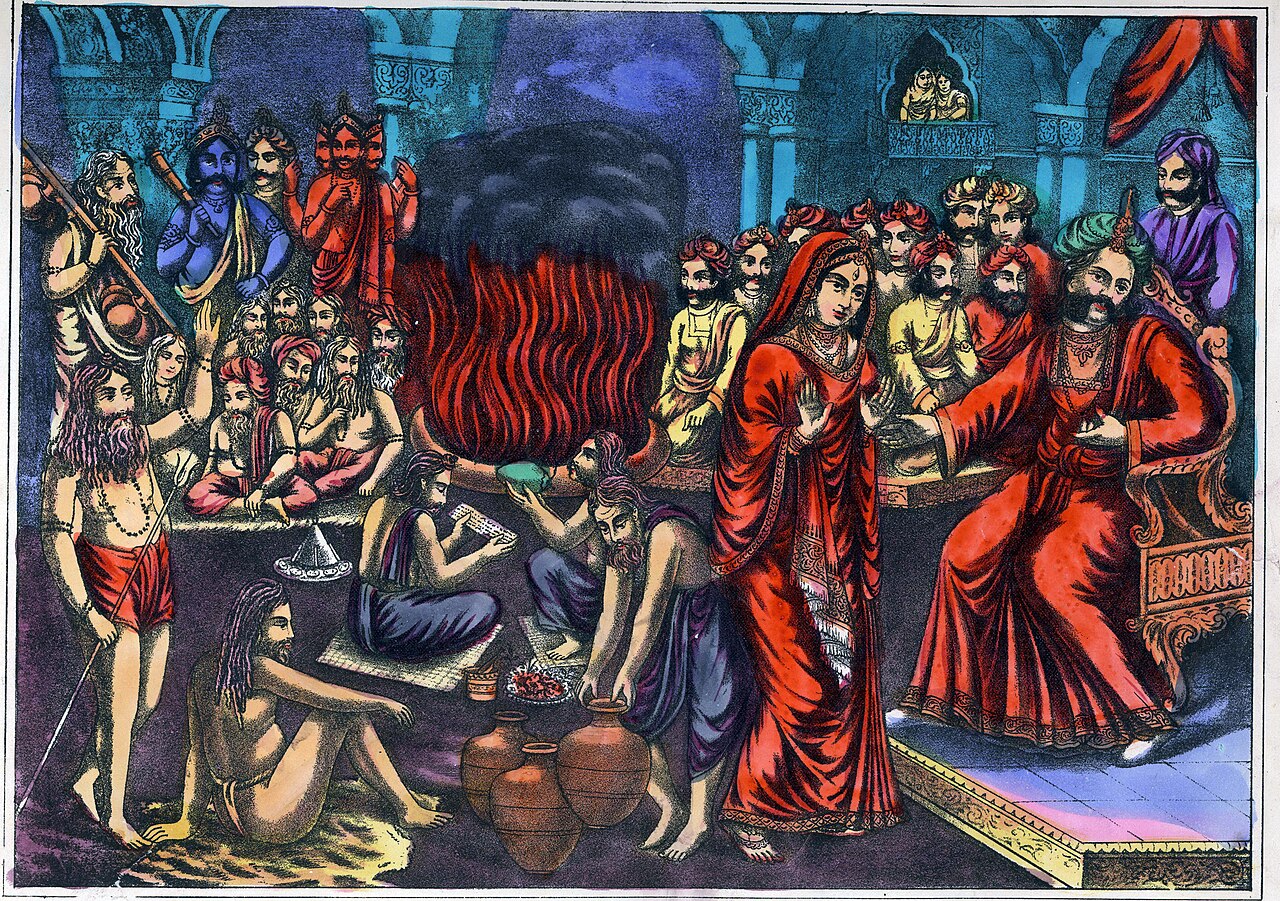
Daksha held a great sacrifice and invited all the gods and sages — but not Shiva. The Bhagavata Purana traces his anger to an earlier assembly where Shiva did not rise to greet him. Sati, hearing of the yajna, wished to go to her father's house. Shiva warned her that she would be dishonoured there, but she went.
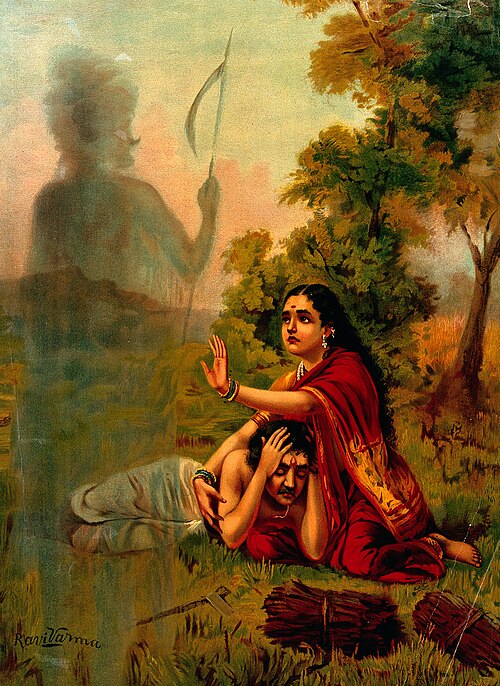
At the sacrifice Daksha ignored her and spoke contemptuously of Shiva before everyone. Unable to bear the insult to her husband, Sati sat down in silence, entered deep yoga, and gave up her body through the inner fire. The Bhagavata and Shiva Puranas describe her death this way, as a yogic self-offering.
Virabhadra and the dance of grief
When Shiva learned what had happened, he tore a lock from his matted hair and from it arose the fierce Virabhadra (with Bhadrakali in some versions), who destroyed the sacrifice and beheaded Daksha. At the gods' pleading, Shiva relented, revived Daksha with the head of a goat, and allowed the sacrifice to be completed. Daksha, humbled, praised Shiva.
Later texts such as the Devi Bhagavata and Kalika Puranas add that Shiva, mad with grief, lifted Sati's body and wandered the worlds. To end his sorrow and save creation, Vishnu cut the body with his Sudarshana chakra, and wherever a part of it fell a Shakti Peetha arose. Lists of these seats differ — 4, 18, 51, 52 or 108 — but they include Kamakhya, Kalighat, Jwalamukhi and many more across the subcontinent.
Return as Parvati
Sati was reborn as Parvati, daughter of Himavan, the mountain king, and Mena. Through great tapas she won Shiva again — the story Kalidasa tells in the Kumarasambhava. In Shaiva and Shakta theology Sati and Parvati are one goddess, Shiva's inseparable Shakti.
Her name and the later custom
The goddess's name later became attached to the practice of widows burning on a husband's pyre. The Puranic Sati, however, was not a widow, and her death was a protest against her father's insult to her living husband. Reformers such as Raja Ram Mohan Roy, who campaigned against the custom, drew this distinction, and the practice was outlawed in Bengal in 1829.
How they are remembered
Sati is remembered in the Shakti Peethas, which draw pilgrims from India, Nepal, Bangladesh, Pakistan and Sri Lanka, and in Shaiva and Shakta worship of Shiva and Shakti as one. In the Ekatmata Stotra she stands among the women whose loyalty to truth and dharma outweighed even the bonds of a father's house.
Ekatmata Stotra · Stanza 10
Named in Stanza 10 of the Ekatmata Stotra — ten women of itihāsa and purāṇa.
अरुन्धती अनसूया च सावित्री जानकी सती।
द्रौपदी कण्णगी गार्गी मीरा दुर्गाश्च वन्दिताः॥
Sources: Wikipedia: Sati (Hindu goddess) · Wikipedia: Daksha yajna · Wikipedia: Shakti Peetha. Written afresh for The Hindu Book; corrections welcome at [email protected].