Bharata was the son of King Dasharatha of Ayodhya and his queen Kaikeyi, princess of Kekaya. According to the Valmiki Ramayana, he was born after Rama and before the twins Lakshmana and Shatrughna, and was especially close to Shatrughna. He married Mandavi, cousin of Sita.
भरत सरिस को राम सनेही। जगु जप राम रामु जप जेही॥“Who is there as loving to Rama as Bharata? The whole world repeats Rama's name — and Rama repeats Bharata's.”Tulsidas, Ramcharitmanas, Ayodhya Kand
When Dasharatha resolved to crown Rama, Bharata was away at his maternal grandfather's capital in Kekaya with Shatrughna. In his absence Kaikeyi, urged on by her maid Manthara, claimed two boons the king had once promised her: that Bharata be crowned, and that Rama be exiled for fourteen years. Rama left for the forest, and Dasharatha died of grief.
The refusal
Messengers summoned Bharata home without telling him why. The Ayodhya Kanda describes his return to a silent, grieving city. When Kaikeyi told him proudly that the kingdom was now his, Bharata turned on her in anger and sorrow: she had killed his father and driven away the brother he loved. He refused the throne outright, performed Dasharatha's funeral rites, and declared that he would go to the forest and bring Rama back.
In the Valmiki Ramayana Bharata goes to Kausalya, Rama's mother, and swears oath after oath that he knew nothing of the plot, until the grieving queen embraces him. When Shatrughna seizes the maid Manthara in anger, Bharata holds him back, saying that Rama would never forgive them for harming a woman. Kaikeyi's own son had become the strongest witness against her plan.
At Chitrakuta
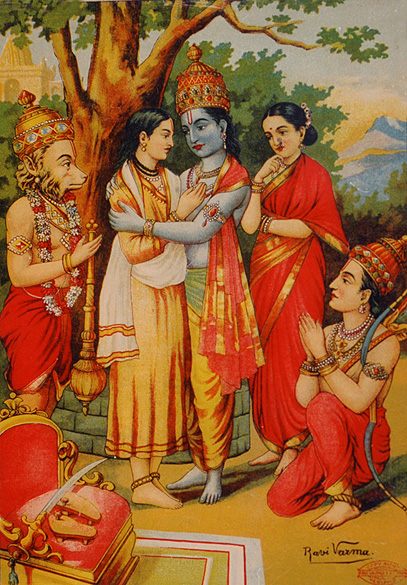
Bharata set out with the queens, the priests, the ministers, an army and the people of Ayodhya. Lakshmana, seeing the army approach, feared an attack — but Bharata came on foot and fell at Rama's feet. He begged Rama to return and rule, offering even to take his place in exile.
Rama would not break his father's word. At last Bharata asked for Rama's sandals (padukas), and Rama gave them. Bharata vowed that he would rule only as their trustee, and that if Rama did not return the day the fourteen years ended, he would enter the fire.
Fourteen years at Nandigram
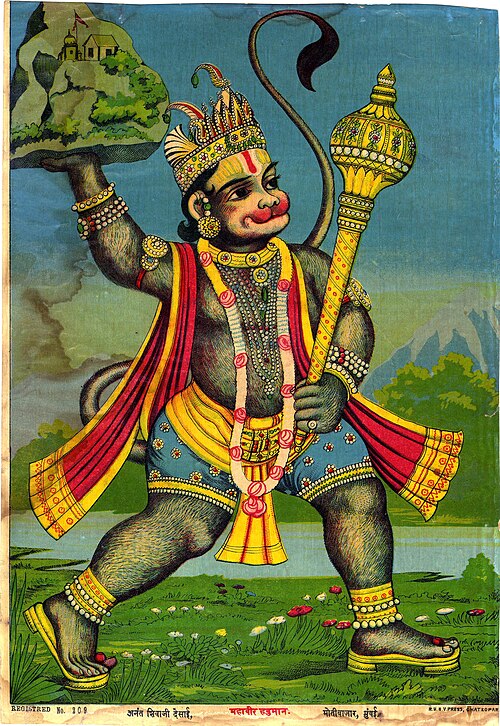
Bharata did not live in the palace. He placed the padukas on the throne and governed from the village of Nandigram, outside Ayodhya, wearing bark garments and matted hair like an ascetic, sleeping on the ground and referring every decision to the sandals. In the Yuddha Kanda, as the fourteenth year ends, Hanuman reaches him with news of Rama's return. Bharata goes out to receive him, carrying the padukas on his head, and returns the kingdom to Rama.
According to the Uttara Kanda, Bharata later conquered the land of the Gandharvas, and his sons Taksha and Pushkala founded Takshashila and Pushkalavati.
The devotee
Tulsidas gives Bharata a special place in the Ramcharitmanas, where the long passages of the Ayodhya Kand about his love for Rama are among the most moving in the poem. For the bhakti tradition Bharata is the model of a devotee who wants nothing — not even what is offered freely — except to serve.
How they are remembered
The meeting of the brothers is celebrated as Bharat Milap in Ramlilas across North India, most famously at Varanasi the day after Dussehra. Nandigram, near Ayodhya, remains a place of pilgrimage. To "rule like Bharata" is to hold power as a trust, not a possession.
Ekatmata Stotra · Stanza 12
Named in Stanza 12 of the Ekatmata Stotra — ten figures from the great epics.
रामो भरतश्च कृष्णो भीष्मो धर्मपुत्र: तथा।
अर्जुनो मार्कण्डेय: हरिश्चन्द्र: प्रह्लादो नारदस्तथा॥
Sources: Wikipedia: Bharata (Ramayana) · valmikiramayan.net · Wikipedia: Bharat Milap. Written afresh for The Hindu Book; corrections welcome at [email protected].