According to the Adi Parva of the Mahabharata, King Shantanu of Hastinapura married the river goddess Ganga on condition that he never question her. She drowned seven sons at birth, freeing seven of the Vasus from a curse of the sage Vasishtha; when Shantanu stopped her from drowning the eighth, she left, taking the child. She returned him years later, grown: Devavrata, taught the Vedas by Vasishtha and the arts of war by Parashurama.
जगत्प्रभुं देवदेवमनन्तं पुरुषोत्तमम्। स्तुवन्नामसहस्रेण पुरुषः सततोत्थितः॥“The person who constantly praises, with the thousand names, the Lord of the universe, God of gods, the infinite Purushottama, is freed from all sorrow.”Bhishma's answer to Yudhishthira, opening the Vishnu Sahasranama (Mahabharata, Anushasana Parva)
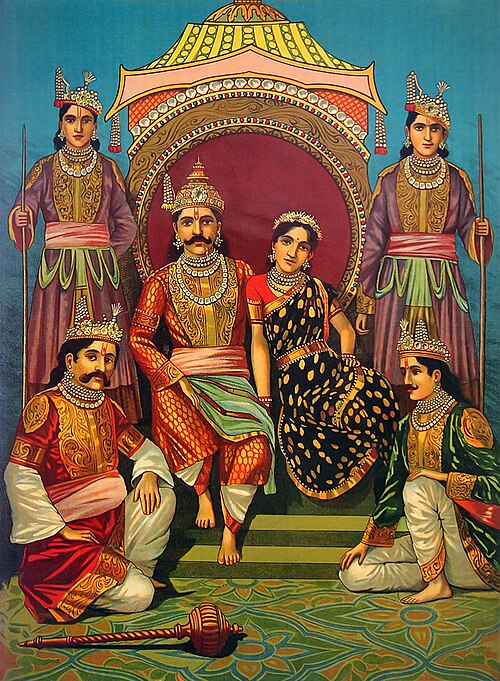
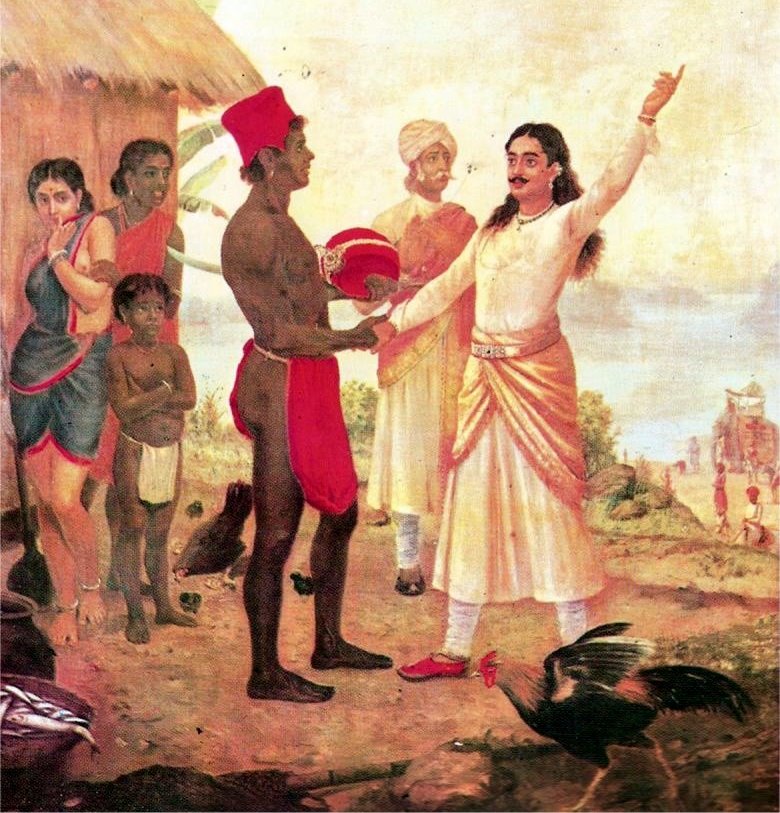
Shantanu made Devavrata his heir. But the king then fell in love with Satyavati, daughter of a fisher chief, who would give her only if her son should rule.
The vow
Seeing his father pine, Devavrata went to the fisher chief himself. He renounced his claim to the throne; and when the chief asked what of Devavrata's own future sons, he vowed lifelong celibacy. The gods showered flowers and called him Bhishma — "the one of the terrible vow". Shantanu, moved, granted him the boon of dying only when he chose.
Bhishma kept the vow through everything. When Satyavati's sons died young and she herself asked him to marry or father heirs, he refused. He served three generations of the Kuru throne as its guardian.
Amba
For his half-brother Vichitravirya, Bhishma carried off the three princesses of Kashi — Amba, Ambika and Ambalika — from their swayamvara. Amba said she had already given her heart to King Shalva, and Bhishma let her go; but Shalva rejected her. Bhishma could not marry her because of his vow. The Udyoga Parva tells how Amba sought revenge, how even Parashurama fought Bhishma on her behalf without result, and how she was reborn as Shikhandi, destined to cause his fall.
The silent elder
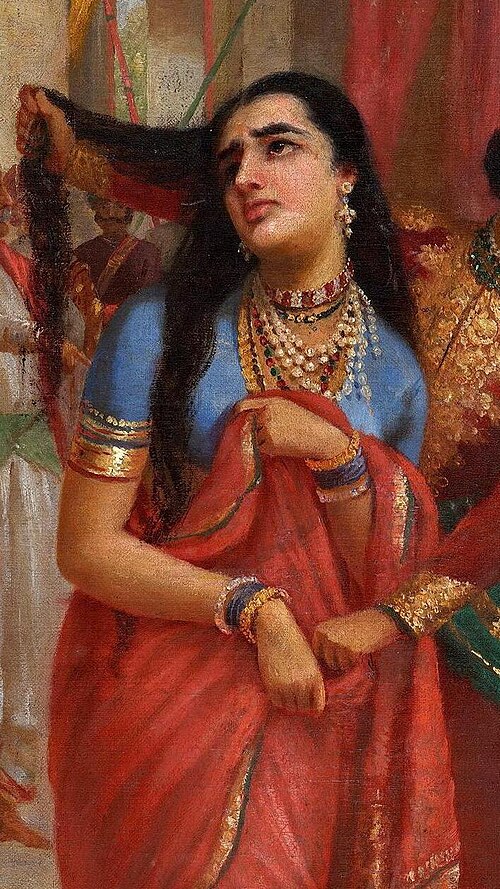
Bhishma's loyalty to the throne of Hastinapura bound him to Dhritarashtra and his sons, though he loved the Pandavas and repeatedly urged peace. In the dice hall, when Draupadi asked her question, he replied that the course of dharma was subtle and gave no clear answer — a silence that readers of the epic have weighed against him ever since.
The bed of arrows
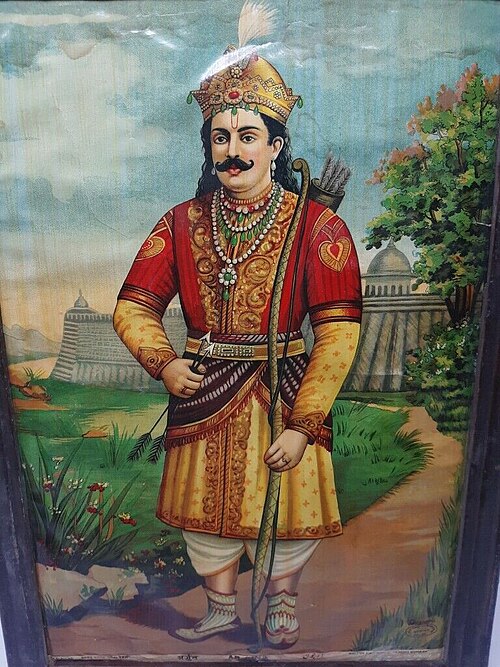
In the Kurukshetra war Bhishma commanded the Kaurava army for ten days, and no one could overcome him. The Bhishma Parva tells that the Pandavas went to him by night and he told them himself how he could be defeated: he would not fight Shikhandi. On the tenth day Arjuna advanced with Shikhandi before him, and Bhishma, lowering his weapons, fell pierced by so many arrows that his body did not touch the ground.
Choosing his time, he waited on the arrow-bed for the sun to turn north (uttarayana). In those days, at Krishna's urging, he taught Yudhishthira on kingship, duty, and liberation — the long teachings of the Shanti and Anushasana Parvas, including the Vishnu Sahasranama. Then he gave up his life.
How they are remembered
Bhishma is remembered as the embodiment of a promise kept at any cost — and as a warning that loyalty to a vow can sit uneasily with justice. On Bhishma Ashtami many Hindus offer water in his name, since he left no children to perform his rites. The Vishnu Sahasranama he recited is chanted daily in homes and temples.
Ekatmata Stotra · Stanza 12
Named in Stanza 12 of the Ekatmata Stotra — ten figures from the great epics.
रामो भरतश्च कृष्णो भीष्मो धर्मपुत्र: तथा।
अर्जुनो मार्कण्डेय: हरिश्चन्द्र: प्रह्लादो नारदस्तथा॥
Sources: Wikipedia: Bhishma · Wikipedia: Vishnu Sahasranama · sacred-texts.com/hin/maha/index.htm. Written afresh for The Hindu Book; corrections welcome at [email protected].