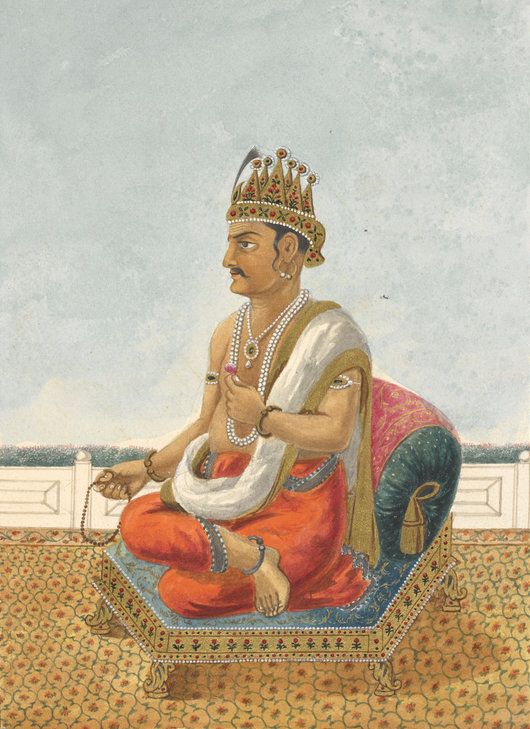
Janaka is less one man than a royal title. The kings of Videha, ruling from Mithila in the plains north of the Ganga, were called Janaka, and the tradition remembers several of them. The best known is the Janaka of the Brihadaranyaka Upanishad and the Shatapatha Brahmana, a king who held great philosophical assemblies, and the Janaka of the Ramayana, named Siradhvaja, who became the father of Sita. Later retellings often merge the two into a single ideal ruler.
कर्मणैव हि संसिद्धिमास्थिता जनकादयः। लोकसंग्रहमेवापि सम्पश्यन्कर्तुमर्हसि॥“Janaka and others reached perfection through action alone. Keeping in view the welfare of the world, you too should act.”Bhagavad Gita 3.20 — Krishna to Arjuna
What unites them is a reputation found nowhere else so strongly: a king who was also a knower of the Self. He is called Videha, "the bodiless", because, tradition says, he lived in the body and on the throne without being bound by either. He is the classic example of the rajarshi, the sage-king.
The court of the sages
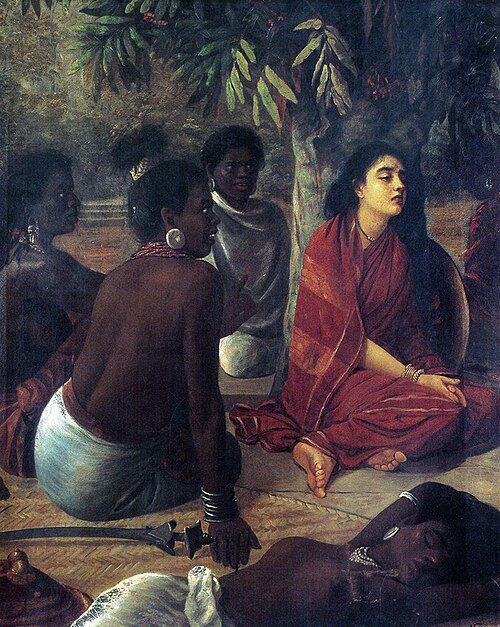
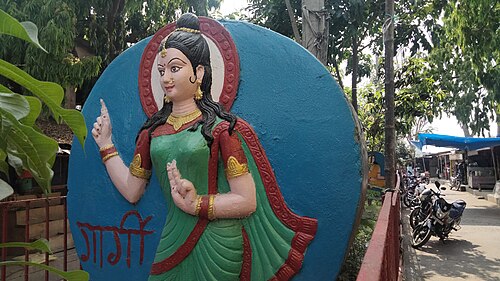
The Brihadaranyaka Upanishad describes how Janaka of Videha performed a great sacrifice and offered a thousand cows, their horns hung with gold, to the wisest Brahmin present. Yajnavalkya calmly told his pupil to drive the cows away, and was then questioned in turn by Gargi, Ushasta, Uddalaka and others. The Upanishad records the debate at length; Yajnavalkya answered them all.
Janaka then became Yajnavalkya's pupil. In the same Upanishad the sage teaches him about the Self that is the light of a person when the sun, moon and fire have set, and about the states of waking, dream and deep sleep. At the end, the text says, Janaka offered his whole kingdom, and himself, to his teacher.
Ashtavakra and the bodiless king
A later tradition links Janaka with the sage Ashtavakra, whose body was bent in eight places. The Mahabharata tells how the boy Ashtavakra came to Janaka's court and defeated the scholar Bandi in debate. The Ashtavakra Gita, a dialogue of uncertain date, presents Janaka as a pupil who quickly awakens to the teaching that he is pure awareness, untouched by the world. The Shanti Parva of the Mahabharata gives Janaka a famous saying: if Mithila burns, nothing of mine burns.
The Mahabharata returns to Janaka again and again in its teaching books. In the Shanti Parva he is shown in dialogue with sages and with the learned woman Sulabha, who tests whether a king can truly be free while holding power; the debate is left open for the reader to weigh. These passages made Janaka the tradition's favourite example of a householder who reaches the goal without renouncing the world.
Father of Sita
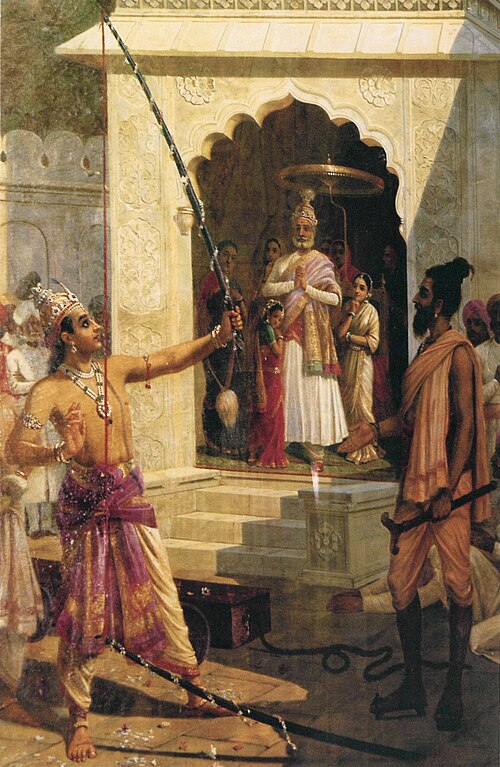
The Valmiki Ramayana tells how King Janaka, ploughing a field to prepare it for a sacrifice, found a baby girl in the furrow. He raised her as his daughter and named her Sita, "furrow"; she is also called Janaki and Maithili after him. Janaka held the great bow of Shiva in his house and declared that Sita would marry only the man who could string it.
Many princes failed. When the sage Vishvamitra brought Rama to Mithila, Rama lifted the bow and broke it in the act of stringing it. Janaka gave Sita to Rama, and his second daughter Urmila to Lakshmana, while his brother Kushadhvaja's daughters married Bharata and Shatrughna.
How they are remembered
Janaka stands for a powerful idea in Indian thought: that freedom does not require leaving the world. In the Gita, Krishna points to Janaka as proof that a person can act fully and still be free, and the phrase Janaka-like detachment is still used for those who carry heavy duties calmly. Janakpur in Nepal, believed to be ancient Mithila, celebrates the marriage of Rama and Sita each year on Vivah Panchami.
Ekatmata Stotra · Stanza 13
Named in Stanza 13 of the Ekatmata Stotra — eleven devotees, sages and seers.
हनुमान् जनको व्यासो वसिष्ठः शुको बलि: तथा।
दधीचिर्विश्वकर्मा च पृथु: वाल्मीकिरेव च॥
Sources: Wikipedia: Janaka · Wikipedia: Brihadaranyaka Upanishad · Wikipedia: Ashtavakra Gita. Written afresh for The Hindu Book; corrections welcome at [email protected].