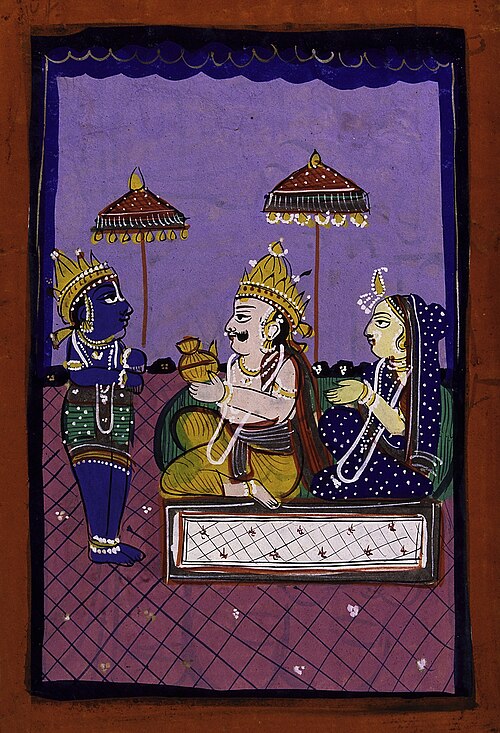
Rantideva was a king of the Lunar dynasty, of the line of Puru and Bharata, and a son of Sankriti according to the Bhagavata Purana. The Mahabharata remembers him as a king of boundless generosity, whose kitchens fed thousands and who gave without measure; it names him among the sixteen great kings whose stories Narada tells to console the grieving.
न कामयेऽहं गतिमीश्वरात्परामष्टर्द्धियुक्तामपुनर्भवं वा। आर्तिं प्रपद्येऽखिलदेहभाजामन्तःस्थितो येन भवन्त्यदुःखाः॥“I do not ask God for the highest state, with its eight powers, nor even for freedom from rebirth. I would take upon myself the pain of all embodied beings, entering into them, so that they may be free of sorrow.”Bhagavata Purana 9.21.12 — Rantideva's prayer
The Bhagavata Purana (9.21) tells the story for which he is most loved, and it is less about royal wealth than about the poverty he chose. Rantideva, it says, gave away everything he had and lived content with whatever came to him by chance, often going hungry with his family.
The last meal
Once, the Bhagavata tells, Rantideva and his family went forty-eight days without food or even water. On the forty-ninth morning they were given a meal of rice cooked with ghee, milk and sweet, and some water. Just as they sat down to eat, a hungry Brahmin guest arrived. Seeing the Lord in every being, Rantideva gladly gave him a share of the food.
Then came a Shudra, and Rantideva shared with him too. Next came a stranger with a pack of dogs, asking food for himself and his animals; the king gave him all the food that was left, and bowed to him and his dogs.
The last drink of water
Only the water remained, barely enough for one. As the king was about to drink, an outcaste Chandala came and begged for water, saying he was dying of thirst. Hearing his pitiful words, Rantideva was moved and gave him the water, though he himself was near death.
It was then that he spoke his famous prayer: that he wanted neither power nor liberation, but to share in the suffering of all beings so that they might be freed from it. By giving water to this man, he said, his own hunger, thirst, weariness, grief and fear had all gone.
The Bhagavata stresses that Rantideva gave without any sense of loss or pride. He did not ask who the guests were or whether they deserved it; he saw each of them as the Lord in another form, and greeted even the dogs with respect. For the Purana, this inner vision matters as much as the gift itself.
The gods revealed
The Bhagavata says the visitors were the lords of the three worlds — commentators name Brahma and Shiva among them — who had come in disguise, by Vishnu’s power of illusion, to test him; they now stood revealed and offered him every blessing. Rantideva asked for nothing. He bowed to them and fixed his mind on Vasudeva alone, and the illusion of the world fell away from him. His followers too, the Purana says, became devotees by his company.
The episode is short, only a few verses, but it has been retold for centuries in sermons and children's books across India.
How they are remembered
Rantideva's prayer is one of the most moving expressions of compassion in Indian literature, sometimes compared with the bodhisattva vow. His story links feeding the hungry, annadana, with the highest devotion, and it is retold whenever Indians speak of serving God by serving the poor. In modern times Swami Vivekananda preached the same ideal of serving God in the poor.
Ekatmata Stotra · Stanza 14
Named in Stanza 14 of the Ekatmata Stotra — six figures of sacrifice and dharma.
भगीरथश्च एकलव्यो मनुर्धन्वन्तरिस्तथा।
शिबिश्च रन्तिदेवश्च दर्शितं धर्म-लक्षणम्॥
Sources: Wikipedia: Rantideva · vedabase.io/en/library/sb/9/21/12 · Wikipedia: Shodasha Rajika. Written afresh for The Hindu Book; corrections welcome at [email protected].