In Hindu tradition, Manu is the ancestor of humankind. The Sanskrit words for a human being, manava and manushya, mean "descendant of Manu". The Rig Veda already calls Manu "our father" and the first to kindle the sacrificial fire, and later texts make him the first king, the founder of law and the father of the royal dynasties.
धृतिः क्षमा दमोऽस्तेयं शौचमिन्द्रियनिग्रहः। धीर्विद्या सत्यमक्रोधो दशकं धर्मलक्षणम्॥“Steadfastness, forgiveness, self-control, not stealing, purity, mastery of the senses, wisdom, learning, truth and freedom from anger — these ten are the marks of dharma.”Manusmriti 6.92
"Manu" is also a title. The Puranas describe vast cosmic cycles called manvantaras, each presided over by its own Manu; there are fourteen in a single day of Brahma. The first was Svayambhuva Manu, son of Brahma. The present age belongs to the seventh, Vaivasvata Manu, son of Vivasvan the sun god, and it is he who is usually meant when Manu is called the father of humankind.
The great flood
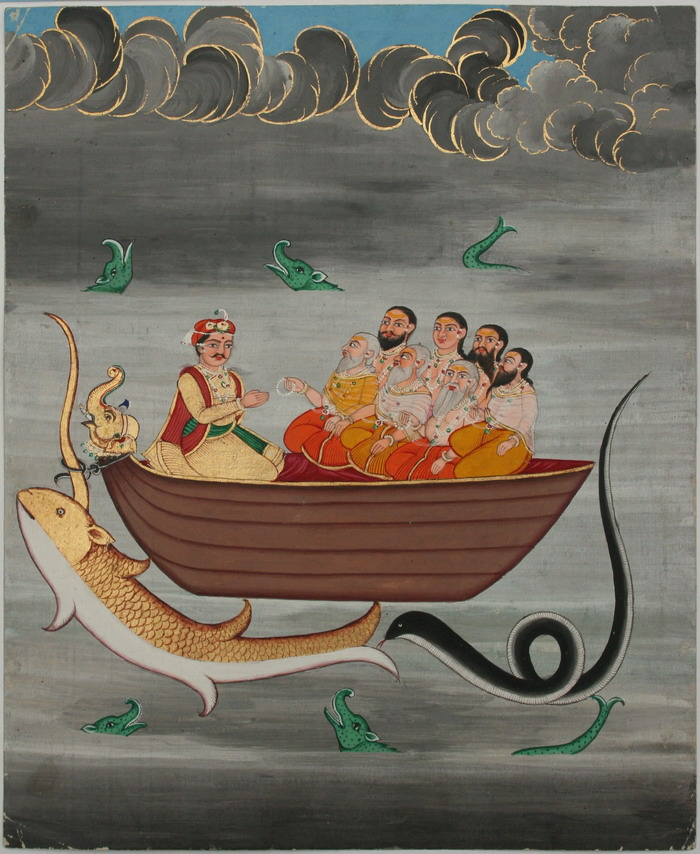
The oldest account is in the Shatapatha Brahmana (1.8.1). While Manu was washing his hands, a small fish came into them and asked him to protect it, promising in return to save him from a coming flood. Manu kept it in a jar, then a pond, then released it into the sea as it grew. When the flood came, he built a ship as the fish had told him; the fish towed it to a northern mountain, and when the waters fell Manu alone survived and began the human race again.
The Mahabharata and the Matsya, Agni and Bhagavata Puranas retell the story with the fish as Vishnu's first avatar, Matsya. In the Bhagavata the king is Satyavrata, who becomes Vaivasvata Manu, and he carries with him the seven sages and the seeds of all plants. The story is often compared with other ancient flood narratives.
Father of kings
The Puranas make Vaivasvata Manu the source of the two great royal lines. His son Ikshvaku founded the Solar dynasty of Ayodhya, in which Rama was born; through his child Ila, who changes sex in the stories, descends the Lunar dynasty of the Kurus and Yadavas. In the Bhagavad Gita (4.1) Krishna says he taught the eternal yoga to Vivasvan, who told it to Manu, who told it to Ikshvaku — placing Manu in the chain of sacred teaching.
The Manusmriti
The Manusmriti, or Manava Dharmashastra, is a Sanskrit text on dharma ascribed by tradition to Manu, through the sage Bhrigu. Scholars generally date it to around the second century BCE to the second century CE. It covers creation, the stages of life, kingship, law, duties, purification and liberation, and was among the most influential law texts of classical India; British colonial courts drew on it heavily.
It is also among the most criticised texts in Indian history. Reformers, most prominently B. R. Ambedkar, condemned its rules on caste and on women, and Ambedkar publicly burned a copy in 1927. Defenders argue that the text has many layers, that smritis were meant to change with the times, and that its ethical teachings, like the ten marks of dharma, remain valuable. The figure of Manu the ancestor and the text that bears his name are best understood separately.
How they are remembered
Manu stands at the start of the human story in Indian tradition: the survivor of the flood, the first king and the ancestor of all. Every Indian word for "human" carries his name, and the idea of the manvantara still frames the Hindu calendar of cosmic time.
Ekatmata Stotra · Stanza 14
Named in Stanza 14 of the Ekatmata Stotra — six figures of sacrifice and dharma.
भगीरथश्च एकलव्यो मनुर्धन्वन्तरिस्तथा।
शिबिश्च रन्तिदेवश्च दर्शितं धर्म-लक्षणम्॥
Sources: Wikipedia: Manu (Hinduism) · Wikipedia: Manusmriti · Wikipedia: Matsya. Written afresh for The Hindu Book; corrections welcome at [email protected].