Bhagiratha belongs to the Ikshvaku, or Solar, dynasty of Ayodhya — the same line into which Shri Rama was later born. His story is told in the Bala Kanda of the Valmiki Ramayana, where the sage Vishvamitra narrates it to the young Rama and Lakshmana as they reach the Ganga, and in the Mahabharata and the Bhagavata and other Puranas.
गङ्गा त्रिपथगा नाम दिव्या भागीरथीति च। त्रीन्पथो भावयन्तीति तस्मात्त्रिपथगा स्मृता॥“She is called the divine Ganga, Tripathaga and Bhagirathi; because she sanctifies the three paths, she is known as Tripathaga.”Valmiki Ramayana, Bala Kanda (sarga 44) — Brahma to Bhagiratha; wording and verse number vary between recensions
It is the story of the Gangavatarana, the descent of the Ganga, and of a king who gave up comfort and throne to complete a task his forefathers had failed to finish in three generations.
The sixty thousand sons of Sagara
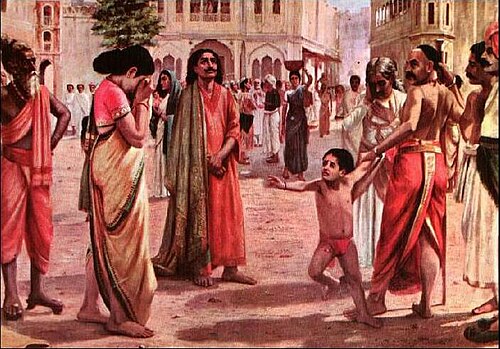
The Ramayana tells that Bhagiratha's ancestor, King Sagara, held a horse-sacrifice. Indra stole the horse and hid it in the underworld beside the sage Kapila. Sagara's sixty thousand sons dug down through the earth searching for it, and on finding it near Kapila they accused him of theft. The sage's anger burned them all to ashes.
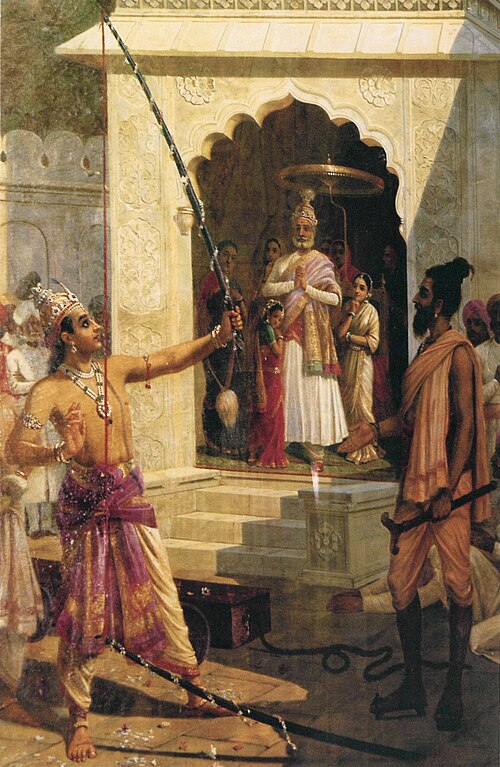
Sagara's grandson Anshuman recovered the horse and learned that only the waters of the heavenly Ganga could purify the ashes and release the souls of the sixty thousand. Anshuman and then his son Dilipa performed tapas for this all their lives, without success.
A king's tapas
Bhagiratha, Dilipa's son, handed his kingdom to his ministers and went to the Himalayas. The Ramayana says he stood in the Gokarna region with arms raised, eating once a month and surrounded by five fires, for a thousand years. Brahma was pleased and granted that the Ganga would descend. But he warned that the earth could not bear the force of her fall; only Shiva could receive her.
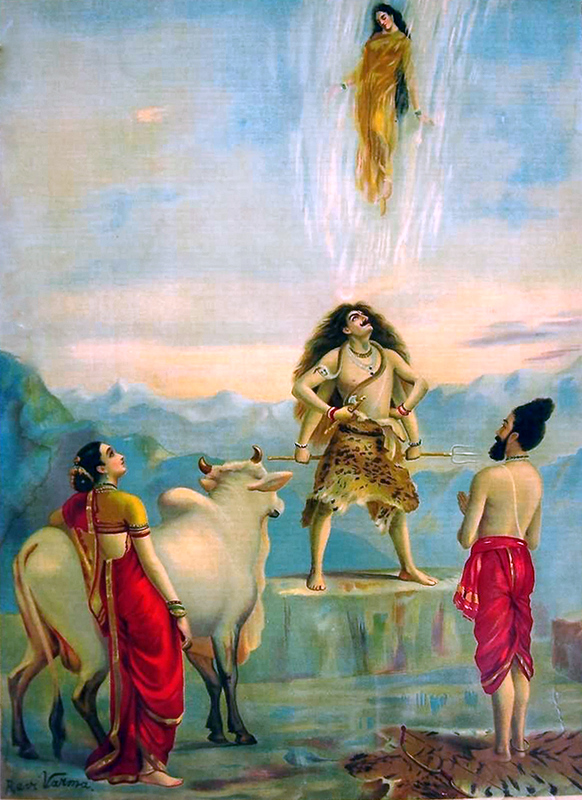
Bhagiratha then performed tapas to Shiva, standing on the tip of one toe. Shiva agreed. The Ramayana tells that the Ganga, proud of her power, meant to sweep Shiva away into the underworld, but he caught her in his matted locks and held her there until she was humbled. Then, at Bhagiratha's further prayer, Shiva released her in streams.
The Ramayana describes the descent as a spectacle watched by gods, sages and celestial beings: the river falling from the sky in white cascades, fish and dolphins flashing in the stream, and the sky glittering as though filled with lightning. Wherever she flowed, beings bathed in her waters and were freed of their sins.
Leading the river home
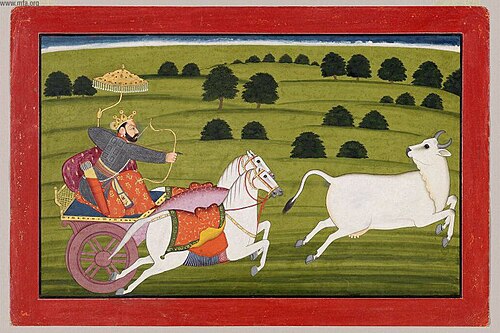
Bhagiratha drove ahead in his chariot and the Ganga followed him across the plains. On the way she flooded the sacrificial ground of the sage Jahnu, who drank her up and released her only when the gods pleaded; from this she is called Jahnavi. At last Bhagiratha led her down to the underworld, where her waters touched the ashes of Sagara's sons and freed them. Brahma then declared that the river would bear his name. The meeting of the Ganga with the sea is honoured at Gangasagar.
The Ramayana closes the episode with Brahma's praise for Bhagiratha's persistence, and with the promise that whoever hears this story with faith will be blessed with long life, sons and fame.
How they are remembered
The Ganga's upper course is still called the Bhagirathi, rising at Gaumukh below Gangotri, where a rock is shown as the place of his tapas. In Hindi and other languages, Bhagiratha prayatna — a Bhagiratha effort — means a heroic, persevering labour. Ganga Dussehra celebrates the river's descent each year.
Ekatmata Stotra · Stanza 14
Named in Stanza 14 of the Ekatmata Stotra — six figures of sacrifice and dharma.
भगीरथश्च एकलव्यो मनुर्धन्वन्तरिस्तथा।
शिबिश्च रन्तिदेवश्च दर्शितं धर्म-लक्षणम्॥
Sources: Wikipedia: Bhagiratha · Wikipedia: Sagara (king) · valmiki.iitk.ac.in. Written afresh for The Hindu Book; corrections welcome at [email protected].