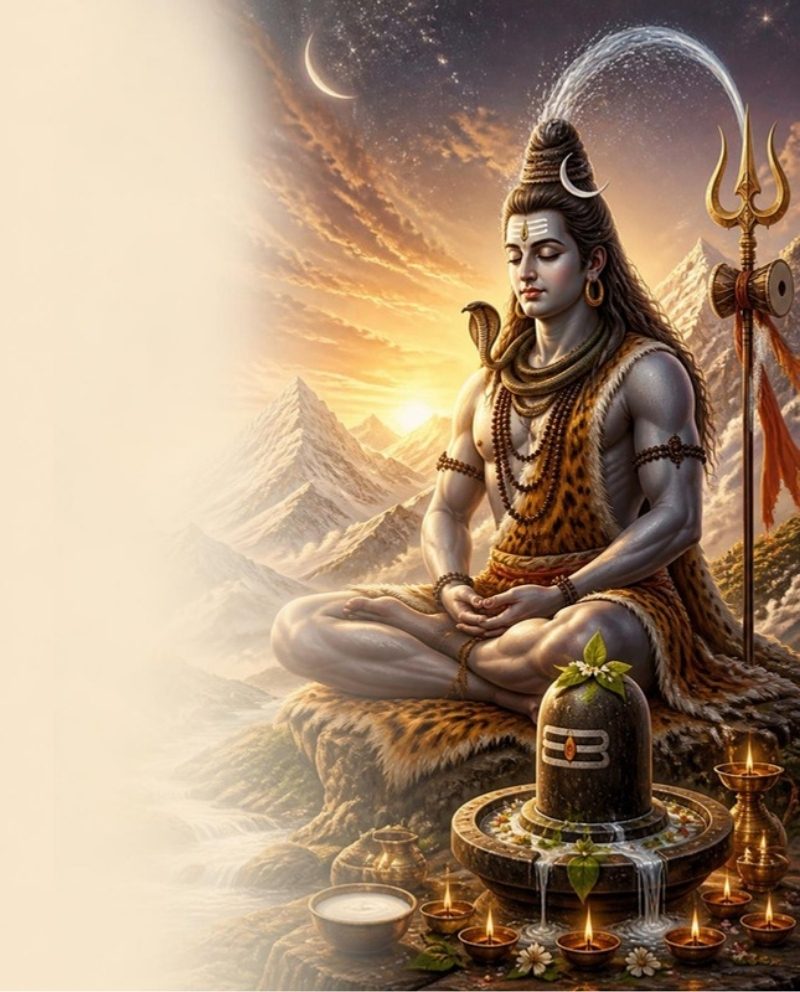
When is Mahashivratri?
| Year | Date | Day |
|---|---|---|
| 2026 | 15 February | Sunday |
| 2027 | 6 March | Saturday |
| 2028 | 23 February | Wednesday |
Observed on Krishna Chaturdashi, Magh/Phalgun month. Dates follow the Panchang for New Delhi and can differ by a day in other places — check the Panchang for your city.
What Mahashivratri means
Maha Shivaratri, the 'great night of Shiva', falls on the Chaturdashi of the dark half of Phalguna (Magha in the southern amanta calendar) — the darkest night before the new moon at the end of winter. Every month has a Shivaratri; this one is the greatest. Devotees fast through the day and keep vigil through the night, worshipping Shiva in the form of the linga.
Unlike most festivals, its heart is not celebration but stillness. The night is divided into four watches (prahar), and in each the linga is bathed and worshipped while the name of Shiva is chanted. Staying awake is itself the practice: a night given wholly to remembering Shiva, when, as the tradition puts it, the mind can turn inward and the soul draw close to its source.
Different traditions remember different things on this night — the marriage of Shiva and Parvati, the appearance of Shiva as an endless column of light, Shiva's cosmic dance, or his drinking of the poison from the churning of the ocean. All of them point to the same Shiva: the auspicious one who is beyond form and yet comes close to his devotees.
The story of Mahashivratri
The Shiva Purana tells that Brahma and Vishnu once argued over which of them was greater. Between them there appeared a pillar of fire with no beginning and no end. Vishnu took the form of a boar and dug down to find its base; Brahma became a swan and flew up to find its top. Neither could find an end. Shiva then emerged from the pillar, and both bowed to him. That endless column of light is the origin of linga worship, and Maha Shivaratri is remembered as the night of that appearance.
A favourite story of the vrat is that of a hunter who, caught in the forest at night, climbed a bel tree to escape wild animals. To keep awake he plucked leaves and dropped them below — onto a Shiva linga he could not see — and the dew from his body fell on it too. Without knowing it, he had fasted, kept vigil and worshipped Shiva with bel leaves and water through the night of Shivaratri, and he was blessed. The story teaches that even a little devotion offered on this night bears great fruit.
Many communities celebrate Maha Shivaratri as the wedding night of Shiva and Parvati, with processions called Shiv Baraat. Some traditions also connect the night with the Neelkantha story, when Shiva held the halahala poison from the churning of the ocean in his throat to save the world.
Mahashivratri puja vidhi, step by step
A simple Shivaratri vrat and puja for home or a temple. Fasting rules and the details of the four-prahar puja differ between families and regions — follow yours.
What you need
- A Shiva linga (or a picture of Shiva), on a plate or in a temple
- Water or Ganga jal, and milk, curd, honey, ghee and sugar for panchamrit abhishek
- Bel (bilva) leaves — whole, three-leaflet, washed
- Dhatura flowers or fruit, white flowers, akshat, sandalwood and bhasma (vibhuti)
- A diya, incense and camphor
- Fruits, milk and fasting foods for the vrat
When to do the puja
The main worship is at night, especially at nishita kaal (around midnight) of Phalguna Krishna Chaturdashi; the night is divided into four prahars. The fast is broken the next morning after sunrise. Exact times change by city and year — check the Panchang for your city. See the Panchang for your city.
Steps
- Take the vow. In the morning, after bathing, take a sankalp to keep the Shivaratri fast. Many eat only fruit and milk; some keep a waterless fast. Choose what your health allows.
- Abhishek. Bathe the linga with water, then milk, curd, honey, ghee and sugar, and again with water, chanting 'Om Namah Shivaya'.
- Offer. Apply sandalwood and bhasma, and offer bel leaves (smooth side down), dhatura and white flowers, a lamp and incense.
- Keep the four prahars. Through the night, repeat the abhishek and puja in each of the four watches, with chanting, the Shiva Chalisa, Rudrashtakam or Mahamrityunjaya mantra, and kirtan. If a full vigil is not possible, keep at least the midnight worship.
- Break the fast. The next morning, after bathing and a final puja, offer food to others and break your fast with prasad.
Offerings & food: Bilva leaves, dhatura, bhang, cannabis leaves, milk, honey, bel fruit; prasad: thandai, bhang pakoras
Mantras for Mahashivratri
Panchakshari
ॐ नमः शिवाय
oṃ namaḥ śivāya
Salutations to Shiva — the five-syllable mantra, chanted through the night.
Mahamrityunjaya mantra
ॐ त्र्यम्बकं यजामहे सुगन्धिं पुष्टिवर्धनम् ।
उर्वारुकमिव बन्धनान्मृत्योर्मुक्षीय माऽमृतात् ॥
oṃ tryambakaṃ yajāmahe sugandhiṃ puṣṭivardhanam |
urvārukam iva bandhanān mṛtyor mukṣīya mā'mṛtāt ||
We worship the three-eyed one, fragrant, who increases nourishment. As the ripe cucumber is freed from its stalk, may he free us from death, but not from immortality.
Full text with meaning →Offering the bel leaf
त्रिदलं त्रिगुणाकारं त्रिनेत्रं च त्रियायुधम् ।
त्रिजन्मपापसंहारं बिल्वपत्रं शिवार्पणम् ॥
tridalaṃ triguṇākāraṃ trinetraṃ ca triyāyudham |
trijanmapāpasaṃhāraṃ bilvapatraṃ śivārpaṇam ||
I offer to Shiva this three-leafed bilva — like the three gunas, the three eyes and the three-pronged weapon — which destroys the sins of three births.
Mahashivratri across India
Mahadev Ki Baraat processions in UP, Shivratri processions in Varanasi, Mahakaleshwar in Ujjain, Pashupatinath in Nepal, Jageshwar in Uttarakhand, the Mandi Shivratri fair in Himachal
- Varanasi and Uttar Pradesh
- Kashi Vishwanath and the ghats are thronged through the night, and Shiv Baraat processions celebrate the wedding of Shiva and Parvati.
- Ujjain (Madhya Pradesh)
- The Mahakaleshwar temple holds days of festivities leading up to Shivaratri, with special Bhasma Aarti and the Lord dressed as a bridegroom.
- Uttarakhand and Himachal
- Pilgrims gather at Jageshwar, Kedar valley temples and Baijnath; the International Shivratri Fair at Mandi brings the valley's deities in procession.
- Jammu and Kashmir
- Kashmiri Pandits keep Herath with the worship of Shiva in a water pot (vatuk), and the festival extends over several days.
- Gujarat
- Bhavnath fair at the foot of Girnar in Junagadh, where sadhus gather and bathe in the Mrigi Kund at midnight.
- Tamil Nadu and Karnataka
- Night-long worship in the great Shiva temples such as Chidambaram, with classical dance offered to Nataraja, and at Gokarna in Karnataka.
- Nepal
- Lakhs of pilgrims and sadhus gather at Pashupatinath in Kathmandu.
Prayers to recite
Do’s and don’ts
Do
- Fast with pure intention
- Stay awake through the night chanting
- Visit a Shiva temple
- Abhishek the Lingam
Avoid
- Avoid grains and salt during fast
- No arguments or anger — maintain inner silence
- Do not sleep during the four prahars
Temples to visit for Mahashivratri


Frequently asked questions
When is Mahashivratri in 2026?
Mahashivratri 2026 falls on Sunday, 15 February 2026 (Krishna Chaturdashi, Magh/Phalgun month). Dates are for New Delhi and may differ by a day in other places.
Mahashivratri 2027 kab hai?
Mahashivratri 2027 Saturday, 6 March 2027 ko hai. Apne shahar ki sahi tithi ke liye Panchang dekhein.
महाशिवरात्रि 2027 कब है?
महाशिवरात्रि 2027 शनिवार, 6 मार्च 2027 को है। अपने शहर की सही तिथि और मुहूर्त के लिए पंचांग देखें।
When is Mahashivratri in 2027?
Mahashivratri 2027 falls on Saturday, 6 March 2027 (Krishna Chaturdashi, Magh/Phalgun month). Dates are for New Delhi and may differ by a day in other places.
When is Mahashivratri in 2028?
Mahashivratri 2028 falls on Wednesday, 23 February 2028 (Krishna Chaturdashi, Magh/Phalgun month). Dates are for New Delhi and may differ by a day in other places.
Why is Mahashivratri celebrated?
The "Great Night of Shiva" — one of the most important Shaiva festivals. Devotees fast all day and keep vigil all night, worshipping the Shiva Lingam.
How is Mahashivratri celebrated?
All-day fast (nirjala or with fruit/milk). All-night vigil (jagran) with chanting. Four-phase (prahar) puja through the night — different offerings in each phase. Abhishek of Shiva Lingam with milk, honey, curd, ghee, sugar, and Ganga water. Bilva (bel) leaves, dhatura, bhang, white flowers offered. Rudrabhishek with Rudram chanting.
What is offered or eaten on Mahashivratri?
Bilva leaves, dhatura, bhang, cannabis leaves, milk, honey, bel fruit; prasad: thandai, bhang pakoras
When is Maha Shivaratri in 2027?
Saturday, 6 March 2027. Phalguna Krishna Chaturdashi runs from about 12:13 pm IST on 6 March to about 1:53 pm IST on 7 March, so the night of worship is the night of 6 March, and the fast is broken on the morning of 7 March. Check the Panchang for your city.
What is the difference between Shivaratri and Maha Shivaratri?
Masik Shivaratri falls on the Krishna Chaturdashi of every month. Maha Shivaratri is the one in Phalguna (Magha in the amanta calendar), the most important Shivaratri of the year.
What can be eaten during the Shivaratri fast?
Customs differ. Many eat only fruit, milk and fasting foods such as sabudana, kuttu, singhara and sendha namak, avoiding grains and ordinary salt; some keep a waterless fast. The elderly, the unwell and pregnant women should fast only as their health allows.
Why are bel leaves offered to Shiva?
The three-leafed bilva is said to be dear to Shiva; its three leaflets are compared to his three eyes, the three gunas and the trident. Leaves are offered washed, whole and with the smooth side touching the linga.
Is it necessary to stay awake all night?
The night vigil (jagaran) is central to the vrat, but if you cannot keep the whole night, keep at least the midnight (nishita) worship with sincerity.
 22 Mar2027
 7 Apr2027
 14 Apr2027
 15 Apr2027