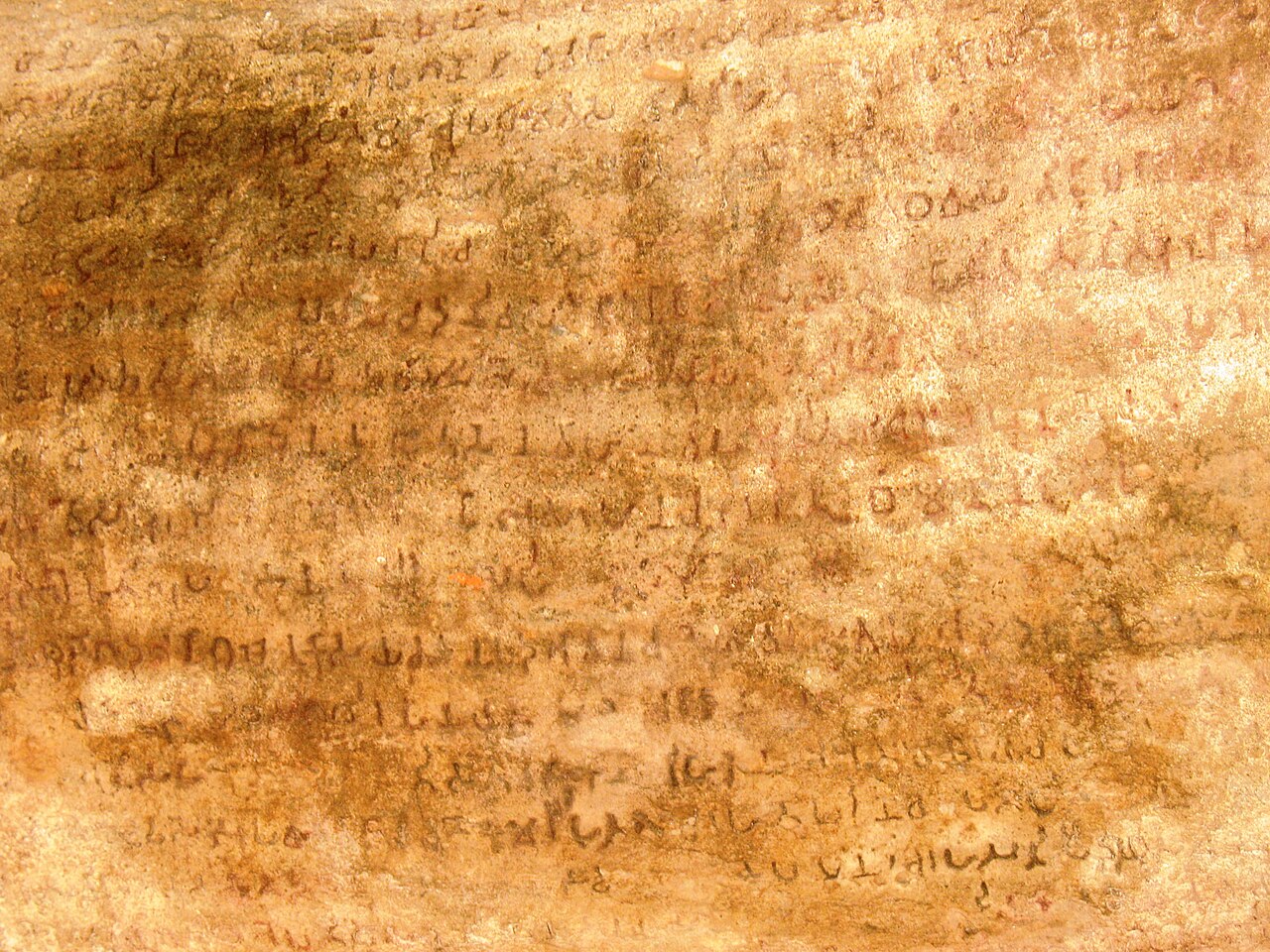
About two centuries after Ashoka's conquest of Kalinga, the region on India's eastern coast rose again as a power under Kharavela of the Mahameghavahana family, a branch of the Chedi dynasty. Almost everything known about him comes from a single remarkable source: a seventeen-line inscription in Prakrit, in the Brahmi script, carved on the overhanging brow of the Hathigumpha (“elephant cave”) on Udayagiri hill near Bhubaneswar.
नमो अरहंतानं। नमो सवसिधानं।“Salutation to the Arhats. Salutation to all the Siddhas.”Hathigumpha inscription of Kharavela, line 1, Udayagiri
His date is debated. Most scholars place him in the 1st century BCE, while others argue for the 2nd century BCE. The inscription is weathered and parts of it are read differently by different experts, so some details below are uncertain.
A reign carved in stone
The inscription opens with a salutation to the Jain Arhats and Siddhas and then tells Kharavela's story in order. He spent his youth in study and play, learning writing, arithmetic, law and statecraft; became crown prince (yuvaraja) at fifteen; and was crowned at twenty-four. What follows is a year-by-year record of his first thirteen years as king, rare in ancient India for its precision.
The inscription describes him as a king who studied the arts of music and dance as well as war, and it lists the shows, processions and feasts he gave for the people of his capital.
Builder and ruler
In his first year, the inscription says, Kharavela repaired the gates, walls and buildings of his capital, damaged by a storm, and restored its tanks and gardens. In his fifth year he extended into the capital a canal first opened by a Nanda king long before — a passage often cited as an early reference to the Nandas. He remitted taxes, staged festivals and performances for his people, and gave generously to Brahmins as well as to Jain monks.
The inscription calls him sava-pasanda-pujaka, “one who honours all sects”, and repairer of all temples — words that recall Ashoka's own appeals for respect between faiths.
Campaigns
Kharavela's armies, according to the inscription, marched in many directions. He sent forces westward, disregarding the Satavahana ruler Satakarni, and subdued the Rathikas and Bhojakas of the Deccan. In a northern campaign he advanced on Rajagriha, and a Yavana (Greek) king is said to have withdrawn to Mathura on hearing of it, though the king's name is unclear. Later he humbled the king of Magadha — whose name some read as Bahasatimita — and brought back to Kalinga an image of a Jina that a Nanda king had carried off long before. In the south he is said to have broken a long-standing confederacy of Tamil states and received tribute from the Pandya king.
Like most royal inscriptions, this is a king's own account and may enlarge his successes; but it shows Kalinga as a major power of its day.
The caves of Udayagiri and Khandagiri
Kharavela and his queens had rock-cut shelters carved for Jain monks in the twin hills of Udayagiri and Khandagiri, decorated with lively sculpture. The inscription records his support for a gathering of Jain monks there. The caves, including the two-storeyed Rani Gumpha, are among the oldest Jain monuments in India.
How they are remembered
The Hathigumpha inscription, first noticed in the 1820s and studied by James Prinsep and later scholars, is one of the most important historical documents of ancient India. Odisha honours Kharavela as one of its greatest rulers, and the Udayagiri and Khandagiri caves near Bhubaneswar still draw pilgrims and visitors.
Ekatmata Stotra · Stanza 21
Named in Stanza 21 of the Ekatmata Stotra — early sages and empire-builders.
अगस्त्यः कम्बुरुचिरः कौण्डिन्यो राजेन्द्रचोल:।
अशोकः पुष्यमित्रश्च खारवेलः प्रकीर्तिताः॥
Sources: Wikipedia: Kharavela · Wikipedia: Hathigumpha inscription · Wikipedia: Udayagiri and Khandagiri Caves. Written afresh for The Hindu Book; corrections welcome at [email protected].