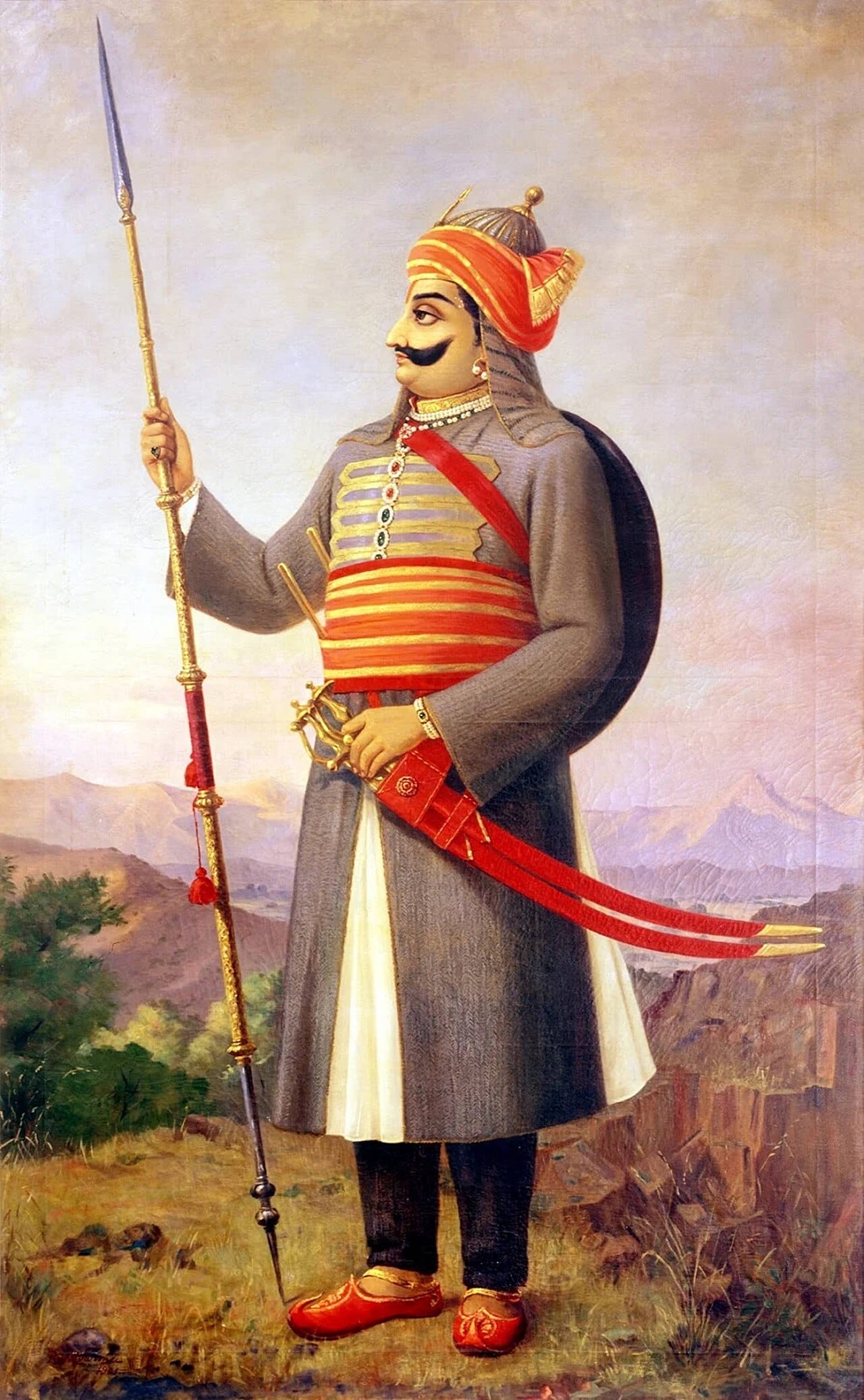
Pratap Singh was born in 1540 at Kumbhalgarh, the eldest son of Maharana Udai Singh II of the Sisodia house of Mewar. In 1568, the Mughal emperor Akbar took the great fort of Chittor after a long siege. Udai Singh had already founded a new capital at Udaipur, and when he died in 1572 Pratap was crowned at Gogunda.
He vowed, tradition says, not to live in palaces, sleep on beds or eat from gold and silver plates until Chittor was free.His defining vow, as remembered in Mewar
Most of the Rajput kingdoms around him had by then made terms with the Mughals. Akbar sent several embassies inviting Pratap to do the same. He received the envoys courteously — and refused to bow. For the next twenty-five years he held to that refusal, whatever it cost him.
Haldighati
On 18 June 1576 a Mughal army under Raja Man Singh of Amber met Pratap's smaller force at the Haldighati pass near Gogunda. Pratap's army included Bhil archers under Rana Punja and an Afghan contingent led by Hakim Khan Sur. The fighting was fierce, and when the battle turned, Pratap was carried to safety by his horse Chetak, who died of his wounds. The Mughals held the field but failed to capture or subdue him.
The years in the hills
Akbar's commanders occupied Gogunda, Kumbhalgarh and Udaipur, and Pratap withdrew into the Aravalli hills, fighting a long war of raids with the help of the Bhils. When his treasury ran dry, his minister Bhamashah placed his own wealth at his king's disposal. In 1582 Pratap defeated the Mughal outposts at Dewair, and over the following years won back most of Mewar except Chittor and Mandalgarh.
Chavand and the last years
Pratap made Chavand, in the southern hills, his new capital and built temples and a palace there. He died there on 19 January 1597, from injuries said to have been suffered in a hunting accident. His son Amar Singh continued the struggle. Mewar's long refusal became, for later generations, the very symbol of independence and self-respect.
How they are remembered
Maharana Pratap Jayanti is observed on Jyeshtha Shukla Tritiya and celebrated across Rajasthan. The Moti Magri memorial in Udaipur shows him astride Chetak, and the Haldighati museum and Chetak's cenotaph mark the battlefield. Ballads, plays and films across India keep alive the story of the king who chose the hills over submission.
Ekatmata Stotra · Stanza 24
Named in Stanza 24 of the Ekatmata Stotra — the warriors of resistance.
मुसुनूरिनायकाः प्रतापो रणजीतसिंहश्च।
शिवाजी नृसिंहसत्त्वो धर्म-रक्षण-दीक्षिताः॥
Sources: Wikipedia: Maharana Pratap · Wikipedia: Battle of Haldighati. Written afresh for The Hindu Book; corrections welcome at [email protected].