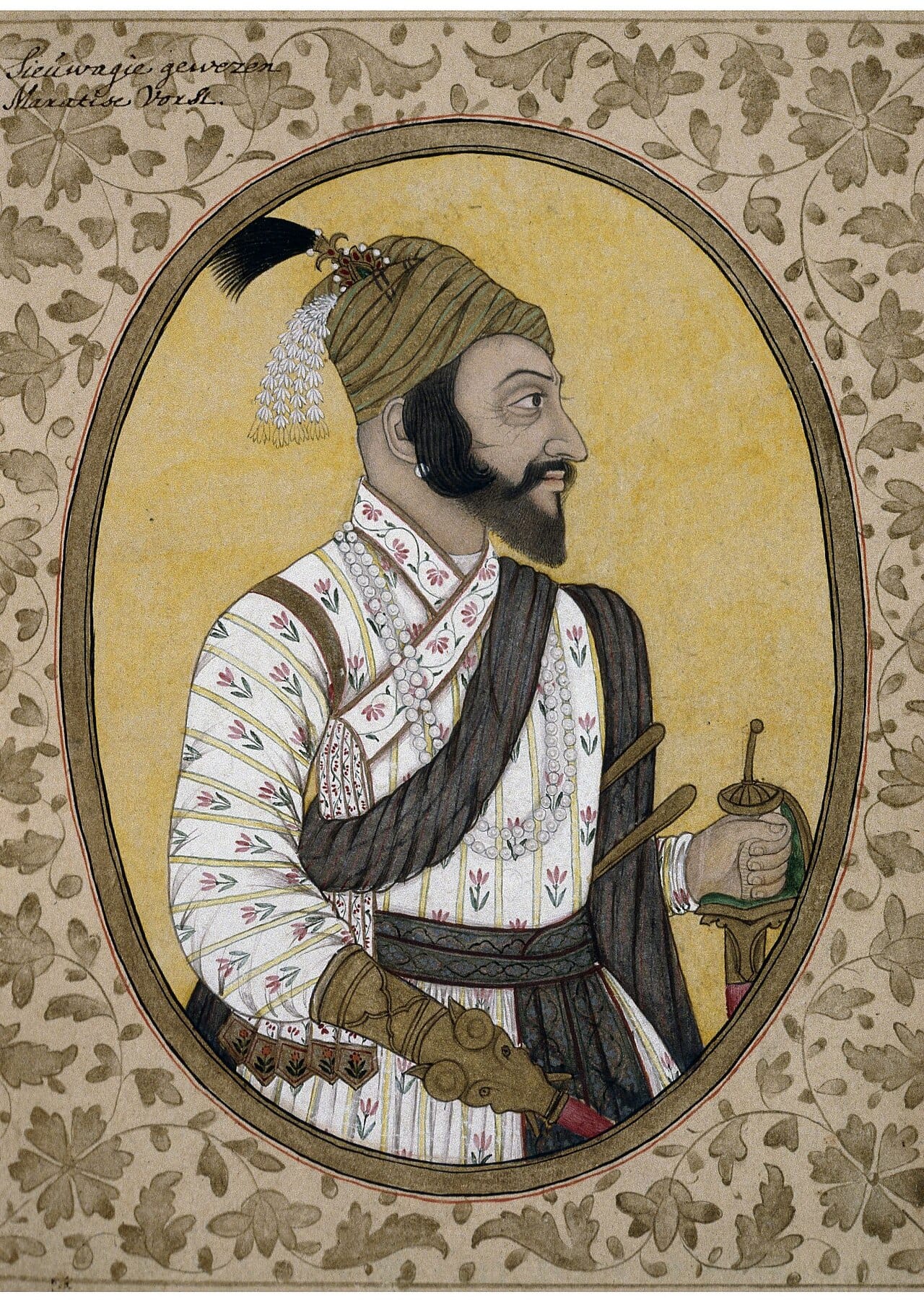
Shivaji Bhonsle was born at Shivneri fort near Junnar to Shahaji, a commander in the service of the Bijapur sultanate, and Jijabai, who raised him at Pune on the stories of the Ramayana and the Mahabharata. While still in his teens he took the fort of Torna and began, fort by fort, to carve out a homeland in the hills of the Sahyadri.
हे राज्य व्हावे हे तो श्रींची इच्छा“That this kingdom should come into being is the wish of Shri.”Words traditionally attributed to Shivaji in an early letter
What he built was more than a kingdom. Surrounded by the Bijapur and Golconda sultanates and the Mughal empire, he created a state run on Marathi and Sanskrit, a council of ministers, a navy and a chain of forts — and called it Swarajya, one's own rule. It outlived him and outlasted the empire that tried for a quarter of a century to destroy it.
The making of Swarajya
In the 1640s and 1650s Shivaji brought the forts around Pune under his control — Torna, Rajgad, Kondhana, Purandar — and built a loyal force from the Mavala farmers of the hills. In 1659 Bijapur sent its general Afzal Khan to crush him. The two met beneath Pratapgad; Shivaji killed Afzal Khan at the meeting and his men routed the Bijapur army in the forest below. The victory made his name across the Deccan.
Against the Mughal empire
In 1663 he raided the Pune camp of the Mughal governor Shaista Khan by night, and in 1664 he struck the rich port of Surat. A large Mughal army under Mirza Raja Jai Singh forced the Treaty of Purandar in 1665, and Shivaji was summoned to Aurangzeb's court at Agra, where he was placed under house arrest. In 1666 he escaped — by tradition hidden in baskets of sweets — and within a few years had won back most of the forts he had surrendered.
Coronation at Raigad
On 6 June 1674, at Raigad, Shivaji was consecrated Chhatrapati in a Vedic ceremony conducted by Gaga Bhatt of Varanasi. He took the title Kshatriya Kulavatamsa, began a new era, the Rajyabhisheka Shaka, and issued coins in his own name. He governed through the Ashta Pradhan, a council of eight ministers, encouraged Marathi and Sanskrit in administration, and had a dictionary of state terms, the Rajavyavahara Kosha, compiled.
The method
Shivaji fought where his enemies were weakest. Light cavalry and hill infantry struck fast and withdrew to forts; he built sea forts such as Sindhudurg and a navy to guard the Konkan coast. He forbade his soldiers to harm women, places of worship or crops, and paid them from the treasury rather than from plunder of his own people. After his death in 1680, Aurangzeb spent his last twenty-six years in the Deccan trying to crush the Marathas — and failed.
How they are remembered
Shiv Jayanti on 19 February is a public holiday in Maharashtra, and the Rashtriya Swayamsevak Sangh observes his coronation as Hindu Samrajya Dinotsav on Jyeshtha Shukla Trayodashi. In 2025, twelve of his forts — including Raigad, Shivneri, Pratapgad and Sindhudurg — were inscribed together as a UNESCO World Heritage Site, the Maratha Military Landscapes of India. The Indian Navy's ensign, adopted in 2022, draws on his royal seal.
Ekatmata Stotra · Stanza 24
Named in Stanza 24 of the Ekatmata Stotra — the warriors of resistance.
मुसुनूरिनायकाः प्रतापो रणजीतसिंहश्च।
शिवाजी नृसिंहसत्त्वो धर्म-रक्षण-दीक्षिताः॥
Sources: Wikipedia: Shivaji · Wikipedia: Maratha Military Landscapes of India. Written afresh for The Hindu Book; corrections welcome at [email protected].