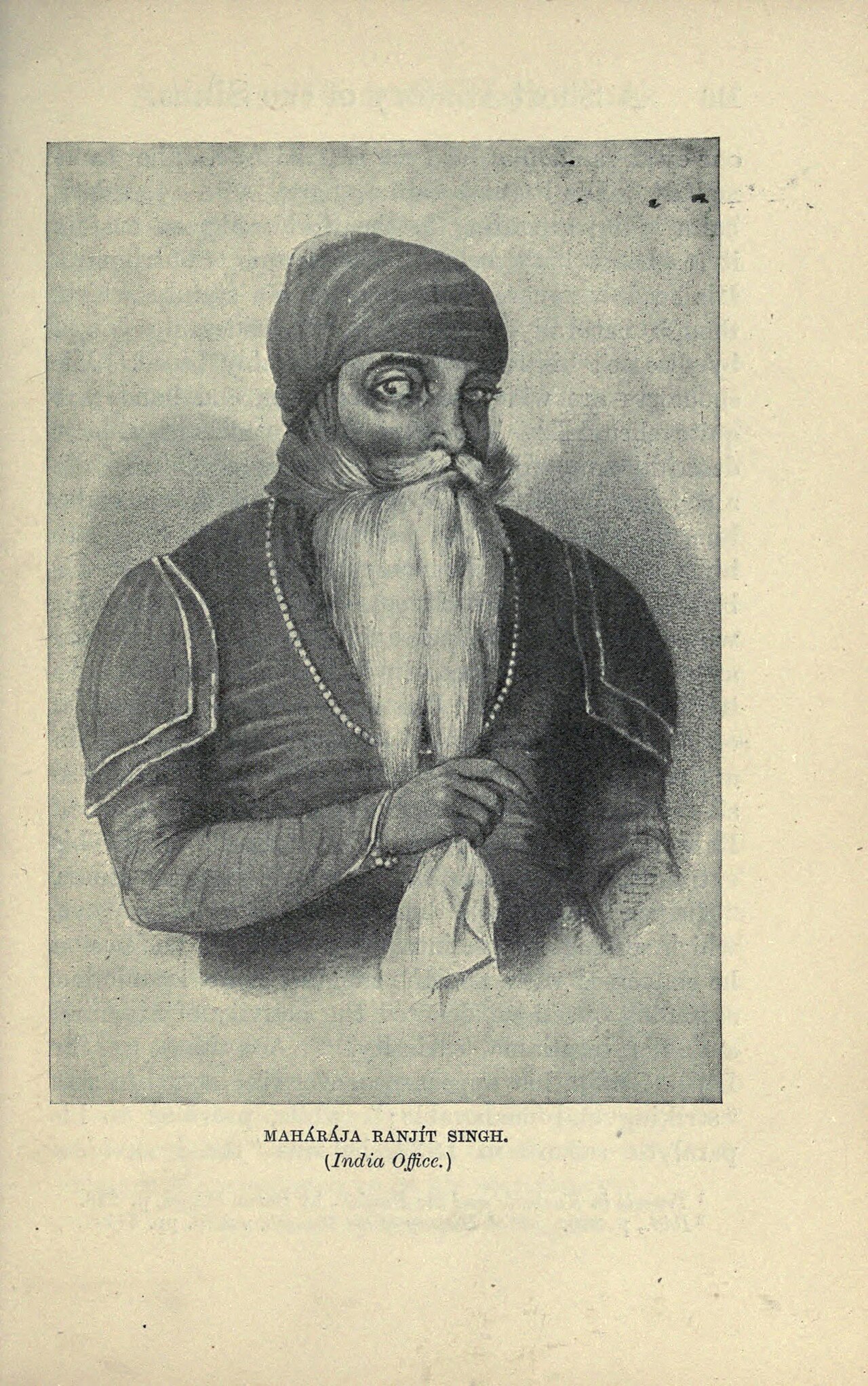
Ranjit Singh was born in 1780 at Gujranwala, the son of Maha Singh, leader of the Sukerchakia misl, one of the twelve Sikh confederacies that held Punjab after the decline of the Mughals. Smallpox in childhood cost him the sight of his left eye. His father died when he was twelve, and he soon took command.
“God intended me to look upon all religions with one eye; that is why He took away the light from the other.”Words attributed to Ranjit Singh
In 1799, at nineteen, he captured Lahore. In 1801 he proclaimed himself Maharaja of Punjab — while striking coins in the name of the Gurus, not his own.
Building an empire
Over the next forty years he brought the misls under one rule and extended his kingdom to Amritsar, Multan (1818), Kashmir (1819) and Peshawar (1834), pushing back the Afghans who had raided India for centuries. By the Treaty of Amritsar in 1809 he agreed with the British on the Sutlej as a boundary, keeping peace on his eastern flank. In 1813 he obtained the Koh-i-Noor diamond from the exiled Afghan ruler Shah Shuja.
The Khalsa army
He built the most modern army in Asia outside British control, hiring European officers such as Jean-François Allard and Jean-Baptiste Ventura to train infantry and artillery in European methods, alongside the traditional Sikh cavalry and the fierce Akali-Nihangs.
Faith and tolerance
A devout Sikh, he covered the Harmandir Sahib in Amritsar with gold leaf, giving it the name Golden Temple, and also gave gold for the spire of the Kashi Vishwanath temple. His ministers and generals included Sikhs, Hindus and Muslims, such as his foreign minister Fakir Azizuddin and the Dogra brothers. He banned cow slaughter and rarely used the death penalty. Within ten years of his death in 1839, his empire fell to the British.
How they are remembered
Remembered as Sher-e-Punjab, the Lion of Punjab, his samadhi stands in Lahore and his statue in Amritsar and in the Parliament of India. In a 2020 BBC History Magazine poll, readers voted him the greatest leader in history.
Ekatmata Stotra · Stanza 24
Named in Stanza 24 of the Ekatmata Stotra — the warriors of resistance.
मुसुनूरिनायकाः प्रतापो रणजीतसिंहश्च।
शिवाजी नृसिंहसत्त्वो धर्म-रक्षण-दीक्षिताः॥
Sources: Wikipedia: Ranjit Singh · Wikipedia: Sikh Empire. Written afresh for The Hindu Book; corrections welcome at [email protected].