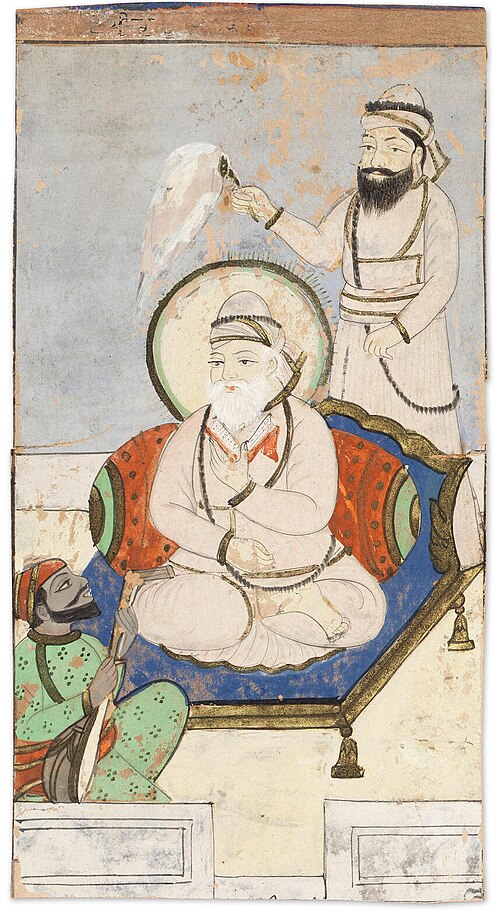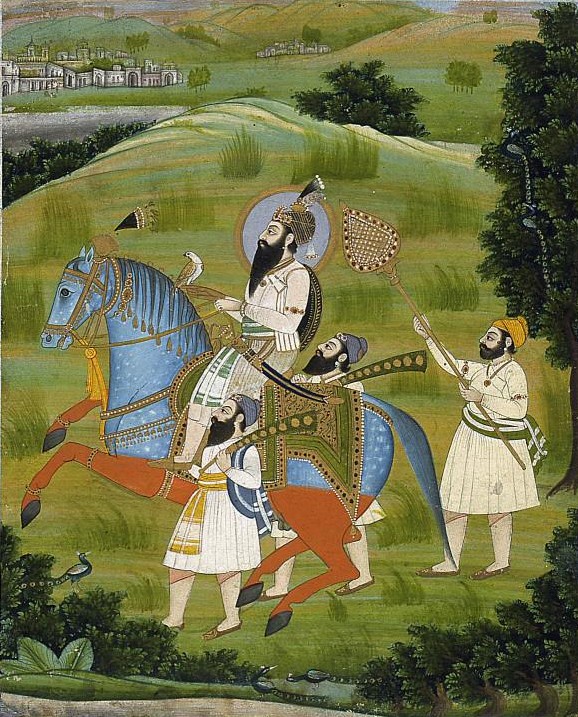
Gobind Rai was born at Patna in 1666, the only son of the ninth Guru, Tegh Bahadur, and Mata Gujri. When he was nine, a group of Kashmiri Pandits came to his father at Anandpur asking for help against forced conversion under the Mughal emperor Aurangzeb. Guru Tegh Bahadur went to Delhi to stand for their freedom of faith and was executed at Chandni Chowk in 1675.
“When all other means have failed, it is right to take up the sword.”Zafarnama, his Persian letter to Aurangzeb
The boy became the tenth Guru. At Anandpur and Paonta he studied Persian, Sanskrit and Braj, trained in arms, and gathered poets at his court. His own writings, later collected in the Dasam Granth, include the hymn Jaap Sahib and the stirring Chandi di Var.
The Khalsa
On Vaisakhi in 1699, before a great gathering at Anandpur, the Guru called for a head. One by one, five men from different castes and regions offered themselves; he initiated them with amrit stirred with a double-edged sword, as the Panj Pyare, the Five Beloved — and then asked them to initiate him. So the Khalsa was born: men took the name Singh and women Kaur, and all were to keep the five Ks, among them uncut hair and the kirpan.
The cost of resistance
The hill rajas and Mughal forces besieged Anandpur. Leaving it in 1704 on a promise of safe passage, the Guru's party was attacked. His two elder sons, Ajit Singh and Jujhar Singh, fell fighting at Chamkaur; the two youngest, Zorawar Singh and Fateh Singh, aged about nine and six, were bricked alive at Sirhind for refusing to convert, and Mata Gujri died there. From Dina he wrote the Zafarnama, a defiant letter to Aurangzeb.
The eternal Guru
After Aurangzeb's death he travelled south with the new emperor Bahadur Shah and settled at Nanded on the Godavari, where he sent Banda Singh Bahadur to Punjab. Wounded by an assassin, he died there in 1708. Before his death he declared that there would be no more human Gurus: the Guru Granth Sahib and the Khalsa Panth would guide the Sikhs for ever.
How they are remembered
Guru Gobind Singh Jayanti (Prakash Purab) on Paush Shukla Saptami is celebrated across the world, and the martyrdom of the Sahibzade is remembered as Veer Bal Diwas on 26 December. Takht Sri Patna Sahib, Anandpur Sahib and Hazur Sahib at Nanded mark his birth, the Khalsa and his last days.
Ekatmata Stotra · Stanza 16
Named in Stanza 16 of the Ekatmata Stotra — the bhakti revolution — Ravidas to Guru Gobind Singh.
देवलो रविदासश्च कबीरश्च गुरुर्नानकः।
नरसी-तुलसीदासौ गुरुगोविन्दसिंहकः॥
Sources: Wikipedia: Guru Gobind Singh · Wikipedia: Khalsa. Written afresh for The Hindu Book; corrections welcome at [email protected].