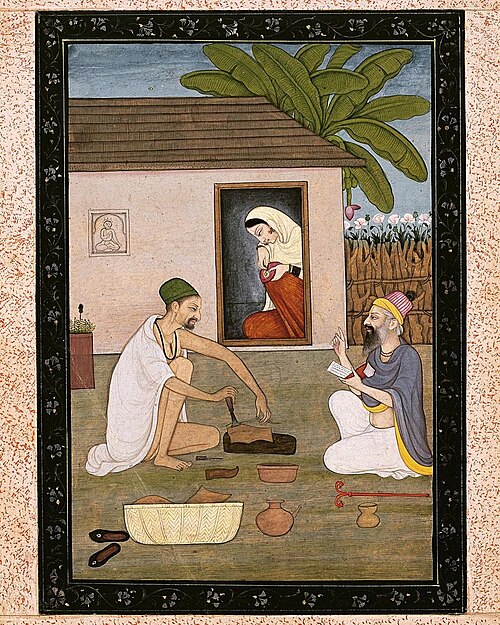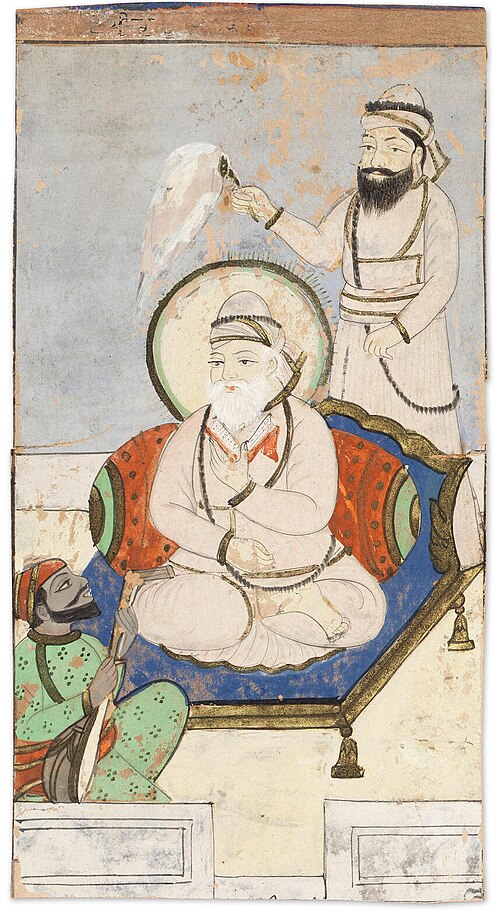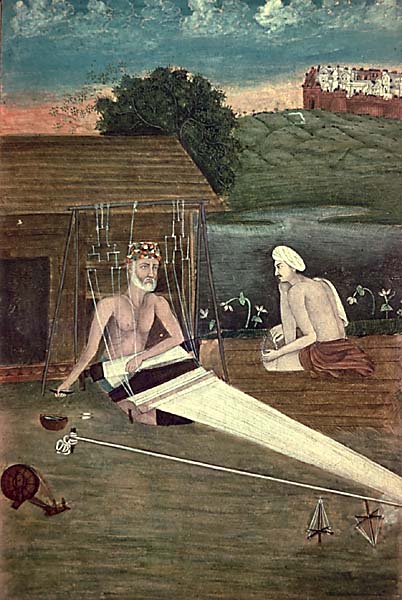
Kabir lived in Varanasi in the fifteenth century; tradition gives him the very long span 1398–1518. Legend says he was found as a baby on a lotus in the Lahartara tank and raised by Niru and Nima, a Muslim weaver couple. He spent his life at the loom, never leaving his trade, and married and had children, Kamal and Kamali.
बुरा जो देखन मैं चला, बुरा न मिलिया कोय। जो दिल खोजा आपना, मुझसा बुरा न कोय॥“I went looking for the wicked and found no one wicked; when I searched my own heart, there was none so wicked as I.”A doha of Kabir
A famous story says he longed to be the disciple of the great Vaishnava teacher Ramananda, who would not accept him. So Kabir lay on the steps of the Panchganga ghat before dawn; Ramananda, coming down to bathe, stepped on him and cried "Ram! Ram!" — and Kabir took that as his initiation.
The dohas
Kabir did not write; his sayings were sung and later written down. His two-line dohas and longer padas are in plain, earthy Hindi. He worshipped a formless God he called Ram, Hari or the Satguru, found within the heart rather than in temple or mosque, and laughed at idols, pilgrimages, caste pride, fasts and the call to prayer alike. Love, the guru and remembering God's name were all that mattered.
Three traditions
His words survive in three great collections: the Bijak of the Kabir Panth, the Kabir Granthavali of Rajasthan, and over five hundred verses in the Sikh Guru Granth Sahib. The Kabir Panth, a community of his followers, has monasteries at the Kabir Chaura in Varanasi and elsewhere.
Death at Maghar
People believed that dying in Kashi brought liberation and dying in Maghar meant rebirth as a donkey. Kabir went to Maghar to die, to show that it is devotion, not place, that matters. Legend says that Hindus and Muslims quarrelled over his body, wishing to cremate and to bury it — and, lifting the sheet, found only a heap of flowers, which they divided. Both a samadhi and a tomb stand side by side at Maghar.
How they are remembered
Kabir Jayanti is celebrated on Jyeshtha Purnima. His dohas are learnt by every Hindi-speaking schoolchild and sung by folk singers from Malwa to Rajasthan, and Tagore translated one hundred of his poems into English.
Ekatmata Stotra · Stanza 16
Named in Stanza 16 of the Ekatmata Stotra — the bhakti revolution — Ravidas to Guru Gobind Singh.
देवलो रविदासश्च कबीरश्च गुरुर्नानकः।
नरसी-तुलसीदासौ गुरुगोविन्दसिंहकः॥
Sources: Wikipedia: Kabir · Wikipedia: Bijak. Written afresh for The Hindu Book; corrections welcome at [email protected].