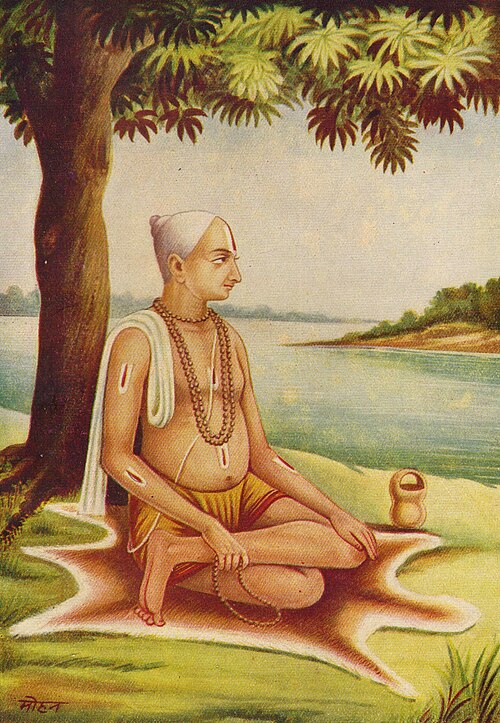
Very little about Ramananda's life is certain; even his dates are disputed. Tradition says he was born at Prayag in 1299 and lived more than a century; scholars place him in the fourteenth and fifteenth centuries. He studied in Varanasi and is linked by tradition to the Sri Vaishnava teaching of Ramanuja, though his own focus was the worship of Rama and Sita.
जाति-पाँति पूछै नहिं कोई। हरि को भजै सो हरि का होई॥“No one asks about caste or clan; whoever worships Hari belongs to Hari.”A saying traditionally attributed to Ramananda
He settled at the Panchganga ghat in Varanasi, from where his influence spread across North India.
Devotion open to all
Ramananda's great step was to teach that devotion to Rama was open to everyone, whatever their caste or sex. He taught in Hindi, the language of the people, rather than only in Sanskrit, and relaxed rules about eating together that divided his followers. The Ramanandi sampradaya he founded became the largest Vaishnava monastic order in North India.
The twelve disciples
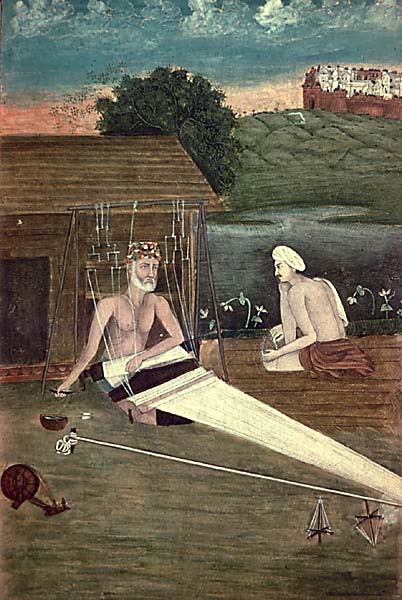
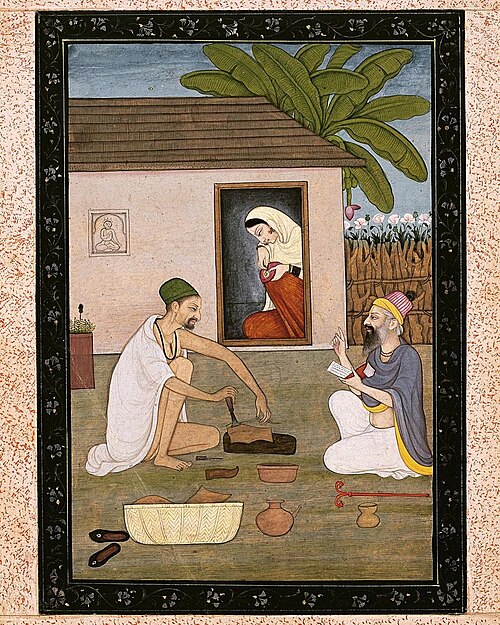
Tradition names twelve chief disciples who show how wide his circle was: among them Kabir the weaver, Ravidas the leather-worker, Sena the barber, Dhanna the farmer, the Rajput prince Pipa, and the woman devotee Padmavati. Historians debate whether all of them were his direct students, but the tradition itself shows how later generations saw him — as the source of the Bhakti movement of the north.
Legacy in song
One hymn attributed to Ramananda is preserved in the Sikh Guru Granth Sahib. Through Kabir, Ravidas and later Tulsidas — whose guru line is often traced to the Ramanandis — his spirit of simple, open devotion to Rama shaped North Indian religious life.
How they are remembered
Ramanandi akharas and maths, with their Vairagi sadhus, are prominent at every Kumbh Mela, and many temples of Ayodhya belong to the tradition. Ramananda Jayanti is observed on Magha Krishna Saptami.
Ekatmata Stotra · Stanza 18
Named in Stanza 18 of the Ekatmata Stotra — nineteenth-century acharyas and reformers.
विरजानन्दः सहजानन्दो रामानन्दः परात्परः।
धर्मोद्धारकर्तारो नमस्यास्ते मुहुर्मुहुः॥
Sources: Wikipedia: Ramananda · Wikipedia: Ramanandi Sampradaya. Written afresh for The Hindu Book; corrections welcome at [email protected].