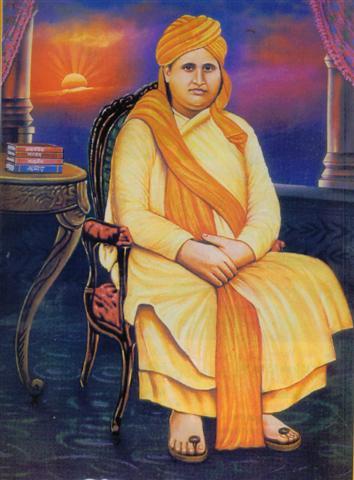
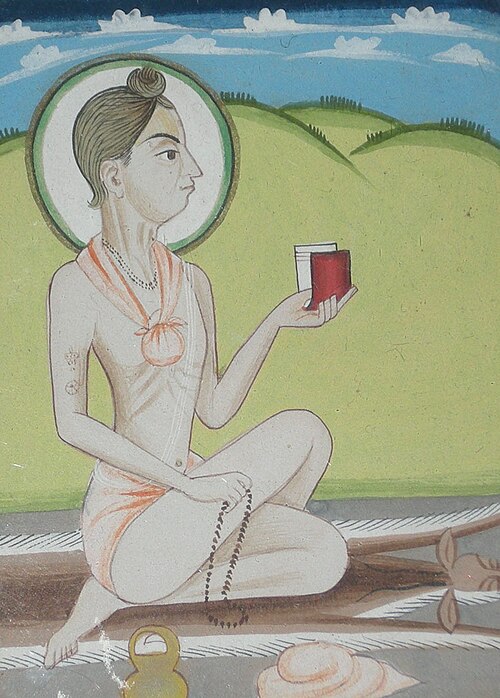
Virajananda was born in 1778 in a Sarasvat Brahmin family at Gangapur, near Kartarpur in the Jalandhar region of Punjab. At the age of about five he lost his sight to smallpox, and by his early teens he had lost both parents. Tradition says that harsh treatment at home drove him out, and he made his way, alone and blind, to Rishikesh and Haridwar.
As his fee, Virajananda asked Dayananda not for gifts but for his life: to spread the knowledge of the Vedas and fight the ignorance that had grown around them.The guru-dakshina of 1863, as told in biographies of Swami Dayananda Saraswati
There he devoted himself to Sanskrit, memorising texts as others read them aloud. He took sannyasa from Swami Purnananda as a dandi monk, studied further at Kashi, and became known for a memory so complete that people called him Prajnachakshu — one whose eyes are wisdom.
The ancient and the later
Virajananda's teaching turned on one idea. He divided Sanskrit learning into arsha works — those of the ancient seers, such as Panini's Ashtadhyayi and Patanjali's Mahabhashya — and anarsha works written later. He held that the later manuals, including the popular Siddhanta Kaumudi, rearranged and obscured the old grammar, and that students should go straight to the sources.
He applied the same test to religion. In his view, much that passed for dharma in his day rested on late texts and custom rather than on the Vedas, and true reform meant returning to the original authorities.
His method was strict. Students were expected to learn the rules of Panini by heart, follow the reasoning of Patanjali, and test every later claim against these sources. For a blind teacher this meant holding thousands of rules and their exceptions in memory and reciting them on demand, which his students recalled with awe.
The school at Mathura
After years of wandering and teaching — including a period under the patronage of the ruler of Alwar — Virajananda settled at Mathura, where he ran a small Sanskrit school (pathshala) for the rest of his life. He was known as a demanding and sharp-tempered teacher, and only a handful of students stayed the course. Accounts say that he urged Hindu princes to found institutions of ancient learning, without much success.
Though he never sought a public role, his reputation spread among pandits of North India, and visiting scholars came to Mathura to test him in debate. Accounts describe him living simply, eating little, and spending his days in recitation and teaching. In his old age the school remained small, but those who completed its course left with an unusually deep command of the Sanskrit language.
Dayananda
In 1860 a wandering monk named Dayananda Saraswati, then in his mid-thirties, came to Mathura and asked to study with him. Biographies of Dayananda relate that Virajananda told him to throw away the later books he had been carrying and start afresh with Panini. For about three years Dayananda studied grammar and the Vedic texts under him.
When the course ended in 1863, Dayananda brought a small offering of cloves, the only gift he could afford. Virajananda refused it and asked instead that he give his life to restoring the knowledge of the Vedas. Dayananda accepted, and twelve years later founded the Arya Samaj.
How they are remembered
Virajananda died at Mathura in 1868. He wrote little and taught few, but through Dayananda Saraswati his insistence on going back to the Vedas and the ancient grammarians became a movement that reshaped Hindu reform, education and public life in North India. Arya Samaj institutions honour him as their founder's guru, and his life remains a powerful example of learning won against great odds.
Ekatmata Stotra · Stanza 18
Named in Stanza 18 of the Ekatmata Stotra — nineteenth-century acharyas and reformers.
विरजानन्दः सहजानन्दो रामानन्दः परात्परः।
धर्मोद्धारकर्तारो नमस्यास्ते मुहुर्मुहुः॥
Sources: Wikipedia: Virjanand · Wikipedia: Dayananda Saraswati. Written afresh for The Hindu Book; corrections welcome at [email protected].