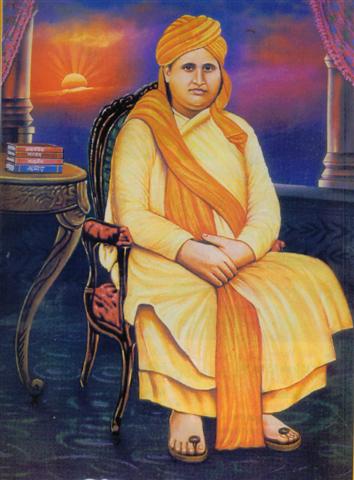
Mool Shankar Tiwari was born in 1824 at Tankara in Kathiawar, the son of a devout Shaiva brahmin. On Mahashivratri, at about fourteen, he kept the night vigil in the temple and saw a mouse running over the Shiva linga eating the offerings. If the image could not protect itself, he wondered, how could it be the almighty God? The question stayed with him.
वेदों की ओर लौटो“Back to the Vedas.”The call of the Arya Samaj, associated with Dayananda
The deaths of his sister and uncle turned him further towards the search for truth, and to escape marriage he left home in 1846. For fifteen years he wandered as a monk, taking the name Dayananda Saraswati.
The blind guru
In 1860 he found his teacher in Mathura: Swami Virajananda, a blind grammarian who taught that only the Vedas and the older texts written by rishis were authoritative. After three years of study, Dayananda offered him cloves as guru-dakshina; Virajananda asked instead that he spend his life spreading the true Vedic teaching. Dayananda vowed to do so.
The Arya Samaj
He debated pandits across North India, most famously at Varanasi in 1869, and in 1875 founded the Arya Samaj in Bombay. That year he also published Satyarth Prakash, "the light of truth". He held the Vedas to be the eternal word of God and rejected idol worship, priestly ritual, caste by birth, untouchability and child marriage; he championed the education of women, widow remarriage and Hindi as a common language, and began shuddhi, the ceremony for welcoming people into Hinduism. His sharp criticism of other faiths and of Puranic Hinduism made him enemies as well as followers.
Death at Ajmer
In 1883, while staying with the Maharaja of Jodhpur, whom he had criticised for his private life, Dayananda fell gravely ill — poisoned, according to his followers. He died at Ajmer on the evening of Diwali, 30 October 1883.
How they are remembered
The Arya Samaj spread across Punjab and North India and abroad; its DAV schools and colleges and Gurukul Kangri educated millions. Many freedom fighters, including Lala Lajpat Rai and Swami Shraddhananda, were Arya Samajis, and Dayananda was among the first to use the word swaraj.
Ekatmata Stotra · Stanza 27
Named in Stanza 27 of the Ekatmata Stotra — those who woke the sleeping civilisation.
रामकृष्णो दयानन्दः ठाकुर रामतीर्थकः।
विवेकानन्द-मोहनौ राष्ट्र-जागरणेऽग्रिमौ॥
Sources: Wikipedia: Dayananda Saraswati · Wikipedia: Arya Samaj. Written afresh for The Hindu Book; corrections welcome at [email protected].