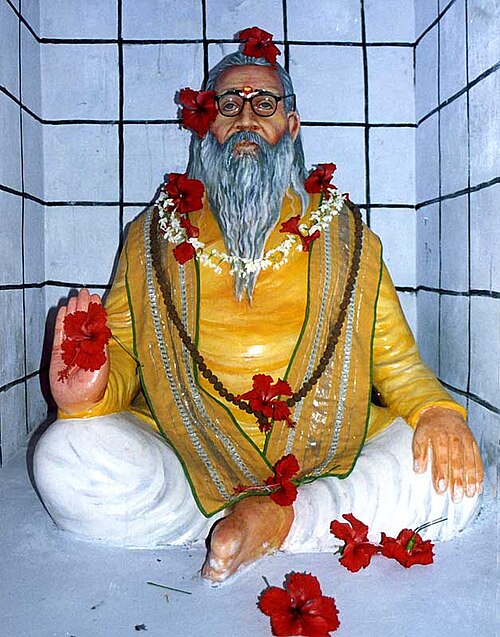
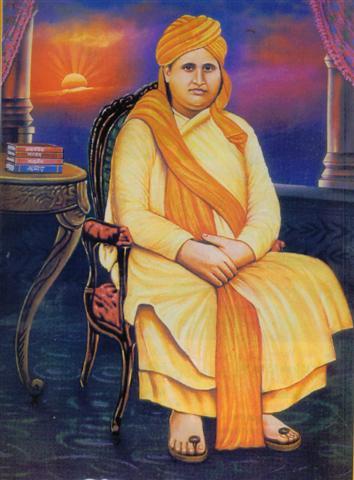
Sayana was born in the early 14th century into a learned family of the Bharadvaja gotra, in the Kannada country. His father was Mayana and his elder brother Madhava, whom tradition identifies with the sage Vidyaranya. Sayana came of age just as the Vijayanagara kingdom was being founded on the banks of the Tungabhadra, and he spent his life in its service.
यस्य निःश्वसितं वेदा यो वेदेभ्योऽखिलं जगत्। निर्ममे तमहं वन्दे विद्यातीर्थमहेश्वरम्॥“I bow to Vidyatirtha, the great Lord, whose breath is the Vedas and who from the Vedas fashioned the whole world.”Sayana, opening verse of the Rigveda Bhashya (Upodghata)
He was both a statesman and a scholar. He served as minister to several princes of the Sangama dynasty — Kampana, Sangama II, Bukka I and Harihara II — and is said even to have led troops. Yet he is remembered for a work of learning: a commentary on the whole Vedic corpus, the most complete ever attempted. He died in 1387.
Vedartha Prakasha
Sayana's commentary is called the Vedartha Prakasha, “the light on the meaning of the Veda”. It covers the Rigveda, the Taittiriya Samhita of the Black Yajurveda, the Samaveda and the Atharvaveda, along with many Brahmanas and Aranyakas. For each verse he explains the words, their grammar, the deity addressed and, above all, the use of the verse in sacrifice.
A work of this size was almost certainly the product of a team. Sayana is believed to have directed a circle of scholars at the Vijayanagara court, with royal patronage, and some parts may have been completed after his death. His long introduction to the Rigveda commentary sets out the traditional case for the authority of the Veda and how it is to be read.
He worked within the tradition of Purva Mimamsa, the school that treats the Veda above all as a guide to right ritual action. That is why his notes so often explain where and how a hymn is used in the sacrifice, and why he draws on older aids such as Yaska's Nirukta and the Brahmanas to fix the meaning of difficult words.
Other writings
Several handbooks with the title Sudhanidhi, “treasury of nectar”, are credited to him, on subjects from medicine (Ayurveda Sudhanidhi) and poetics (Alankara Sudhanidhi) to atonement rites and the goals of life (Purushartha Sudhanidhi). His Subhashita Sudhanidhi is an anthology of wise verses. Together they show the range of learning gathered at Vijayanagara in its first generation.
Sayana and the modern world
When European scholars began to study the Vedas in the 19th century, Sayana was their main guide. Max Müller's edition of the Rigveda, printed in six volumes between 1849 and 1874 with funding from the East India Company, presented the full text alongside Sayana's commentary for the first time in print. Early translators leaned heavily on him.
His reading also drew criticism. German scholars such as Rudolf Roth argued that Sayana, writing some two thousand years after the hymns, often missed their original sense. Within India, Swami Dayananda Saraswati and Sri Aurobindo rejected his mainly ritual interpretation and sought deeper philosophical or spiritual meanings. Others, including Pischel and Geldner, defended the value of the Indian tradition he preserved. The debate itself shows how central he had become.
How they are remembered
For more than six centuries Sayana's bhashya has been the first resource for anyone trying to understand a Vedic verse. Pandits and university scholars alike still begin with him, even when they disagree with him. He stands at the start of the Vijayanagara revival as the man who made sure that, in an age of upheaval, the meaning of the Veda was written down in full.
Ekatmata Stotra · Stanza 17
Named in Stanza 17 of the Ekatmata Stotra — saints who gave their regional language a bhakti canon.
शङ्करदेव: सायण-माधवौ ज्ञानदेवस्तुकारामो।
रामदासश्च पुरन्दरदासश्च सम्भाव्या सदा हृदि॥
Sources: Wikipedia: Sayana · britannica.com/biography/Sayana. Written afresh for The Hindu Book; corrections welcome at [email protected].