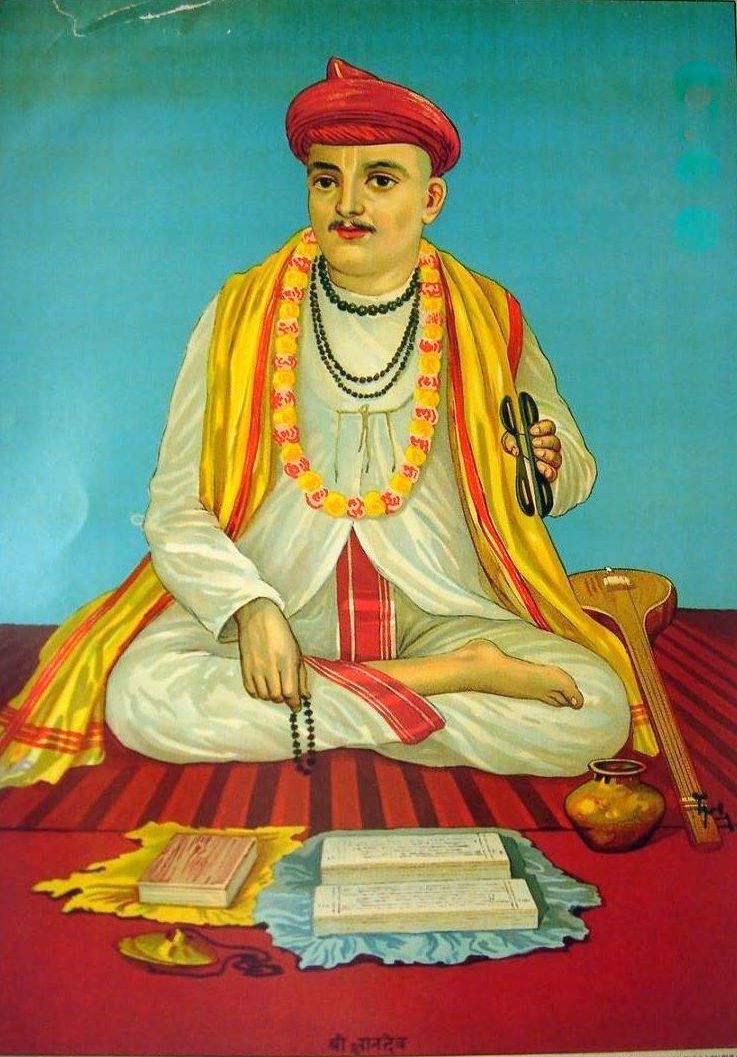
Jnaneshwar — Dnyaneshwar in Marathi, lovingly called Mauli, "mother" — was born in 1275 at Apegaon near Paithan. His father Vitthalpant had taken sannyasa and then, on his guru's instruction, returned to married life. The brahmins of the time declared the family outcaste, and the children — Nivrittinath, Jnaneshwar, Sopan and Muktabai — grew up rejected. Tradition says their parents gave up their lives hoping the community would accept the children.
जो जे वांछील तो ते लाहो प्राणिजात“May every being obtain whatever it desires.”Pasaydan, his closing prayer to the Jnaneshwari
The children went to Paithan to seek purification. Legend says that when the scholars mocked them, Jnaneshwar made a buffalo recite the Vedas — and the scholars bowed.
The Jnaneshwari
Initiated by his elder brother Nivrittinath into the Nath tradition, Jnaneshwar at the age of about fifteen gave a commentary on the Bhagavad Gita in Marathi verse at Nevasa in 1290. The Jnaneshwari (or Bhavarthadipika) runs to some nine thousand ovi verses. For the first time the Gita's wisdom was open to people who did not know Sanskrit, in poetry of extraordinary beauty.
Amritanubhav and the Pasaydan
His Amritanubhav, "the nectar of experience", is a philosophical poem on the oneness of Shiva and Shakti. At the end of the Jnaneshwari he offered the Pasaydan, a prayer asking not for himself but that the wicked lose their wickedness, that friendship grow among all beings, and that everyone obtain what they desire. It is still sung at the close of countless gatherings in Maharashtra.
Samadhi at Alandi
Legend says the proud yogi Changdev came to meet him riding a tiger and holding a snake as a whip — and Jnaneshwar and his siblings rode out to meet him on a wall that moved at their command. Jnaneshwar travelled to Pandharpur and with Namdev and others gave the Warkari devotion to Vitthala its shape. In 1296, at twenty-one, he entered sanjivan samadhi, a living samadhi, at Alandi.
How they are remembered
Each year the Palkhi carrying Jnaneshwar's padukas sets out from Alandi with hundreds of thousands of warkaris on the walk to Pandharpur for Ashadhi Ekadashi. His samadhi at Alandi is one of Maharashtra's holiest places.
Ekatmata Stotra · Stanza 17
Named in Stanza 17 of the Ekatmata Stotra — saints who gave their regional language a bhakti canon.
शङ्करदेव: सायण-माधवौ ज्ञानदेवस्तुकारामो।
रामदासश्च पुरन्दरदासश्च सम्भाव्या सदा हृदि॥
Sources: Wikipedia: Dnyaneshwar · Wikipedia: Dnyaneshwari. Written afresh for The Hindu Book; corrections welcome at [email protected].