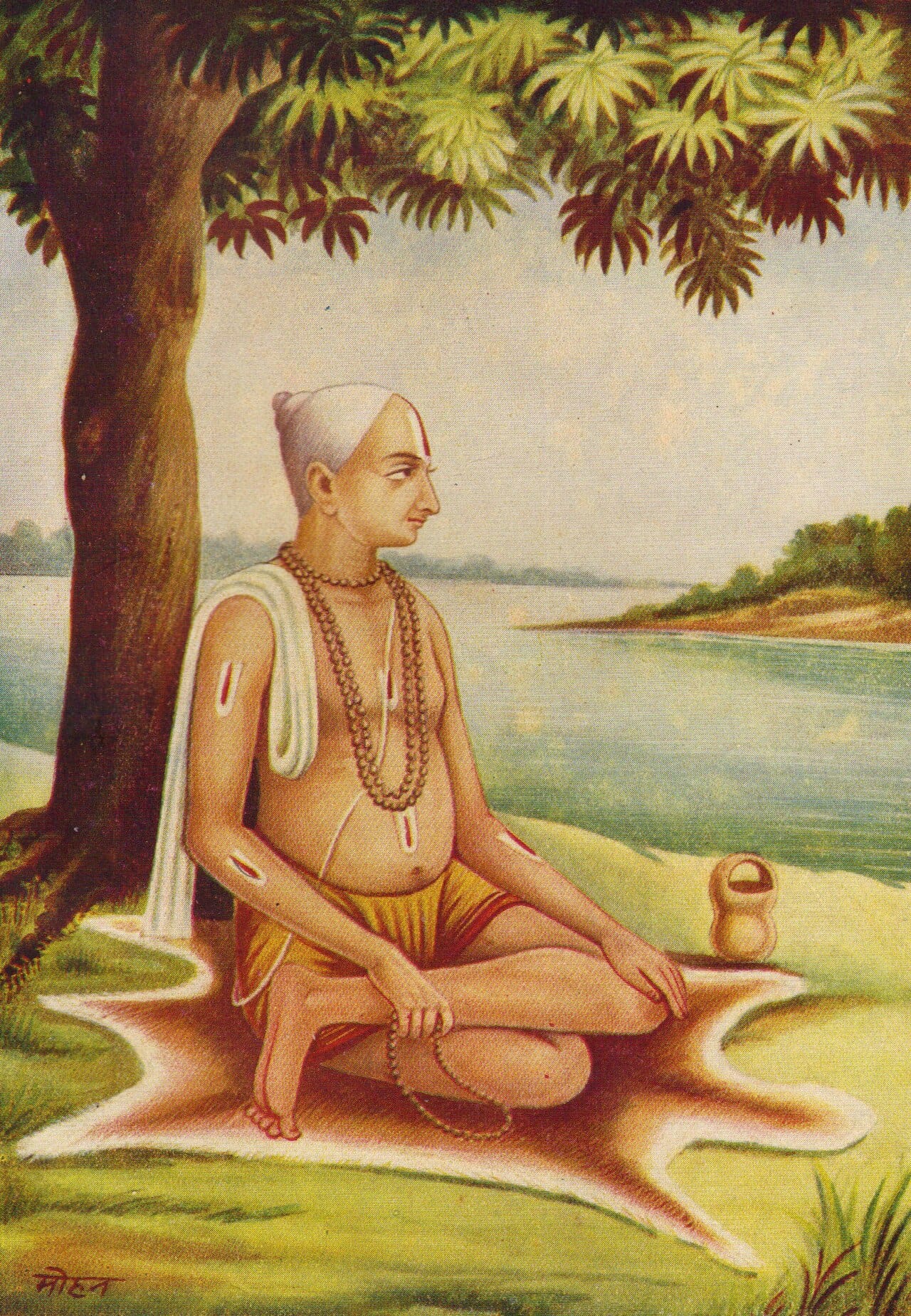
Tulsidas was born, by most accounts, at Rajapur on the Yamuna, in today's Chitrakoot district of Uttar Pradesh; his birth year is uncertain, and many scholars place it around 1532. Tradition says he lost his parents young and was raised by the saint Narharidas, who taught him the story of Rama. A famous story tells how his wife Ratnavali rebuked him for his attachment to her, saying that such love, turned towards Rama, would free him — and he left home to become a wandering devotee.
सीय राममय सब जग जानी। करउँ प्रनाम जोरि जुग पानी॥“Knowing the whole world to be filled with Sita and Rama, I bow to it with joined palms.”Ramcharitmanas, Bala Kanda
He spent his life between Ayodhya, Chitrakoot and Kashi, and composed in the languages ordinary people spoke. His Ramcharitmanas brought the Ramayana out of Sanskrit and into village squares, where it has been read, sung and enacted ever since.
The Ramcharitmanas
Tulsidas began the Ramcharitmanas, “the lake of the deeds of Rama”, at Ayodhya on Rama Navami in 1574 and completed it over the following years. Written in Awadhi in chaupai and doha metres, it tells the Ramayana in seven kandas, framed as conversations between Shiva and Parvati and between other sages. More than an epic, it is a work of bhakti: Rama is the supreme Lord, and devotion to him is open to all.
Other works
His Vinaya Patrika, a “letter of petition” to Rama, is a collection of deeply personal hymns. The Kavitavali, Gitavali, Dohavali and Janaki Mangal are among the other works attributed to him. The Hanuman Chalisa, the forty verses recited by millions every day, is traditionally ascribed to Tulsidas, and Hanuman is honoured throughout his poetry as the ideal devotee.
In Kashi
In his later years Tulsidas lived at Varanasi, where tradition credits him with founding the Sankat Mochan Hanuman temple and with beginning the Ramlila performances that the city still stages. The ghat where he lived is now called Tulsi Ghat. He died at Assi Ghat in 1623, and his house and manuscripts are preserved there to this day.
How they are remembered
Tulsidas Jayanti is observed on Shravana Shukla Saptami. The Ramcharitmanas is recited in homes and temples across North India — in nine-day Navahna recitations and the unbroken Akhand Path — and is the source of most Ramlila performances. In 2024 its manuscripts were added to UNESCO's Memory of the World Asia-Pacific register.
Ekatmata Stotra · Stanza 16
Named in Stanza 16 of the Ekatmata Stotra — the bhakti revolution — Ravidas to Guru Gobind Singh.
देवलो रविदासश्च कबीरश्च गुरुर्नानकः।
नरसी-तुलसीदासौ गुरुगोविन्दसिंहकः॥
Sources: Wikipedia: Tulsidas · Wikipedia: Ramcharitmanas. Written afresh for The Hindu Book; corrections welcome at [email protected].