When is Makar Sankranti?
| Year | Date | Day |
|---|---|---|
| 2026 | 14 January | Wednesday |
| 2027 | 15 January | Friday |
| 2028 | 15 January | Saturday |
Observed on Sun enters Capricorn (Makar Rashi). Dates follow the Panchang for New Delhi and can differ by a day in other places — check the Panchang for your city.
What Makar Sankranti means
Makar Sankranti is the day the Sun enters Makara (Capricorn) in the sidereal zodiac. Most Hindu festivals follow the moon; Sankranti follows the sun, which is why it falls on almost the same date every year — 14 or 15 January. In the traditional reckoning it begins Uttarayana, the Sun's northward half of the year, which the scriptures call the bright and auspicious path, the 'day of the gods'.
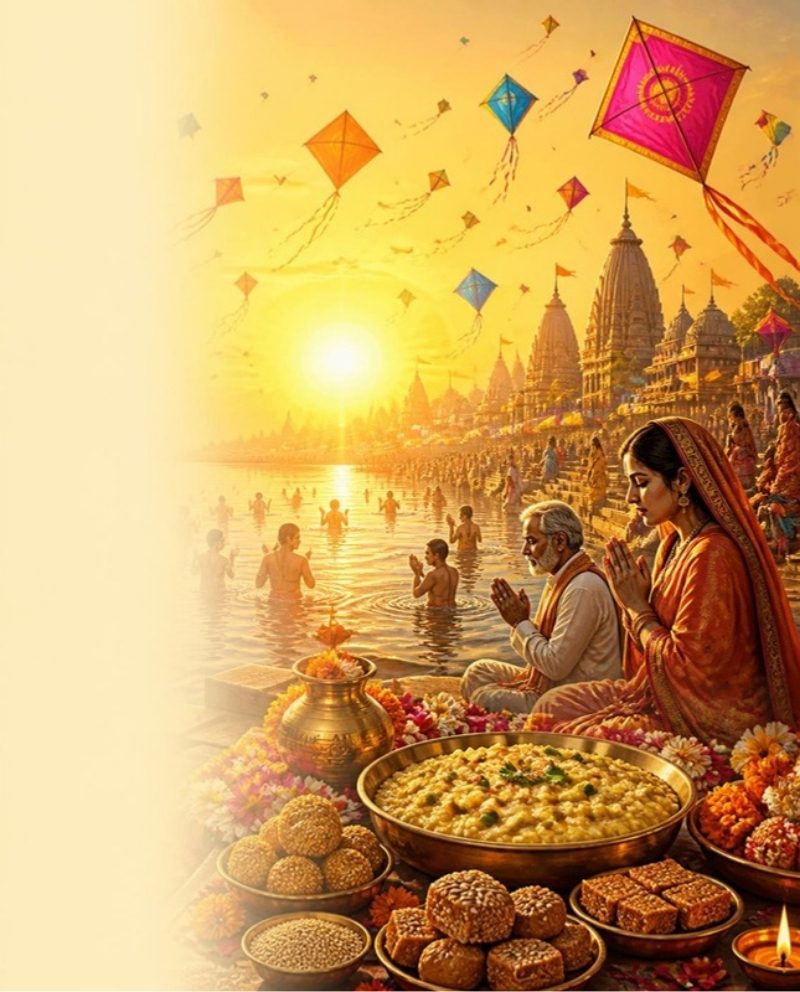
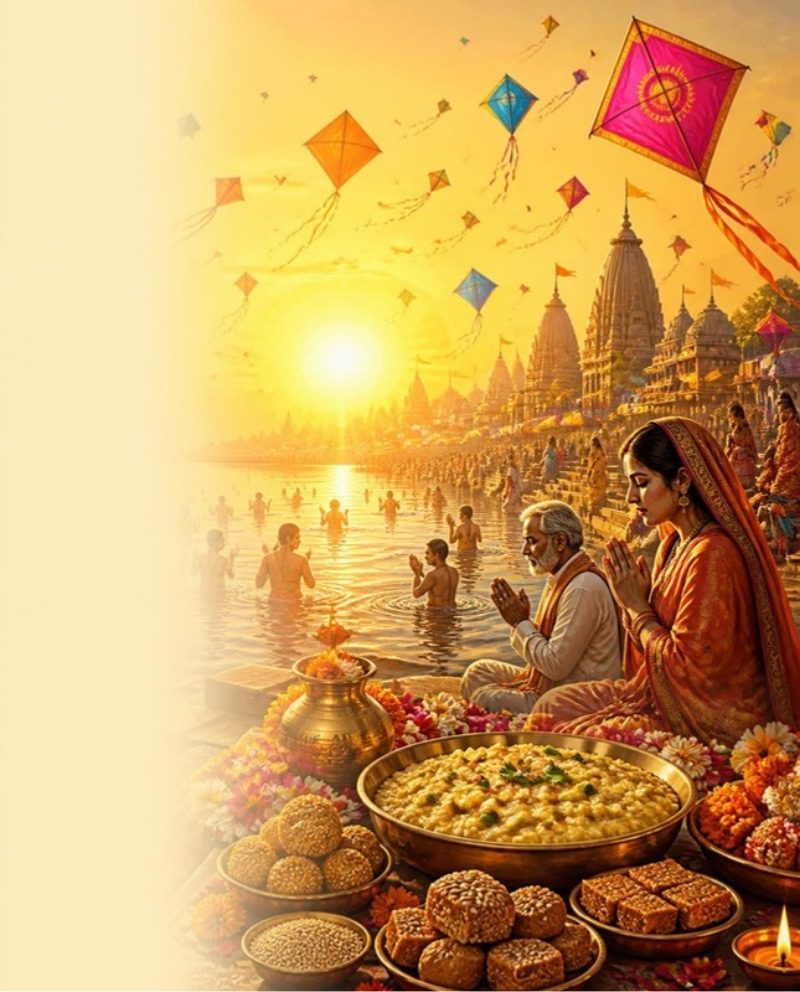
It is above all a harvest festival and a festival of giving. The winter crop is coming in, the days are growing longer, and across India people bathe in rivers at dawn, worship the Sun, and give — sesame and jaggery, khichdi, blankets and warm clothes. Sesame (til) and jaggery (gur) are at the heart of the day: warming food for the cold season, and a sign of sweetness and closeness, as in the Marathi greeting 'tilgul ghya, goad goad bola' — take this sesame-jaggery and speak sweetly.
Few festivals take so many names. It is Pongal in Tamil Nadu, Uttarayan with its skies full of kites in Gujarat, Maghi in Punjab after the bonfires of Lohri, Magh or Bhogali Bihu in Assam, Poush Sankranti in Bengal with the great bath at Gangasagar, Khichdi in Uttar Pradesh and Bihar, and Sankranti in Karnataka, Andhra Pradesh and Telangana. The customs differ, but the sun, the harvest and the sharing are the same everywhere.
The story of Makar Sankranti
In the Mahabharata, Bhishma, wounded and lying on his bed of arrows, chose not to leave his body until the Sun had turned north. Blessed with the power to choose the time of his death, he waited through the war for Uttarayana, and passed away on the eighth day of the bright half of Magha, now kept as Bhishma Ashtami. His waiting made Uttarayana a symbol of a good and peaceful passing.
The Puranas tell that Surya, the Sun, visits his son Shani, the lord of Makara, at this time — a reminder that even strained relationships can be renewed. Bengal's Gangasagar tradition remembers that on Sankranti the Ganga, brought down by King Bhagiratha, reached the ocean at Sagar island and purified the ashes of the sixty thousand sons of King Sagara. A popular legend also says that Vishnu ended the asuras' terror on this day and buried their heads beneath Mount Mandara.
Makar Sankranti puja vidhi, step by step
A simple observance at home. Customs differ greatly between regions — Pongal, Bihu, Lohri and Uttarayan each have their own way — so follow your family's tradition where it differs.
What you need
- Water in a copper vessel (lota) for arghya to the Sun, with red flowers, akshat and a little kumkum
- Til (sesame) for the bath water and for daan
- Til-gur sweets — ladoos, chikki, revdi or gajak
- Khichdi ingredients (rice and urad or moong dal) — cooked and offered, or given raw as daan
- Warm clothes or blankets to give
- A diya and incense
When to do the puja
Sankranti has a punya kaal, a window of time after the Sun enters Makara, for the bath and daan. When the Sun enters Makara after sunset, many traditions keep the festival and its punya kaal on the next day. Exact times change by year and city — check the Panchang for your city. See the Panchang for your city.
Steps
- Bathe at dawn. Bathe in a river or at home, adding a few sesame seeds to the water.
- Offer arghya to the Sun. Facing the rising sun, slowly pour water from the copper lota with flowers and akshat, reciting the arghya mantra or the Gayatri.
- Worship and recite. Light a lamp, worship Surya, Vishnu or your family deity, and recite the Aditya Hridayam or a Surya stotra if you can.
- Give. Give sesame, jaggery, khichdi, grain, warm clothes or blankets to those in need. Daan is the heart of the day.
- Share sweetness. Eat and share til-gur sweets and khichdi with family and neighbours. In the afternoon, many families fly kites.
Offerings & food: Til-gur ladoo, khichdi, chuda-dahi, revdi, gajak
Mantras for Makar Sankranti
Arghya to the Sun
एहि सूर्य सहस्रांशो तेजोराशे जगत्पते ।
अनुकम्पय मां भक्त्या गृहाणार्घ्यं दिवाकर ॥
ehi sūrya sahasrāṃśo tejorāśe jagatpate |
anukampaya māṃ bhaktyā gṛhāṇārghyaṃ divākara ||
Come, O Sun of a thousand rays, mass of radiance, lord of the world; be gracious to me and accept this arghya offered with devotion, O maker of the day.
Surya mantra
ॐ घृणिः सूर्याय नमः
oṃ ghṛṇiḥ sūryāya namaḥ
Om — salutations to Surya, the radiant one.
Japakusuma — salutation to the Sun
जपाकुसुमसङ्काशं काश्यपेयं महाद्युतिम् ।
तमोऽरिं सर्वपापघ्नं प्रणतोऽस्मि दिवाकरम् ॥
japākusumasaṅkāśaṃ kāśyapeyaṃ mahādyutim |
tamo'riṃ sarvapāpaghnaṃ praṇato'smi divākaram ||
I bow to the maker of the day, red as the hibiscus flower, son of Kashyapa, of great brilliance, the enemy of darkness and destroyer of all sins.
Full text with meaning →Makar Sankranti across India
Pongal in Tamil Nadu (4-day harvest festival), Lohri in Punjab (eve-of celebration), Magh (Bhogali) Bihu in Assam, Uttarayan in Gujarat (kite festival), Khichdi in Uttar Pradesh
- Tamil Nadu
- Pongal, over four days: Bhogi (clearing out the old), Thai Pongal (rice boiled with milk and jaggery until it overflows, offered to the Sun), Mattu Pongal (honouring cattle) and Kaanum Pongal (visiting family).
- Gujarat
- Uttarayan: rooftops and skies filled with kites from dawn to dusk, with undhiyu and chikki.
- Punjab and Haryana
- Lohri bonfires on the eve, with rewri, peanuts and popcorn offered to the fire; Maghi on the day, with a dip and the mela at Muktsar.
- Assam
- Magh (Bhogali) Bihu: community feasts, meji bonfires at dawn, and pitha and laru.
- West Bengal
- Poush Sankranti: pithe-puli sweets, and the Gangasagar Mela, where lakhs of pilgrims bathe where the Ganga meets the sea.
- Maharashtra
- Tilgul is exchanged with 'tilgul ghya, goad goad bola', and married women hold haldi-kunku gatherings.
- Karnataka, Andhra Pradesh and Telangana
- Ellu-bella (sesame, jaggery, coconut and peanuts) is shared in Karnataka; in Andhra and Telangana the festival runs over Bhogi, Sankranti and Kanuma, with rangoli (muggulu) and Haridasu singers.
- Uttar Pradesh and Bihar
- Khichdi: khichdi is cooked and given; in Bihar chura-dahi with tilkut is the festival meal. Large melas gather at Prayagraj and at the Gorakhnath temple.
- Kerala
- Makaravilakku at Sabarimala, when the Makara Jyothi is seen at the end of the pilgrimage season.
Prayers to recite
Do’s and don’ts
Do
- Donate warmly to the needy
- Rise before sunrise for the holy dip
- Chant Surya mantras
Avoid
- Avoid non-vegetarian food on this day
- Don't ignore charity — it is central to the day
Temples to visit for Makar Sankranti


Frequently asked questions
When is Makar Sankranti in 2026?
Makar Sankranti 2026 falls on Wednesday, 14 January 2026 (Sun enters Capricorn (Makar Rashi)). Dates are for New Delhi and may differ by a day in other places.
Makar Sankranti 2027 kab hai?
Makar Sankranti 2027 Friday, 15 January 2027 ko hai. Apne shahar ki sahi tithi ke liye Panchang dekhein.
मकर संक्रांति 2027 कब है?
मकर संक्रांति 2027 शुक्रवार, 15 जनवरी 2027 को है। अपने शहर की सही तिथि और मुहूर्त के लिए पंचांग देखें।
When is Makar Sankranti in 2027?
Makar Sankranti 2027 falls on Friday, 15 January 2027 (Sun enters Capricorn (Makar Rashi)). Dates are for New Delhi and may differ by a day in other places.
When is Makar Sankranti in 2028?
Makar Sankranti 2028 falls on Saturday, 15 January 2028 (Sun enters Capricorn (Makar Rashi)). Dates are for New Delhi and may differ by a day in other places.
Why is Makar Sankranti celebrated?
Marks the sun's transition into Capricorn, the start of the sun's northward journey (Uttarayana). One of the few Hindu festivals that follows the sun, so it falls on 14 or 15 January every year.
How is Makar Sankranti celebrated?
Early morning holy dip in Ganga, Yamuna, or any sacred river. Donation of til (sesame), gur (jaggery), warm clothes and khichdi. Flying colourful kites — most vividly in Gujarat and Rajasthan. Preparing til-gur sweets and khichdi. Sun worship facing east at sunrise.
What is offered or eaten on Makar Sankranti?
Til-gur ladoo, khichdi, chuda-dahi, revdi, gajak
When is Makar Sankranti in 2027?
Friday, 15 January 2027. The Sun enters Makara at about 8:57 pm IST on 14 January; because this is after sunset, the bath, daan and festival are kept on 15 January in most of North India. Check the Panchang for your city.
Why does Makar Sankranti fall on a fixed date?
Because it follows the Sun, not the Moon. It marks the Sun's entry into sidereal Makara, which happens on 14 or 15 January. Over the centuries the date is slowly moving later — about one day every 70 years or so.
Is Makar Sankranti the winter solstice?
Not any more. Astronomically the Sun turns north at the winter solstice, around 21 December. Because the traditional calendar follows the sidereal zodiac, the Sun's entry into Makara now comes about three weeks after the solstice; the two coincided many centuries ago. Tradition still keeps Uttarayana from Makar Sankranti.
Why are til and gur eaten on Makar Sankranti?
Sesame and jaggery are warming, nourishing foods for the cold season, and sesame is traditionally offered in daan and to the ancestors at this time. Sharing them is also a sign of friendship — 'take this sweetness and speak sweetly'.
Are Pongal, Lohri and Bihu the same festival as Makar Sankranti?
They belong to the same harvest season and the Sun's move into Makara, but each is a festival in its own right with its own customs. Lohri is kept on the evening before Sankranti; Pongal and Magh Bihu usually fall on the same day or close to it.
 15 Jan2027
 11 Feb2027
 13 Feb2027
 6 Mar2027