Nanak was born in 1469 at Rai Bhoe di Talwandi, now Nankana Sahib in Pakistan, to Mehta Kalu, a village accountant, and Mata Tripta. The janamsakhis, the stories of his life, tell of a thoughtful child who questioned empty ritual — refusing, for instance, to wear the sacred thread unless it was made of compassion and contentment.
ੴ ਸਤਿ ਨਾਮੁ ਕਰਤਾ ਪੁਰਖੁ ਨਿਰਭਉ ਨਿਰਵੈਰੁ“There is One God; Truth is His name; the Creator, without fear, without hate…”The Mool Mantar, opening of the Guru Granth Sahib
As a young man he worked as a storekeeper for the Nawab at Sultanpur Lodhi, where his sister Nanaki lived. There, one morning, he went to bathe in the Vein river and disappeared for three days. When he returned, his first words were: "There is no Hindu, there is no Musalman" — all are one before God.
The udasis
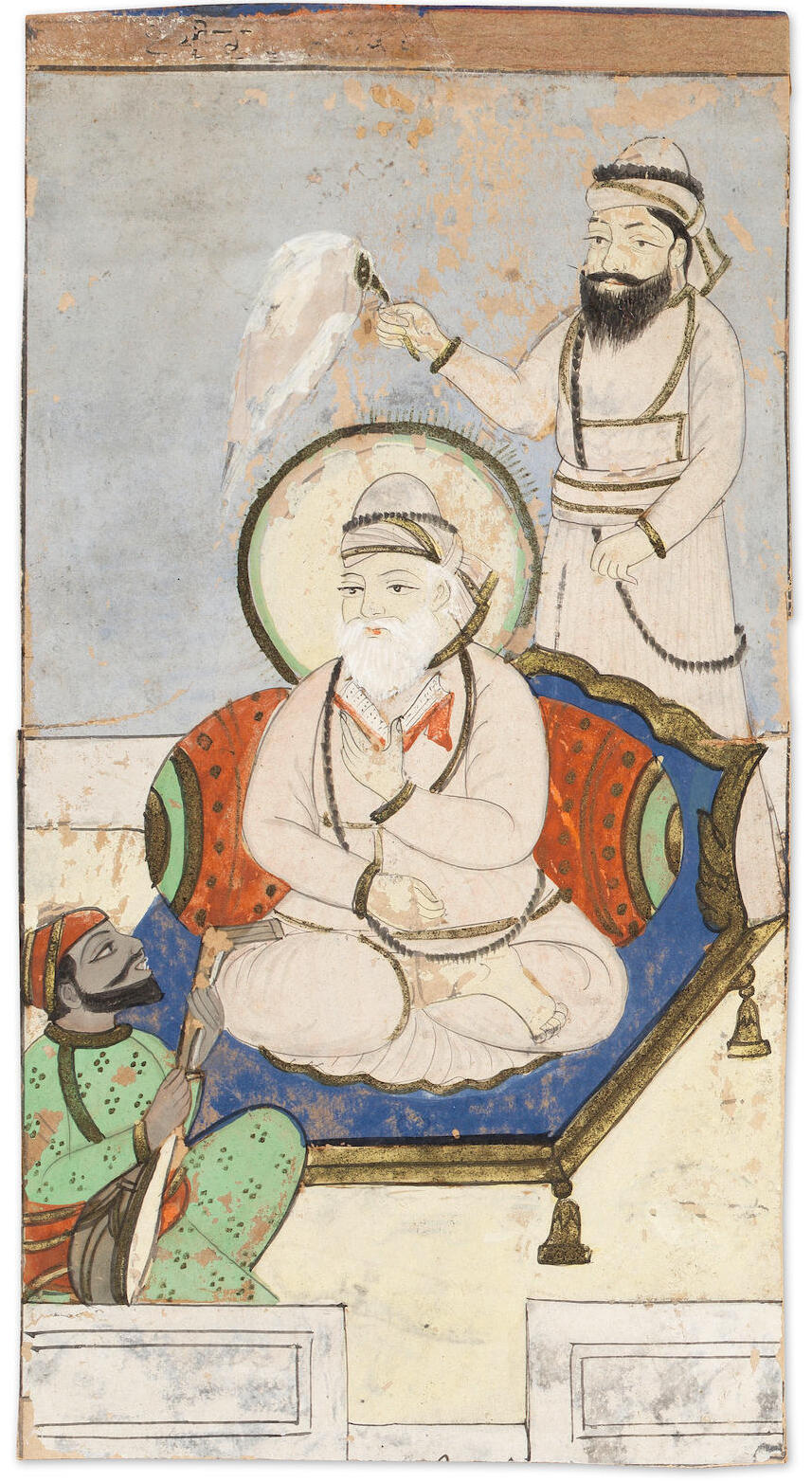
For over twenty years Guru Nanak travelled on long journeys, the udasis, with his companion Bhai Mardana, a Muslim musician who played the rabab while the Guru sang his hymns. Tradition takes them east to Assam and Bengal, south to Sri Lanka, north into the Himalayas and west to Mecca and Baghdad, talking with yogis, sufis, pandits and qazis.
Kartarpur
In his last years he settled at Kartarpur on the Ravi, where he farmed his own land. Here he set the pattern of Sikh life: naam japna (remembering God's name), kirat karni (honest work) and vand chhakna (sharing with others). Everyone, whatever their caste, sat together in the pangat to eat at the free kitchen, the langar.
Teachings and succession
His 974 hymns, including the morning prayer Japji Sahib, are in the Guru Granth Sahib. He taught that God is one, formless and present in all; that liberation comes through devotion, truthful living and grace rather than ritual or renunciation; and that women deserve honour — "from woman, kings are born". Passing over his own sons, he chose his devoted disciple Lehna, whom he renamed Angad, as the second Guru. He died at Kartarpur in 1539.
How they are remembered
Guru Nanak Jayanti (Gurpurab) on Kartik Purnima is celebrated with akhand path, prabhat pheris, kirtan and langar worldwide. The Kartarpur Corridor, opened in 2019, lets pilgrims from India visit Gurdwara Darbar Sahib in Pakistan, where he spent his last years.
Ekatmata Stotra · Stanza 16
Named in Stanza 16 of the Ekatmata Stotra — the bhakti revolution — Ravidas to Guru Gobind Singh.
देवलो रविदासश्च कबीरश्च गुरुर्नानकः।
नरसी-तुलसीदासौ गुरुगोविन्दसिंहकः॥
Sources: Wikipedia: Guru Nanak · Wikipedia: Japji Sahib. Written afresh for The Hindu Book; corrections welcome at [email protected].