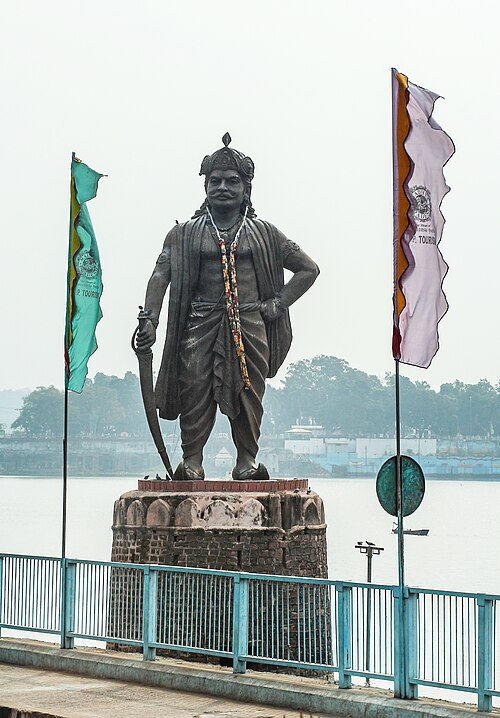
Jakanachari — Amarashilpi, the “immortal sculptor” — is the hero of one of Karnataka's best-loved legends. Popular tradition says he was born at Kridapura, today's Kaidala near Tumakuru, in the 12th century, and that his chisel created the intricate temples built under the Hoysala kings, above all the Chennakeshava temple at Belur.
Belur's Chennakeshava temple, begun under the Hoysala king Vishnuvardhana in 1117, took over a century to complete — the work popular tradition places in the hands of Jakanachari.History behind the legend
He belongs to legend rather than to recorded history. No Hoysala inscription mentions him, and the temples themselves name other sculptors. Yet his story has been told for centuries, and the Ekatmata Stotra places him among the great lives of Bharat as a symbol of India's tradition of temple art and the craftsmen who created it.
The legend
As the story is told in Karnataka, young Jakana was a gifted sculptor who left his wife and home to wander in search of perfection in his art. He came to work on the Hoysala temples, where his skill made him the leading master.
Years later a young sculptor arrived at Belur and remarked that a newly finished image of Keshava had a flaw. Jakana, sure of his craft, vowed to cut off his right hand if this proved true. When the image was coated with sandal paste, the paste stayed wet at one spot; the stone there was cut open and found to hold a hollow containing a live frog, with sand and water. Jakana kept his vow. The young man turned out to be his own son, Dankanachari, born after he left home.
In the story's ending, Jakana returned to his native Kridapura and built a temple to Keshava there; when it was finished, his hand was restored — and so the village, tradition says, became Kai-dala, “where the hand was regained”. The Chennakeshava temple at Kaidala is pointed out as that shrine.
What history records
The Belur temple was commissioned by the Hoysala king Vishnuvardhana and consecrated in 1117. Unlike many temple builders of the time, Hoysala sculptors often signed their work, and inscriptions at Belur, Halebidu and Somanathapura preserve names such as Dasoja and his son Chavana, Mallitamma, Kedaroja, Masanitamma and others. None is Jakanachari.
Scholars therefore treat Jakanachari as a folk figure, whose story may preserve memories of the real family workshops, in which skills passed from father to son, but who cannot be identified with any one documented artist.
A craft tradition
The Hoysala style, worked in soft soapstone that hardens over time, is known for star-shaped plans, bands of friezes and figures of extraordinary detail, especially the bracket figures of dancers (madanikas) at Belur. The legend of the hidden frog captures what people felt about this art: that its masters could see into the stone itself.
Like the legend of Vishwakarma, the divine architect, the story of Jakanachari gives a single face to a collective achievement. Generations of masons, carvers and polishers — many of them from hereditary craft communities who still honour Vishwakarma — worked for over a century to finish these temples, and Jakanachari's name has become a way of honouring all of them.
How they are remembered
Jakanachari's story inspired the 1964 Kannada film Amarashilpi Jakanachari, and his name is honoured in Karnataka's awards and observances for traditional sculptors. Since 2023 the Hoysala temples of Belur, Halebidu and Somanathapura have been a UNESCO World Heritage Site. In remembering him, Karnataka remembers the countless artists who gave India its temples.
Ekatmata Stotra · Stanza 19
Named in Stanza 19 of the Ekatmata Stotra — from Kālidāsa to Tyāgarāja.
भरतो मुनिरीशानः कालिदासो महाकविः।
भोजो जक्कणसूरदासस्त्यागराजो रसखानकः॥
Sources: Wikipedia: Jakanachari · Wikipedia: Chennakeshava Temple, Belur · whc.unesco.org/en/list/1670. Written afresh for The Hindu Book; corrections welcome at [email protected].