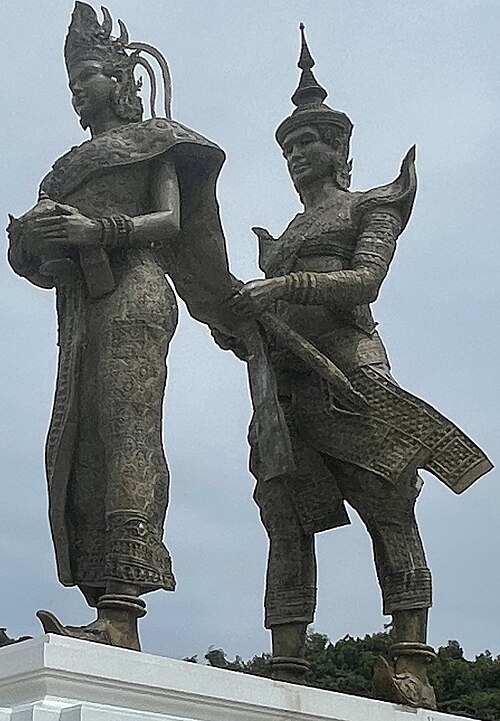
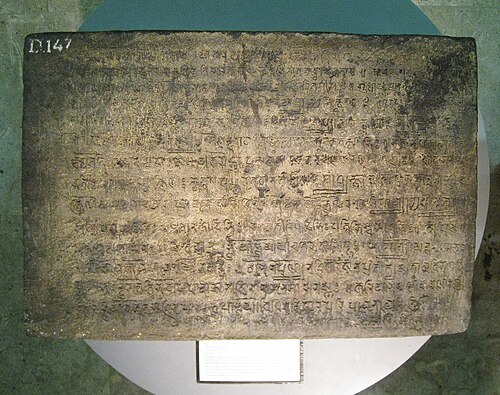
Kambu Swayambhuva is known not from Indian texts but from the stone inscriptions of the Khmer kings of Cambodia, written in Sanskrit between the 9th and 13th centuries. In them, Kambu appears as a sage, “self-born” (svayambhuva), from whom the royal line descended. His descendants were the Kambuja, “those born of Kambu”, and the land they ruled became Kambujadesha — the source of the names Kampuchea and Cambodia.
The Sanskrit inscription of the Baksei Chamkrong temple at Angkor, dated 947 CE, traces the Khmer kings back to the sage Kambu Svayambhuva and the celestial maiden Mera.Baksei Chamkrong inscription, Angkor (10th century)
He is a figure of legend, not history. But the legend matters, because it shows how deeply the kings of Angkor saw themselves as part of a wider Indian world of Sanskrit, Shiva and Vishnu, and the Ekatmata Stotra honours him as a symbol of that cultural bond.
The legend of Kambu and Mera
The best-known version of the story is found in the inscription of the Baksei Chamkrong temple at Angkor, set up in the reign of Rajendravarman II in the mid-10th century. It tells that Kambu Svayambhuva, a great sage, received from Shiva a celestial maiden named Mera as his wife. From their union came the solar line of Khmer kings. Some scholars have suggested that the name Mera may be connected with the word “Khmer”, though this is uncertain.
Kambu's legend sits alongside another origin story found in the region: that of the Brahmin Kaundinya and the Naga princess Soma. Khmer kings could claim descent from both, placing themselves in both the solar and lunar lines of Indian tradition.
Such legends were common in the region: rulers across Southeast Asia traced their lines to divine or semi-divine founders, often through a union between a holy man and a celestial or serpent bride.
Where did Kambu come from?
Scholars have long asked whether the name Kambu echoes an Indian people. Some connect it with the ancient Kambojas of north-west India, named in the Mahabharata and in Ashoka's edicts; others see Kambu as a purely local creation in Sanskrit dress. There is no agreement, and the inscriptions themselves present Kambu as a sage rather than an emigrant.
The Indian world of Angkor
From the early centuries CE, traders, Brahmins and Buddhist monks travelled between India and mainland Southeast Asia. Over time, Khmer rulers adopted Sanskrit as the language of royal inscriptions, Indian scripts, the worship of Shiva and Vishnu, and Indian ideas of kingship. They took names ending in -varman, as Pallava kings in South India did.
This culture reached its peak at Angkor. Angkor Wat, built in the 12th century under Suryavarman II and dedicated to Vishnu, is the largest religious monument in the world, and its galleries carve scenes from the Ramayana and Mahabharata, including the churning of the ocean. Khmer was the people's language, but Sanskrit was the language of the gods and kings, and the stories of Kambu belong to that Sanskrit world.
The Khmer kings also built temples to Shiva on mountain tops, installed lingas named after themselves and the god together, and kept Brahmin priests at court, some of whom traced their own lineages to India. Kambu's legend was one way the kings expressed this identity: their first ancestor was a sage blessed by Shiva himself.
How they are remembered
Every time the name Cambodia is spoken, Kambu's legend is recalled. The Ramayana lives on in Cambodia as the Reamker, performed in classical dance, and Angkor Wat appears on the national flag. Kambu stands for the centuries in which India and Southeast Asia shared gods, stories and a sacred language.
Ekatmata Stotra · Stanza 21
Named in Stanza 21 of the Ekatmata Stotra — early sages and empire-builders.
अगस्त्यः कम्बुरुचिरः कौण्डिन्यो राजेन्द्रचोल:।
अशोकः पुष्यमित्रश्च खारवेलः प्रकीर्तिताः॥
Sources: Wikipedia: Kambu Swayambhuva · Wikipedia: Baksei Chamkrong · Wikipedia: Name of Cambodia. Written afresh for The Hindu Book; corrections welcome at [email protected].