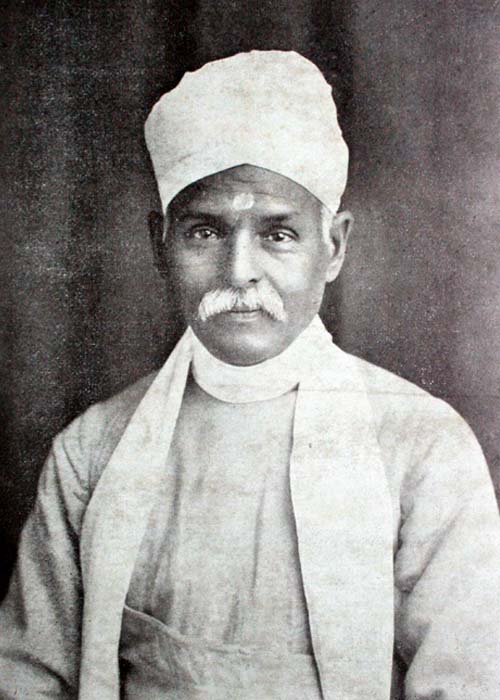
Madan Mohan Malaviya was born on 25 December 1861 in Allahabad, into a family of Sanskrit scholars whose ancestors had come from Malwa — hence the name Malaviya. His father, Brajnath, was a reciter of the Bhagavata. Malaviya studied at Allahabad and graduated from Calcutta University, then became a schoolteacher in Allahabad.
सत्यमेव जयते"Truth alone triumphs." — the Upanishadic phrase that Malaviya helped popularise as a national motto; it now stands beneath India's state emblem.Mundaka Upanishad 3.1.6
A speech at the second session of the Indian National Congress in Calcutta in 1886 brought him to notice, and the Raja of Kalakankar invited him to edit the Hindi daily Hindustan. He later qualified in law and practised at the Allahabad High Court, but public life increasingly claimed him. Gandhi and others called him Mahamana, "the great-souled".
Editor and legislator
Malaviya was one of the great journalists of his age. Besides editing Hindustan and the Indian Union, he founded the Hindi weekly Abhyudaya in 1907 and the English daily The Leader in 1909, and later chaired the board of the Hindustan Times. He campaigned for Hindi in the Devanagari script to be used in the courts and offices of the United Provinces, a demand granted in 1900.
He served in the provincial and Imperial Legislative Councils from 1902 to 1920, where he was a sharp critic of government policy, and later in the Central Legislative Assembly. He was elected president of the Congress in 1909 and 1918, and again in 1932 and 1933, though in those years he was arrested before he could preside. In 1931 he attended the Second Round Table Conference in London with Gandhi.
Banaras Hindu University
His great work was the Banaras Hindu University. Malaviya believed that India needed a university where Sanskrit, philosophy and the arts would be studied alongside engineering, medicine and the sciences. From 1904 onwards he travelled the country collecting funds — from maharajas and merchants, and from ordinary people who gave a few rupees. He joined forces with Annie Besant, whose Central Hindu College at Varanasi became the university's nucleus, and with the Maharaja of Darbhanga.
The Banaras Hindu University Act was passed in 1915, and the foundation stone was laid by the Viceroy, Lord Hardinge, on 4 February 1916. Malaviya served as vice-chancellor for about two decades from 1919, building it into one of the largest residential universities in Asia, with one of India's earliest engineering colleges.
Lawyer of the condemned
Though he had given up regular legal practice, Malaviya returned to court in 1923 to argue the appeal of the men condemned after the Chauri Chaura violence of 1922. Of the 172 sentenced to death by the lower court, all but nineteen were spared on appeal. He also worked for the protection of the Ganga at Haridwar and for cow protection, and helped found the Seva Samiti and the Indian scout movement.
Debate
Malaviya was a leader of the Hindu Mahasabha in the 1920s while remaining in the Congress, and supported shuddhi and Hindu organisation. Some historians see this Hindu-centred politics as contributing to communal polarisation in that decade; his admirers stress that he consistently worked for Hindu–Muslim cooperation in the national movement. Personally he was strictly orthodox in observance, yet in his later years he supported temple entry for Dalits and gave them initiation into sacred mantras on the banks of the Ganga.
How they are remembered
Malaviya died in Varanasi on 12 November 1946, months before Independence. BHU remains his living monument. He was awarded the Bharat Ratna posthumously in 2014, and his birthday, 25 December, is celebrated at the university every year. His ideal of an education both modern and rooted in Indian tradition continues to be debated and admired.
Ekatmata Stotra · Stanza 28
Named in Stanza 28 of the Ekatmata Stotra — the Grand Old Men and the gentle revolutionaries.
दादाभाई-गोपबन्धुः तिलको गान्धि-महर्षिकः।
मालवीय: भारती च सप्तर्षयो नरोत्तमाः॥
Sources: Wikipedia: Madan Mohan Malaviya · Wikipedia: Banaras Hindu University. Written afresh for The Hindu Book; corrections welcome at [email protected].