Pushyamitra was the commander-in-chief (senani) of Brihadratha, the last ruler of the Maurya dynasty that Chandragupta and Ashoka had made the greatest power in India. By the early 2nd century BCE the Mauryan state had weakened, and Greek rulers from Bactria were pressing into the north-west.
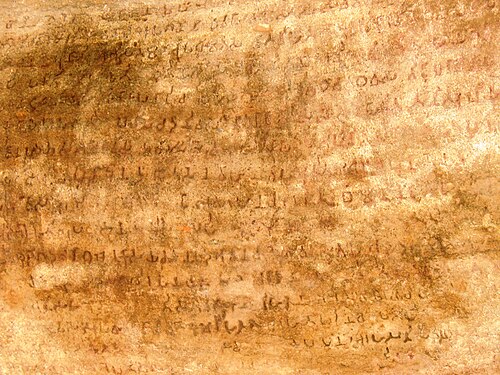
द्विरश्वमेधयाजिनः सेनापतेः पुष्यमित्रस्य“…of Senapati Pushyamitra, performer of two horse sacrifices.”Ayodhya inscription of Dhanadeva, a descendant of Pushyamitra (c. 1st century BCE)
Around 185 BCE, according to Bana's Harshacharita, Pushyamitra killed Brihadratha in front of the army while the king was reviewing the troops, and took the throne. The Puranas say that he ruled for thirty-six years and that the dynasty he founded, the Shungas, lasted for about 112 years.
Defending the north
Several sources speak of Greek (Yavana) invasions in this period. The grammarian Patanjali, generally thought to have lived in Pushyamitra's time, gives as an example of recent events the sentence “the Yavana besieged Saketa”. The Yuga Purana also describes Yavana armies reaching Pataliputra before withdrawing.
Kalidasa's play Malavikagnimitram, about Pushyamitra's son Agnimitra, includes a letter from Pushyamitra relating that the sacrificial horse, guarded by his grandson Vasumitra, was seized by Yavana horsemen on the bank of the Sindhu river and recovered after a battle. Historians debate which river is meant and how much of this reflects real events, but together these sources suggest that the Shungas fought to keep the Greeks out of the Ganga plain.
The Shunga kingdom was smaller than the Mauryan empire it replaced. It centred on Magadha and the middle Ganga valley, reaching west to Vidisha in Malwa, where Agnimitra served as viceroy. Several neighbouring regions, including Kalinga and the Deccan, went their own way in this period.
Return of Vedic ritual
Pushyamitra is remembered as a patron of Vedic religion. An inscription found at Ayodhya, set up by his descendant Dhanadeva, calls him the performer of two Ashvamedhas, the royal horse sacrifice. Patanjali's Mahabhashya contains the line “here we perform the sacrifice for Pushyamitra”, which some scholars read as a hint that the grammarian himself served as a priest at his court. Interestingly, Pushyamitra kept the title Senapati and is not known to have called himself king.
A debated record
Later Buddhist texts, especially the Divyavadana, accuse Pushyamitra of destroying monasteries and putting a price on the heads of monks. Many historians treat these accounts with caution: they were written long afterwards, and they use stock images also applied to other rulers. Archaeology complicates the picture, since major Buddhist monuments at Bharhut and Sanchi were enlarged and decorated in the Shunga period, and a gateway inscription at Bharhut is dated “in the reign of the Shungas”. The question remains open, and scholars weigh the evidence differently.
The question of motive is also debated. Some historians see Pushyamitra's seizure of power as the act of an ambitious general; others see it as a response to a weakened state that could no longer defend its borders. Both views may hold some truth. What is not in doubt is that his dynasty kept the core of the old empire intact for over a century.
How they are remembered
The Shunga age saw the rise of the stone gateways and railings of Bharhut and Sanchi, the grammar of Patanjali, and a revival of Vedic and Bhagavata worship that paved the way for later Hindu dynasties. Pushyamitra is remembered as the soldier who held the heartland together when the Mauryan empire fell.
Ekatmata Stotra · Stanza 21
Named in Stanza 21 of the Ekatmata Stotra — early sages and empire-builders.
अगस्त्यः कम्बुरुचिरः कौण्डिन्यो राजेन्द्रचोल:।
अशोकः पुष्यमित्रश्च खारवेलः प्रकीर्तिताः॥
Sources: Wikipedia: Pushyamitra Shunga · Wikipedia: Shunga Empire · Wikipedia: Dhanadeva-Ayodhya inscription. Written afresh for The Hindu Book; corrections welcome at [email protected].