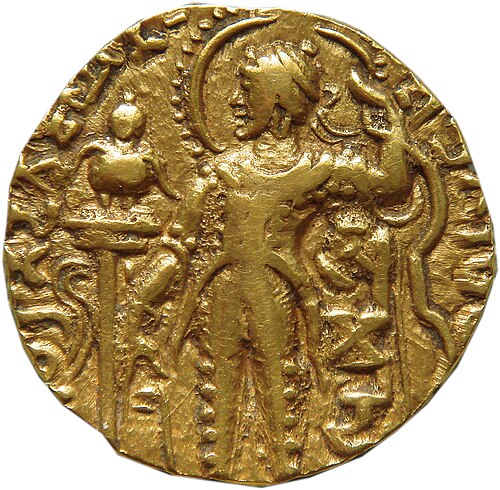
In the late fifth and early sixth centuries, the Hunas — the people the Romans and Persians knew as the White Huns or Hephthalites, and whose Indian branch historians now call the Alchon Huns — broke into north-western India. Under their kings Toramana and Mihirakula they overran the Punjab and pushed into central India, and the Gupta empire, already weakening, could not hold them. An inscription of Mihirakula's fifteenth regnal year found at Gwalior shows how deep into central India his rule had once reached.
The pillar inscription says that homage was paid at his feet even by the famous king <em>Mihirakula</em>, whose head had never before bowed to anyone but the god Shiva.Summary of the Sondani pillar inscription, Mandsaur, 6th century
The ruler remembered for breaking their power is Yashodharman, king of Dashapura, today's Mandsaur in western Madhya Pradesh. He belonged to the Aulikara family, a line of local rulers in Malwa who had earlier served or allied with the Guptas. Almost all we know of him comes from three inscriptions found at and near Mandsaur.
The Sondani pillars
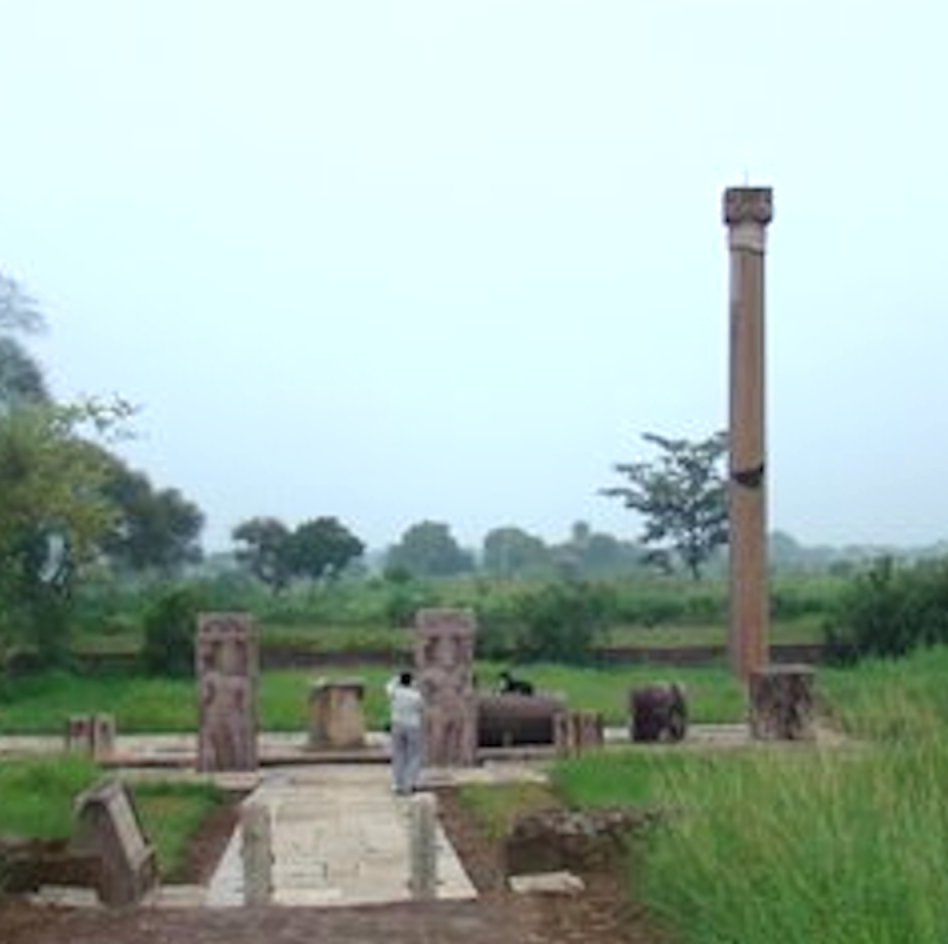
At Sondani, a village just outside Mandsaur, stand the remains of two great monolithic sandstone pillars, each about 12 metres high when whole, crowned with bell capitals. Both carry the same Sanskrit poem, composed by a poet named Vasula, in praise of Yashodharman's victories. It claims that he ruled lands that even the Guptas had never held and that the Hunas had never entered — from the Lauhitya (the Brahmaputra) to the western ocean, and from the Himalaya to Mount Mahendra in the south.
Historians treat this description of a vast empire as court poetry; there is no other evidence that his rule reached so far. But the core claim — a decisive defeat of Mihirakula — is widely accepted.
The victory over Mihirakula
The battle is usually dated to around 528 CE. The Chinese pilgrim Xuanzang, writing a century later, preserved a separate tradition that Mihirakula, a persecutor of Buddhists, was defeated and captured by a king named Baladitya — usually identified with the Gupta ruler Narasimhagupta — and then released. Some historians think Yashodharman and the Gupta king acted together or one after the other; others see two separate defeats. Either way, after about 530 the Hunas ceased to be a threat to the heartland, and Mihirakula retreated to Kashmir and the north-west.
The Mandsaur stone inscription
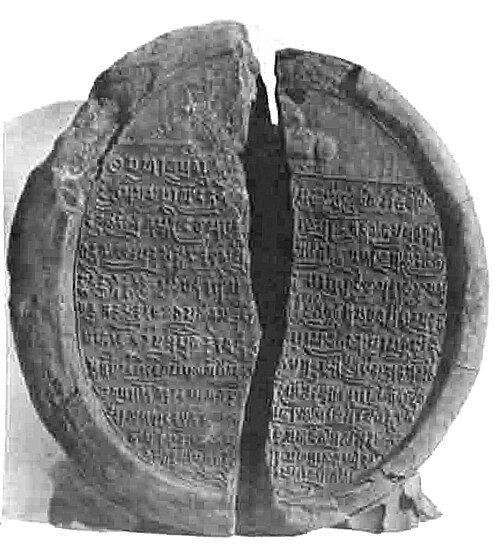
A third inscription, a stone tablet dated to the Malava year 589 — that is, 532 CE — records the building of a well at Dashapura by a local official naming Yashodharman together with a ruler called Vishnuvardhana, who may be the same king or a successor. It calls the king a samrat and rajadhiraja, and its date is the firmest point in his chronology. The Malava era used here is the same era later known as Vikrama Samvat.
A short-lived empire
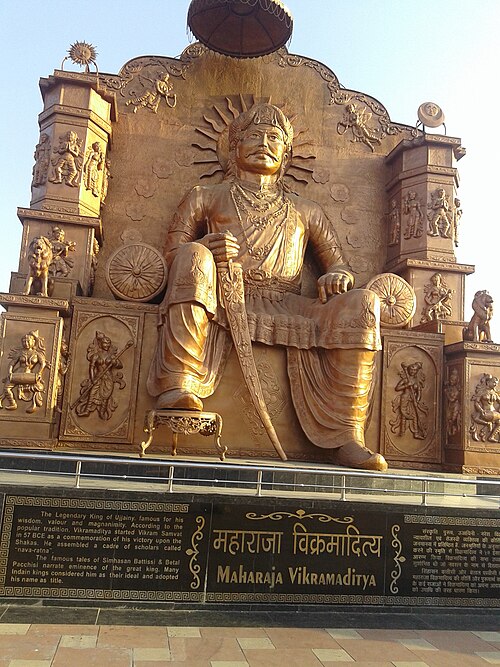
Nothing is known of how Yashodharman's reign ended, and no successor of comparable power followed him. Within a generation his empire had vanished from the record. Some modern writers have identified him with the legendary King Vikramaditya who drove out foreign invaders, but this remains speculation.
How they are remembered
Yashodharman's reign was brief, but it marked the end of the Huna threat to the Gangetic heartland and preserved the culture of the Gupta age into the time of Harsha. The Sondani pillars still stand in fragments beside the fields of Mandsaur — the stone witnesses of a king who would otherwise be forgotten. The Ekatmata Stotra honours him as nripottama, "best of kings".
Ekatmata Stotra · Stanza 23
Named in Stanza 23 of the Ekatmata Stotra — those who held the line against invasion.
लाचित्-भास्करवर्मा च यशोधर्मा नृपोत्तमः।
कृष्णदेवश्च ललितादित्यो वीराः प्रकीर्तिताः॥
Sources: Wikipedia: Yashodharman · Wikipedia: Mandsaur pillar inscription of Yashodharman · Wikipedia: Mihirakula. Written afresh for The Hindu Book; corrections welcome at [email protected].