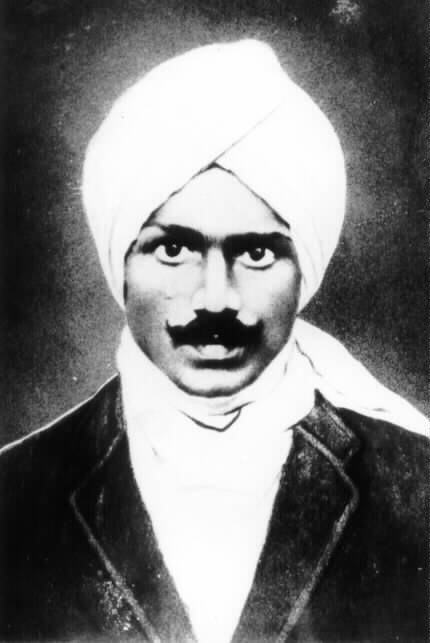
C. Subramania Bharati was born in 1882 at Ettayapuram in the Tirunelveli region. His gift for verse was so striking that at the age of eleven the poets of the Ettayapuram court gave him the title Bharati, "blessed by Saraswati". He lost his mother young and his father at sixteen.
யாமறிந்த மொழிகளிலே தமிழ்மொழி போல் இனிதாவது எங்கும் காணோம்“Of all the languages we know, we have found none as sweet as Tamil.”Subramania Bharati
He spent some years in Varanasi, studying Sanskrit and Hindi and taking up the turban that became his trademark. Back in Madras he worked as a journalist on the Tamil daily Swadesamitran and edited the weekly India, writing fiercely for swaraj.
Exile in Pondicherry
Threatened with arrest in 1908, Bharati escaped to Pondicherry, then French territory, where he lived for ten years in poverty. There he met Sri Aurobindo and V. V. S. Aiyar and wrote much of his greatest poetry. He returned to British India in 1918, was briefly arrested, and settled in Madras.
Poet of a new Tamil
Bharati wrote in simple, vivid Tamil that ordinary people could sing. His works include Kuyil Pattu (the song of the cuckoo), Kannan Pattu, songs to Krishna as friend, mother, lover and child, and Panchali Sabatham, retelling Draupadi's humiliation and vow as a call to the nation. His patriotic songs, such as "Endru thaniyum indha sudhandhira thagam" ("When will this thirst for freedom end?"), stirred the freedom movement.
Reformer
He demanded education and freedom for women — his "new woman", pudhumai penn, walks with head held high — and attacked caste and untouchability; he is said to have invested a young Dalit man with the sacred thread. In 1921 he was struck by the elephant of the Parthasarathy temple in Triplicane, which he used to feed; he never fully recovered and died that September, aged thirty-eight.
How they are remembered
Tamils call him Mahakavi and Bharathiyar. His house in Triplicane and his birthplace at Ettayapuram are memorials, and Bharathiar University in Coimbatore bears his name. His songs are sung at every Tamil celebration.
Ekatmata Stotra · Stanza 28
Named in Stanza 28 of the Ekatmata Stotra — the Grand Old Men and the gentle revolutionaries.
दादाभाई-गोपबन्धुः तिलको गान्धि-महर्षिकः।
मालवीय: भारती च सप्तर्षयो नरोत्तमाः॥
Sources: Wikipedia: Subramania Bharati · Wikipedia: Panchali Sabatham. Written afresh for The Hindu Book; corrections welcome at [email protected].