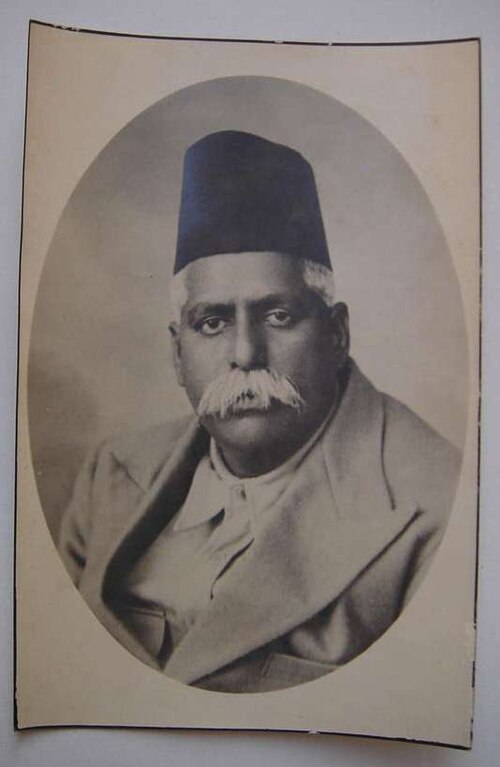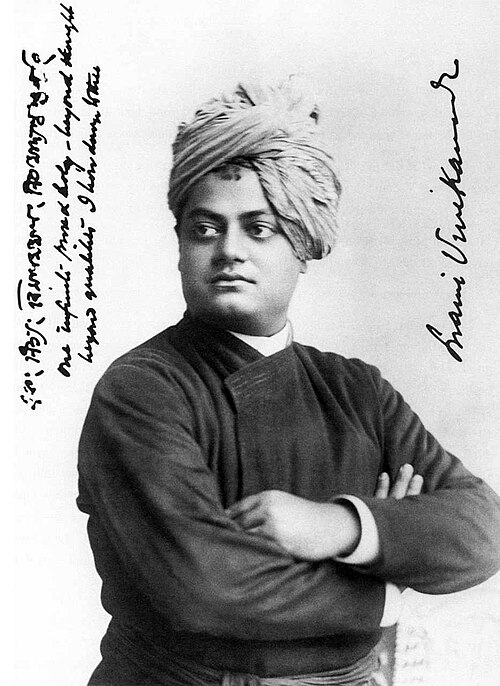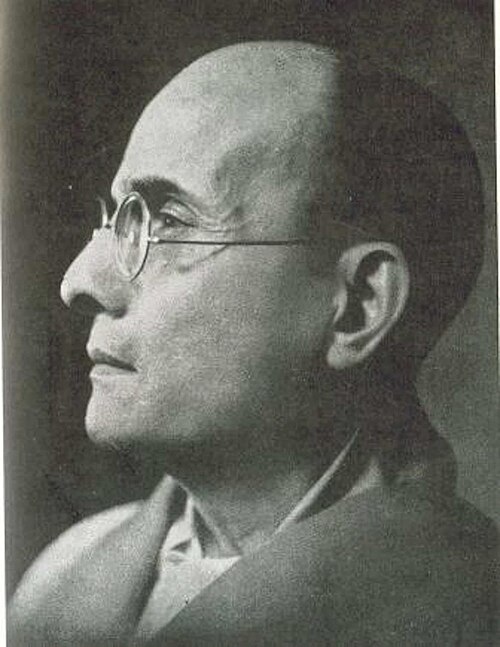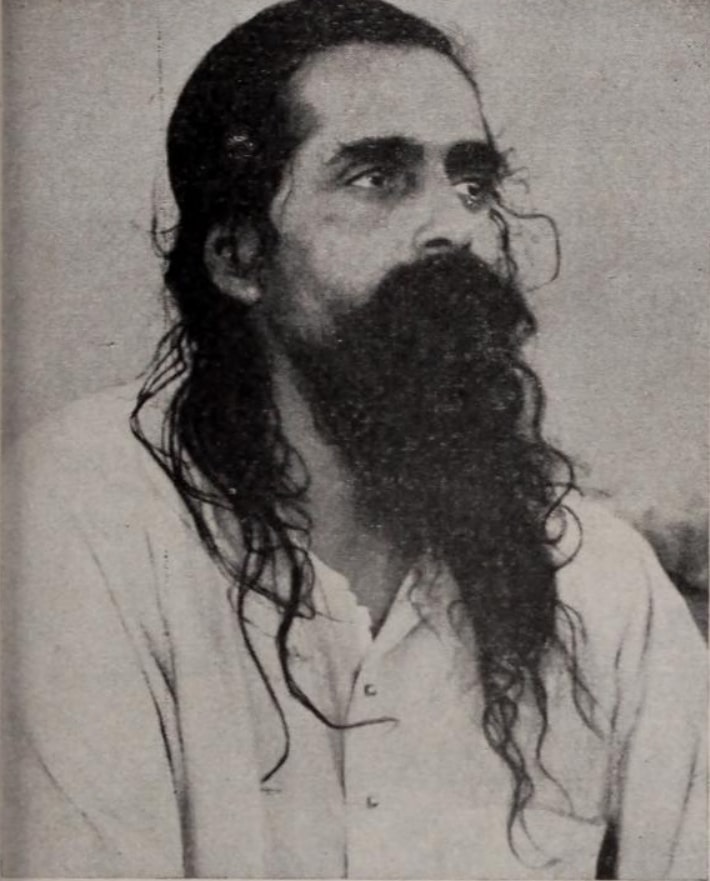
Madhav Sadashiv Golwalkar was born on 19 February 1906 at Ramtek, near Nagpur, the only surviving child of a schoolteacher, Sadashiv Golwalkar, and his wife Lakshmibai. A gifted student, he studied science at Banaras Hindu University, taking his B.Sc. and then an M.Sc. in zoology around 1926–28. He began research in marine biology at Madras but had to give it up for lack of funds.
His students at Banaras Hindu University called the young zoology lecturer <em>Guruji</em> — and as "Shri Guruji" he was known for the rest of his life.The origin of his popular name, as recorded by his biographers
Returning to BHU as a lecturer in zoology around 1931, he won his students' affection with his learning and his readiness to help them; they called him "Guruji", and the name stayed with him for life. At Banaras he came into contact with the Rashtriya Swayamsevak Sangh, founded in Nagpur in 1925 by Dr K. B. Hedgewar.
The seeker
Golwalkar took a law degree at Nagpur, but his deepest pull was spiritual. In 1936 he went to the Ramakrishna Mission ashram at Sargachhi in Bengal to serve Swami Akhandananda, a direct disciple of Sri Ramakrishna, and in 1937 received initiation from him. After Akhandananda's death he returned to Nagpur, drew close to Hedgewar, and was soon given senior responsibilities. On his deathbed in June 1940 Hedgewar named Golwalkar, then thirty-four, as his successor as sarsanghchalak, the organisation's head.
Leadership and the 1948 ban
Golwalkar led the RSS for thirty-three years. He kept it out of the Quit India movement of 1942, a decision critics have long cited against the organisation and which supporters defend as protecting a young body from suppression. After Nathuram Godse assassinated Mahatma Gandhi on 30 January 1948, the government banned the organisation and arrested Golwalkar with thousands of members. No court held the organisation responsible for the murder, but Home Minister Sardar Patel wrote to Golwalkar that its leaders' speeches had helped create the communal atmosphere in which the tragedy became possible. The ban was lifted in July 1949, after negotiations, a satyagraha by members, and the adoption of a written constitution committing the organisation to cultural work.
Institutions
In the decades that followed, Golwalkar travelled the country almost without pause, and members founded bodies in many fields with his encouragement — among them the student body Akhil Bharatiya Vidyarthi Parishad (1949), the Vanvasi Kalyan Ashram for tribal communities (1952), the trade union Bharatiya Mazdoor Sangh (1955), the Saraswati Shishu Mandir schools, and the Vishva Hindu Parishad (1964), in whose founding he took a leading part. Members also helped found the Bharatiya Jana Sangh in 1951, though Golwalkar personally kept his distance from electoral politics. He was known for personal austerity and an ascetic, Vedantic outlook.
His writings and the criticism
We or Our Nationhood Defined (1939), published under his name, argued that India was a Hindu nation. Historians and political scientists — among them Christophe Jaffrelot and Ramachandra Guha — have criticised it sharply for passages that held up Nazi Germany's treatment of Jews as a lesson in national unity and that said minorities could live in India only as wholly subordinate to the Hindu nation, without citizens' rights. In 2006 the RSS stated that the book was an abridged rendering of Babarao Savarkar's Marathi Rashtra Mimamsa and did not represent Golwalkar's mature views; scholars continue to debate its authorship and influence.
Bunch of Thoughts (1966), a compilation of his speeches, sets out his ideals of Hindu society and national character. Critics point above all to a chapter that named Muslims, Christians and communists as "internal threats". Supporters argue that his later statements on national unity and on all citizens as children of one motherland should also be read, and that the books reflect the anxieties of their time.
How they are remembered
Golwalkar died of cancer in Nagpur on 5 June 1973. For members he remains the great consolidator who turned a young organisation into a nationwide movement, and a spiritual guide in the Ramakrishna–Vivekananda tradition. For his critics he is the principal ideologue of an exclusive idea of the nation. Both judgements make him one of the most influential and contested figures of twentieth-century India.
Ekatmata Stotra · Stanza 30
Named in Stanza 30 of the Ekatmata Stotra — the architects of the modern Sangh.
केशव: माधवश्चैव पूज्यौ धर्मप्रबोधकौ।
यौ प्रचण्ड-तपो-दीप्तौ राष्ट्र-जागरण-कृतौ॥
Sources: Wikipedia: M. S. Golwalkar · Wikipedia: We or Our Nationhood Defined · Wikipedia: Bunch of Thoughts. Written afresh for The Hindu Book; corrections welcome at [email protected].