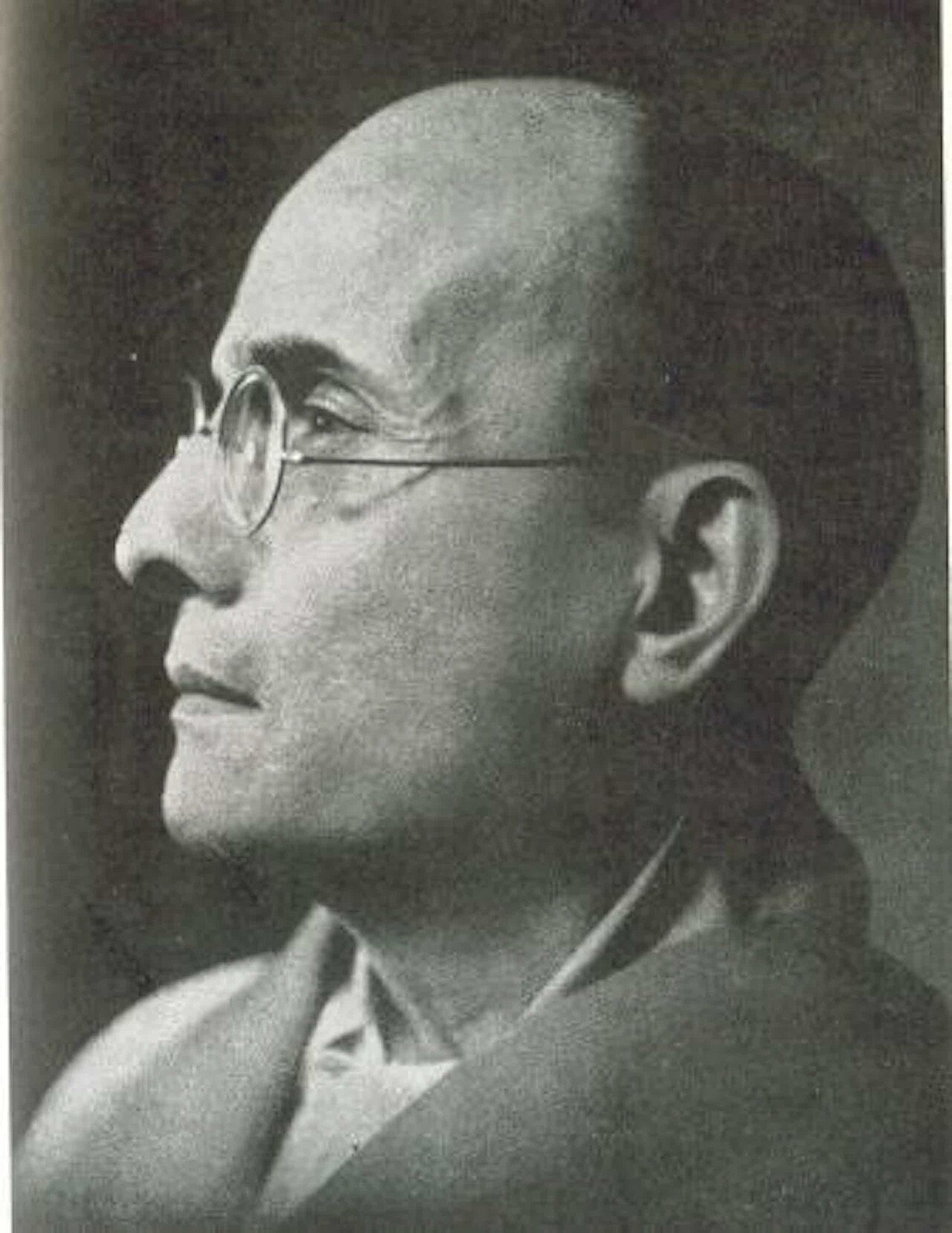
Vinayak Damodar Savarkar was born in 1883 at Bhagur near Nashik. As a schoolboy he vowed to fight for India's freedom, and with his brother Ganesh he founded a secret society that became Abhinav Bharat. He studied at Fergusson College in Pune, where he led a bonfire of foreign cloth in 1905.
ने मजसी ने परत मातृभूमीला, सागरा प्राण तळमळला“Ne Majasi Ne Parat Matrubhumila” — “O sea, take me back to my motherland.”His Marathi poem written in Brighton, 1909
In 1906 he went to London to study law, living at India House. There he wrote The Indian War of Independence of 1857, recasting the "Mutiny" as a national rising; the book was banned in India before it was even published, and circulated secretly among revolutionaries.
Marseilles and the Cellular Jail
After the assassination of the Nashik collector Jackson in 1909, linked to Abhinav Bharat, Savarkar was arrested in London. Being shipped to India in 1910, he squeezed through a porthole at Marseilles and swam ashore, but was recaptured on French soil — a case later argued at the Hague tribunal. He was sentenced to two life terms, fifty years, and sent in 1911 to the Cellular Jail in the Andamans, where he endured hard labour in solitary conditions.
From prison he submitted several petitions for clemency to the British government; he was moved to Ratnagiri in 1921–24 and released on condition that he stay out of politics. These petitions are a major point of debate — critics see surrender, admirers see a tactic to get free and keep working.
Hindutva and social reform
In Ratnagiri jail he wrote Hindutva: Who is a Hindu? (1923), defining a Hindu as one who regards Bharat as both fatherland and holy land. In Ratnagiri he also campaigned hard against untouchability: inter-caste dining, temple entry and the Patit Pavan temple open to all. He wrote poetry, plays and an epic, and coined Marathi words such as mahapaur (mayor) and digdarshak (director).
Hindu Mahasabha and later years
After his restrictions were lifted in 1937 he led the Hindu Mahasabha until 1943, opposing the Congress's Quit India movement and urging Hindus to join the armed forces. After Gandhi's assassination in 1948 he was tried with the conspirators and acquitted for lack of evidence; the Kapur Commission of 1969 later criticised his circle. He ended his life in 1966 by voluntary fasting (atmarpan).
How they are remembered
Admirers call him Swatantryaveer and his cell in the Cellular Jail is now a national memorial; Port Blair's airport bears his name and his portrait hangs in Parliament. He also remains one of the most contested figures in Indian history, and debates over his record continue.
Ekatmata Stotra · Stanza 29
Named in Stanza 29 of the Ekatmata Stotra — the fierce voices — Netaji to Ambedkar.
सुभाषश्च प्रणवानन्दः सावरकरस्ठक्करबापा।
अम्बेडकरो नारायण-गुरुर्वन्द्या जयन्ति धर्मिणः॥
Sources: Wikipedia: Vinayak Damodar Savarkar · Wikipedia: Cellular Jail. Written afresh for The Hindu Book; corrections welcome at [email protected].