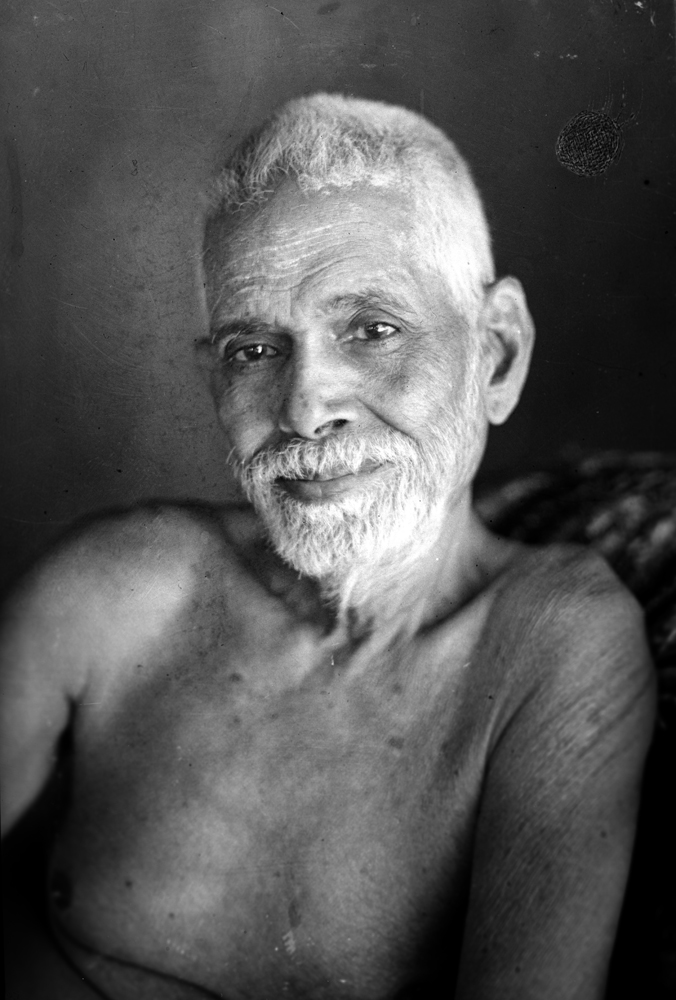
Venkataraman Iyer was born in 1879 at Tiruchuzhi near Madurai, the son of a lawyer. An ordinary schoolboy, he heard the name of the holy hill Arunachala and felt strangely moved. In 1896, at sixteen, alone in his uncle's house in Madurai, he was seized by a sudden fear of death. He lay down, imagined his body dead, and asked what remained. He realised, he later said, that he was not the body but the deathless Self — and that realisation never left him.
நான் யார்?“Who am I?”The question at the heart of his teaching, and the title of his first written instructions
Six weeks later he left home with a note saying he was going in search of his Father, and travelled to Tiruvannamalai, at the foot of Arunachala. He never left it again.
Years of silence
For years he lived in deep absorption — first in the temple of Arunachaleswara, in an underground vault so neglected that insects ate at his legs, then in the Virupaksha cave and Skandashram on the hill. He spoke little; seekers who came wrote down his answers. His mother eventually joined him, and after her death in 1922 the ashram grew up around her shrine at the foot of the hill: Sri Ramanasramam.
Self-enquiry
Ramana taught atma-vichara, self-enquiry. When any thought arises, he said, ask "To whom does this thought come?" The answer is "to me"; then ask "Who am I?" and trace the "I" back to its source. The ego dissolves, and the Self, pure awareness, shines alone. He also honoured devotion: surrender to God, he said, leads to the same end. His teaching is summed up in short works such as Nan Yar and Upadesa Saram.
A teacher to the world
Paul Brunton's book A Search in Secret India (1934) made him known in the West, and seekers came from across the world — among them the novelist Somerset Maugham. He treated everyone alike, sharing the ashram food, cutting vegetables in the kitchen, and loving the animals around him. He died of cancer in 1950; at that moment, witnesses said, a bright star was seen moving slowly over Arunachala.
How they are remembered
Sri Ramanasramam at Tiruvannamalai welcomes visitors from all over the world, especially for Karthigai Deepam, when a great flame is lit on Arunachala. His Jayanti is celebrated in December or January.
Ekatmata Stotra · Stanza 28
Named in Stanza 28 of the Ekatmata Stotra — the Grand Old Men and the gentle revolutionaries.
दादाभाई-गोपबन्धुः तिलको गान्धि-महर्षिकः।
मालवीय: भारती च सप्तर्षयो नरोत्तमाः॥
Sources: Wikipedia: Ramana Maharshi · Wikipedia: Self-enquiry (Ramana Maharshi). Written afresh for The Hindu Book; corrections welcome at [email protected].