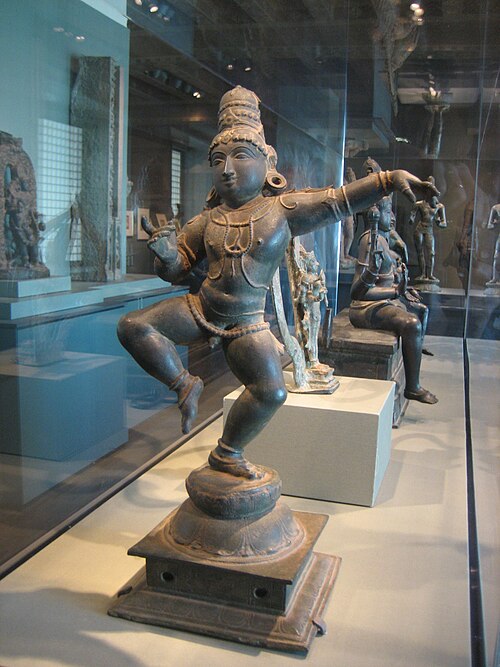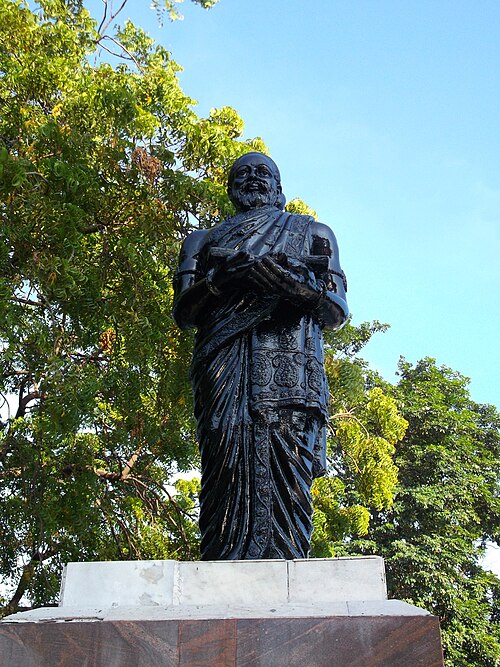
The Alvars — the name is usually explained as “those immersed” in God — were twelve poet-saints devoted to Vishnu, who lived in the Tamil country between roughly the 6th and 9th centuries. Like the Shaiva Nayanmars of the same age, they went from shrine to shrine singing in Tamil, and their songs made temples such as Srirangam and Tirupati centres of a passionate, personal devotion.
மார்கழித் திங்கள் மதி நிறைந்த நன்னாளால்“In the month of Margazhi, on this good day of the full moon…”Andal, Tiruppavai, verse 1 — sung in temples and homes every morning of Margazhi
Their verses, about four thousand in all, were gathered in the 10th century by the teacher Nathamuni into the Naalayira Divya Prabandham, “the four thousand sacred compositions”. Sri Vaishnavas honour this collection as equal to the Sanskrit Vedas, and the great teacher Ramanuja built his philosophy on the foundation the Alvars laid.
The twelve
Tradition lists the twelve as Poigai, Bhutam and Pey (the first three), Tirumalisai, Nammalvar, Madhurakavi, Kulasekhara, Periyalvar, Andal, Tondaradippodi, Tiruppan and Tirumangai. The order and dates given in the traditional biographies are much earlier than historians accept, and scholars place most of the twelve between the 6th and 9th centuries.
A well-loved story tells how the first three Alvars, sheltering from a storm in a narrow porch at Tirukkoyilur, felt a fourth presence crowding them in the dark — Vishnu himself — and each burst into a hundred verses lighting a lamp of devotion.
Nammalvar and Andal
Nammalvar, “our own Alvar”, is counted the greatest. Tradition says he sat in silent meditation under a tamarind tree at Tirukkurugur (Alvartirunagari) until the poet Madhurakavi came to him. His Tiruvaymoli, a cycle of 1,102 verses, is called the Tamil Upanishad and is the heart of the collection.
Andal, the only woman among the twelve, was found as an infant in a tulsi garden at Srivilliputhur and raised by Periyalvar. She longed to marry Vishnu alone, and tradition says she merged with Ranganatha at Srirangam. Her thirty-verse Tiruppavai is sung across South India each Margazhi (December–January), and is among the best-loved devotional poems in Tamil.
Kings and outsiders
The Alvars came from every rank. Kulasekhara was a Chera king of Kerala who, tradition says, left his throne to sing of Rama and of the Lord of Tirupati. Tirumangai was a chieftain and warrior. Tiruppan belonged to the Panar community of minstrels, who were then kept outside the temple; the story goes that a priest of Srirangam, told by the Lord, carried him in on his shoulders, and he sang his ten verses before the deity.
The Divya Desams
The 108 shrines of Vishnu praised in their hymns are the Divya Desams, from Badrinath in the Himalayas to Srirangam and Tirumala, though most lie in Tamil Nadu and Kerala. In many of these temples the Prabandham is recited daily, and at Srirangam the Araiyar singers still act out its verses with music and gesture during the winter festival.
Sri Vaishnava teachers wrote long commentaries on the Prabandham in a rich mix of Tamil and Sanskrit called Manipravalam, and images of the Alvars are worshipped in Vishnu temples beside the deity, honoured as the Lord's own companions.
How they are remembered
The Alvars put Tamil devotional poetry on the same footing as Sanskrit scripture and showed that the Lord answers love, whoever offers it. Their influence runs through Ramanuja's Sri Vaishnavism, and from there through Ramananda into the bhakti movement of North India. Margazhi mornings, when girls draw kolams and sing the Tiruppavai, keep Andal's voice alive in millions of homes.
Ekatmata Stotra · Stanza 15
Named in Stanza 15 of the Ekatmata Stotra — from Buddha and Mahāvīra to Basaveśvara.
बुद्धो जिनश्च गोरक्षो वल्लुवस्तिरुनामकः।
नायन्माराश्च आळ्वाराः कम्बन्बसवेश्वरौ तथा॥
Sources: Wikipedia: Alvars · Wikipedia: Naalayira Divya Prabandham · Wikipedia: Andal · britannica.com/topic/Alvar. Written afresh for The Hindu Book; corrections welcome at [email protected].