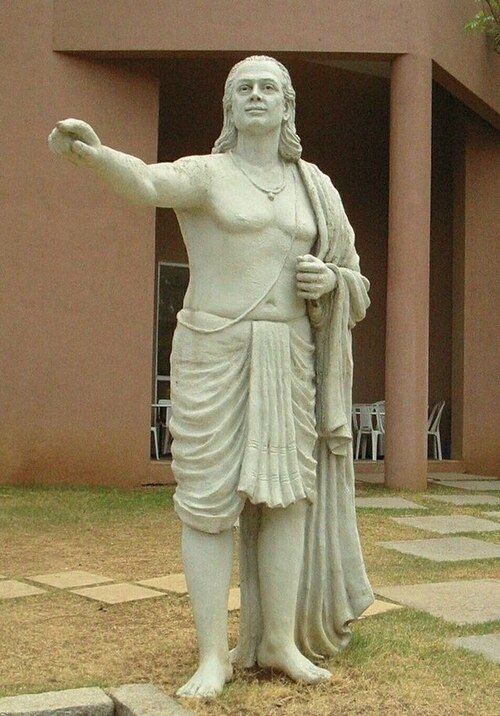
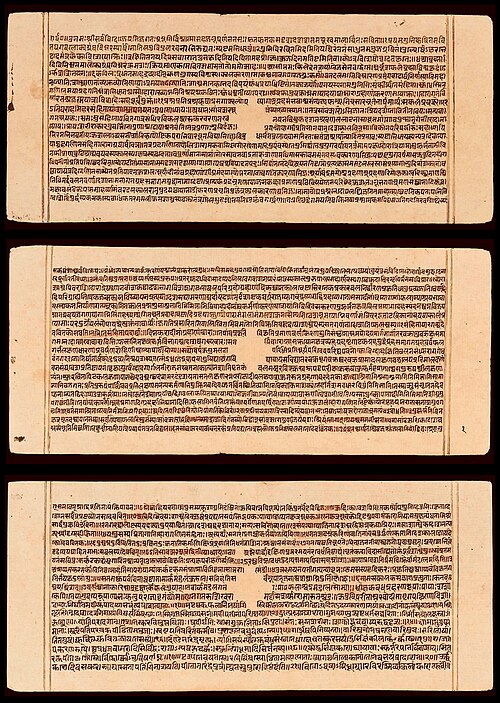
Bhaskara — called Bhaskara II to distinguish him from a seventh-century namesake — was born in 1114 at Vijjadavida in the Sahyadri region, in a family of scholars; his father Maheshvara taught him mathematics and astronomy. He became head of the astronomical observatory at Ujjain, the leading centre of Indian mathematics.
He asks the reader: of a swarm of bees, the square root of half went to a jasmine bush, eight-ninths of the whole stayed behind, and two remained — one bee buzzing around a lotus in which its mate was trapped. How many bees were there? (Answer: 72.)A verse problem from Lilavati (paraphrased)
In 1150, at the age of thirty-six, he completed his great work, Siddhanta Shiromani, "crown of treatises".
Lilavati
The first part of the Siddhanta Shiromani, Lilavati, is a textbook of arithmetic, measurement and geometry written in graceful verse, full of problems about bees, peacocks, merchants and lovers. A popular legend says Bhaskara named it after his daughter, whose wedding hour was spoiled when a pearl fell into the water-clock, and wrote the book to console her. It was the standard mathematics textbook in India for centuries and was translated into Persian at Akbar's court.
Algebra and the chakravala
In Bijaganita, his algebra, Bhaskara worked with negative numbers, zero and surds, and perfected the chakravala ("cyclic") method for solving equations of the form Nx² + 1 = y² — a problem European mathematicians took up only in the seventeenth century. He also wrote that a number divided by zero is infinite, unchanged by adding or taking away.
Astronomy and early calculus
The astronomical parts, Grahaganita and Goladhyaya, treat planetary motion, eclipses and the sphere. In calculating the instantaneous motion of planets he used ideas close to the derivative and noted that a quantity is unchanged at its maximum — glimpses of differential calculus. An inscription of 1207 at Patan records a school founded by his grandson to teach his works.
How they are remembered
India named its second experimental satellite, launched in 1979, Bhaskara in honour of both astronomers of that name. Lilavati's verse problems are still used to make mathematics joyful in Indian classrooms.
Ekatmata Stotra · Stanza 25
Named in Stanza 25 of the Ekatmata Stotra — the six foundational minds.
कपिलः कणादश्च सुश्रुतश्चरकस्तथा।
भास्कराचार्यो वराहमिहिरस्तेजस्विनामहम्॥
Sources: Wikipedia: Bhāskara II · Wikipedia: Lilavati. Written afresh for The Hindu Book; corrections welcome at [email protected].