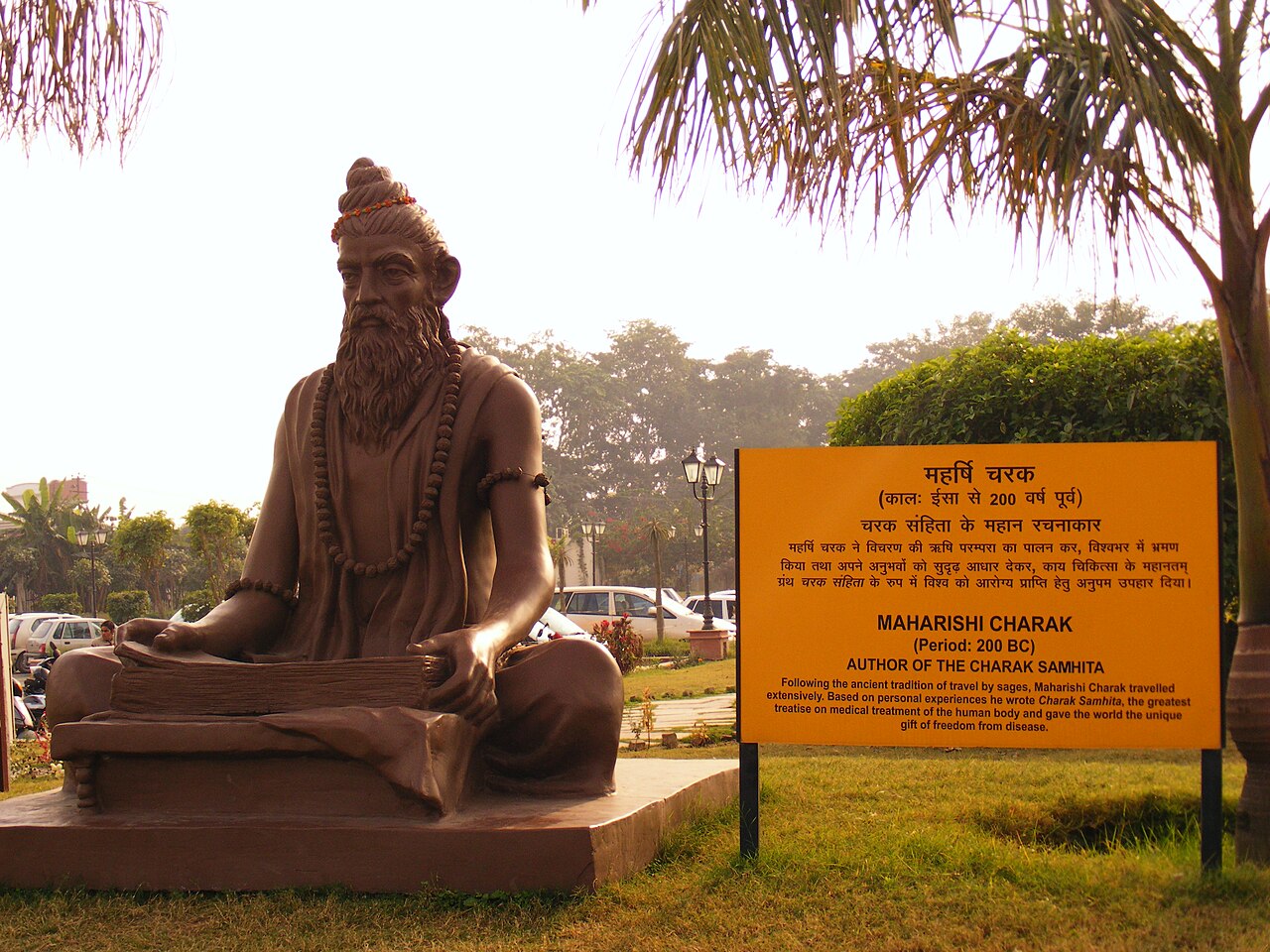
The Charaka Samhita presents itself as the teaching of the sage Atreya Punarvasu, written down by his disciple Agnivesha and later revised and enlarged by Charaka. Centuries afterwards a Kashmiri scholar, Dridhabala, completed missing chapters. Its date is debated; most scholars place Charaka's revision between the second century BCE and the second century CE. A Buddhist tradition makes him physician to the Kushan king Kanishka.
प्रयोजनं चास्य स्वस्थस्य स्वास्थ्यरक्षणमातुरस्य विकारप्रशमनं च“The purpose of this science is to protect the health of the healthy and to relieve the illness of the sick.”Charaka Samhita, Sutrasthana 30.26
With the Sushruta Samhita and Vagbhata's Ashtanga Hridaya, it is one of the three great classics of Ayurveda, the Brihat Trayi.
A complete medicine
The Samhita has eight sections and 120 chapters, covering the principles of health, diagnosis, anatomy, the senses, treatment, pharmacy and rejuvenation. It explains health as the balance of the three doshas — vata, pitta and kapha — and of the tissues and digestive fire, and describes hundreds of medicinal plants and preparations.
Prevention first
Charaka gives great weight to keeping well: a daily routine (dinacharya), adjusting food and habits to the seasons (ritucharya), moderation in eating, sleep and exercise, and not suppressing natural urges. He teaches that the mind matters as much as the body, and that wisdom, patience and right conduct are themselves medicine.
The physician's duty
The Samhita sets out a code for physicians, often compared to the Hippocratic oath: to work for the good of all living beings, to give the patient whole-hearted care even at risk to oneself, to keep the patient's confidences, and to keep learning throughout life. It also encourages debate and the testing of ideas by reason and experience.
How they are remembered
The Charaka Samhita is still the foundation of Ayurvedic study, and its lessons on routine, season and diet underlie much modern interest in Ayurveda. India's Ministry of AYUSH marks Dhanvantari Jayanti, on Dhanteras, as National Ayurveda Day.
Ekatmata Stotra · Stanza 25
Named in Stanza 25 of the Ekatmata Stotra — the six foundational minds.
कपिलः कणादश्च सुश्रुतश्चरकस्तथा।
भास्कराचार्यो वराहमिहिरस्तेजस्विनामहम्॥
Sources: Wikipedia: Charaka · Wikipedia: Charaka Samhita. Written afresh for The Hindu Book; corrections welcome at [email protected].