Sushruta is known only through the great medical treatise that bears his name, the Sushruta Samhita. In it he is the disciple of Divodasa Dhanvantari, king of Kashi, who teaches him surgery. Scholars think the core of the text took shape in the first millennium BCE and was revised over the following centuries; the version we have was edited by about the 3rd–4th century CE.
समदोषः समाग्निश्च समधातुमलक्रियः। प्रसन्नात्मेन्द्रियमनाः स्वस्थ इत्यभिधीयते॥“One whose doshas, digestion, tissues and functions are in balance, and whose self, senses and mind are content, is called healthy.”Sushruta Samhita, Sutrasthana 15.41
Where the Charaka Samhita focuses on internal medicine, the Sushruta Samhita is above all a book of shalya, surgery — the most detailed surgical text of the ancient world.
Surgery in detail
The Samhita describes more than a hundred surgical instruments, modelled on the beaks and jaws of animals and birds, and classifies operations into incision, excision, scraping, puncture, probing, extraction, drainage and suturing. It explains how to remove stones from the bladder, set fractures, treat wounds and deliver a baby in a difficult birth, and gives rules for cleanliness in the operating room.
The first plastic surgery
Its most famous passage describes rebuilding a nose with a flap of skin taken from the cheek — an operation needed because cutting off the nose was a common punishment. A similar method, using skin from the forehead, was still practised in India in the eighteenth century; a report of one such operation in Pune, published in London in 1794, helped launch modern plastic surgery in Europe. The text also describes couching for cataract.
Training the surgeon
Sushruta insisted that students practise before touching a patient: incisions on gourds and watermelons, puncturing on vessels filled with water, suturing on cloth and leather, and studying the body by dissection. He also set out the qualities of a good physician — knowledge, skill, purity and compassion.
How they are remembered
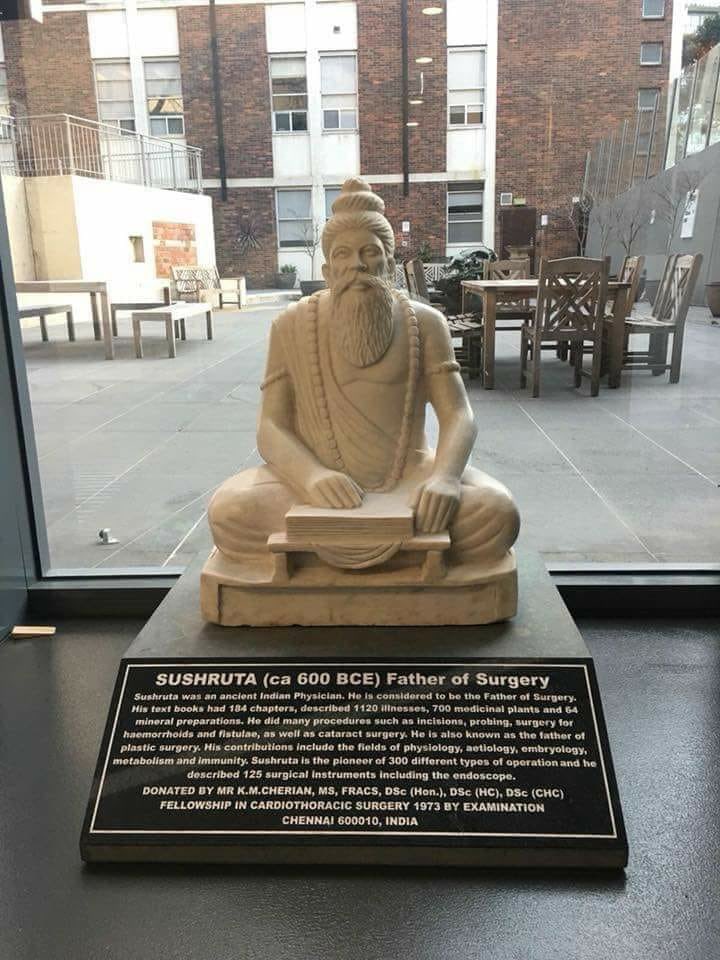
Surgeons around the world honour Sushruta as an early father of surgery; the Royal Australasian College of Surgeons in Melbourne displays his statue. His text remains central to Ayurvedic training in shalya tantra.
Ekatmata Stotra · Stanza 25
Named in Stanza 25 of the Ekatmata Stotra — the six foundational minds.
कपिलः कणादश्च सुश्रुतश्चरकस्तथा।
भास्कराचार्यो वराहमिहिरस्तेजस्विनामहम्॥
Sources: Wikipedia: Sushruta · Wikipedia: Sushruta Samhita. Written afresh for The Hindu Book; corrections welcome at [email protected].