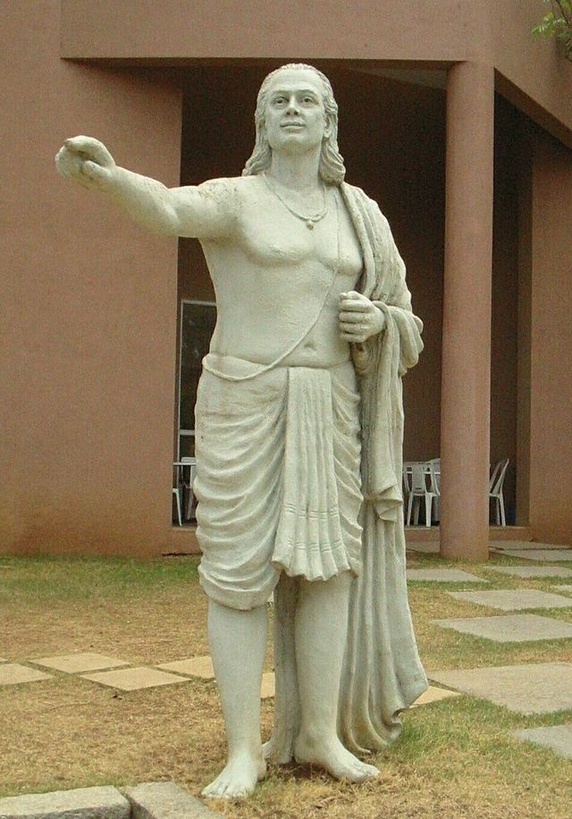
Almost everything we know of Aryabhata's life comes from a single verse in his own book. He tells us that when 3,600 years of the Kali Yuga had passed, he was twenty-three years old — which places his birth in 476 CE and the writing of the Aryabhatiya in 499 CE. He worked at Kusumapura, near Pataliputra, in the age of the Guptas.
चतुरधिकं शतमष्टगुणं द्वाषष्टिस्तथा सहस्राणाम्“Add four to one hundred, multiply by eight, and add sixty-two thousand: the result is approximately the circumference of a circle whose diameter is twenty thousand.”Aryabhatiya, Ganitapada 10 — giving π ≈ 3.1416
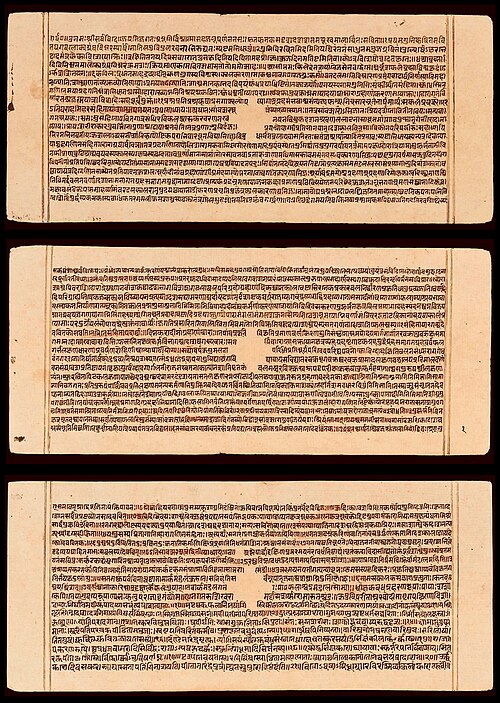
In just 121 compact Sanskrit verses he set out arithmetic, algebra, trigonometry and a complete system of astronomy. The book was studied and commented on for a thousand years across India, and through Arabic translations it reached the wider world.
The Aryabhatiya
The book has four parts. The Gitikapada sets out large units of time and a table of sines; the Ganitapada covers mathematics — square and cube roots, areas, progressions and equations; the Kalakriyapada deals with time and planetary motion; and the Golapada describes the celestial sphere. To pack numbers into verse he invented his own alphabetic notation, and his methods assume a decimal place-value system.
π, sines and equations
Aryabhata gave the ratio of circumference to diameter as 62,832 to 20,000 — that is, 3.1416 — and called it asanna, “approximate”, a word many scholars read as an awareness that the exact value cannot be written. His table of half-chords, jya, is the ancestor of the modern sine: the word passed through Arabic into Latin as sinus. He also gave a method, kuttaka, for solving indeterminate equations in whole numbers.
A turning Earth
In the Golapada he wrote that just as a man in a moving boat sees the trees on the bank move backwards, so the stars, though fixed, appear to move west because the Earth turns. He explained eclipses not by demons but by the shadows of the Earth and the Moon, and taught that the Moon and planets shine by reflected sunlight. Later astronomers, including Brahmagupta, debated him — but kept studying him.
How they are remembered
India's first satellite, launched on 19 April 1975, was named Aryabhata. The Aryabhatta Research Institute of Observational Sciences at Nainital and Aryabhatta Knowledge University in Patna carry his name, as does a crater on the Moon. The Aryabhatiya, through commentators such as Bhaskara I, shaped Indian astronomy for over a thousand years.
Ekatmata Stotra · Stanza 26
Named in Stanza 26 of the Ekatmata Stotra — bridging the ancient and the modern.
नागार्जुनो भरद्वाजः आर्यभट्टो वसुस्तथा।
रमणो रामानुजश्च नवदीप्त्या विराजिताः॥
Sources: Wikipedia: Aryabhata · Wikipedia: Aryabhatiya. Written afresh for The Hindu Book; corrections welcome at [email protected].