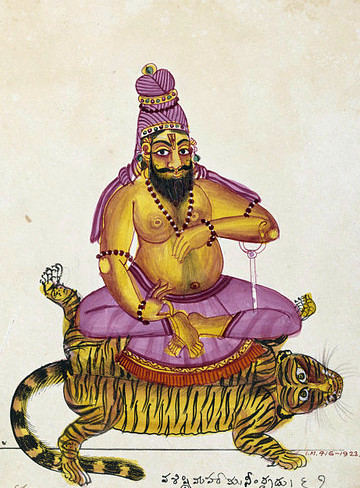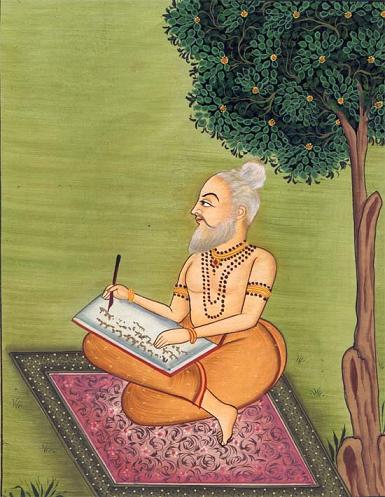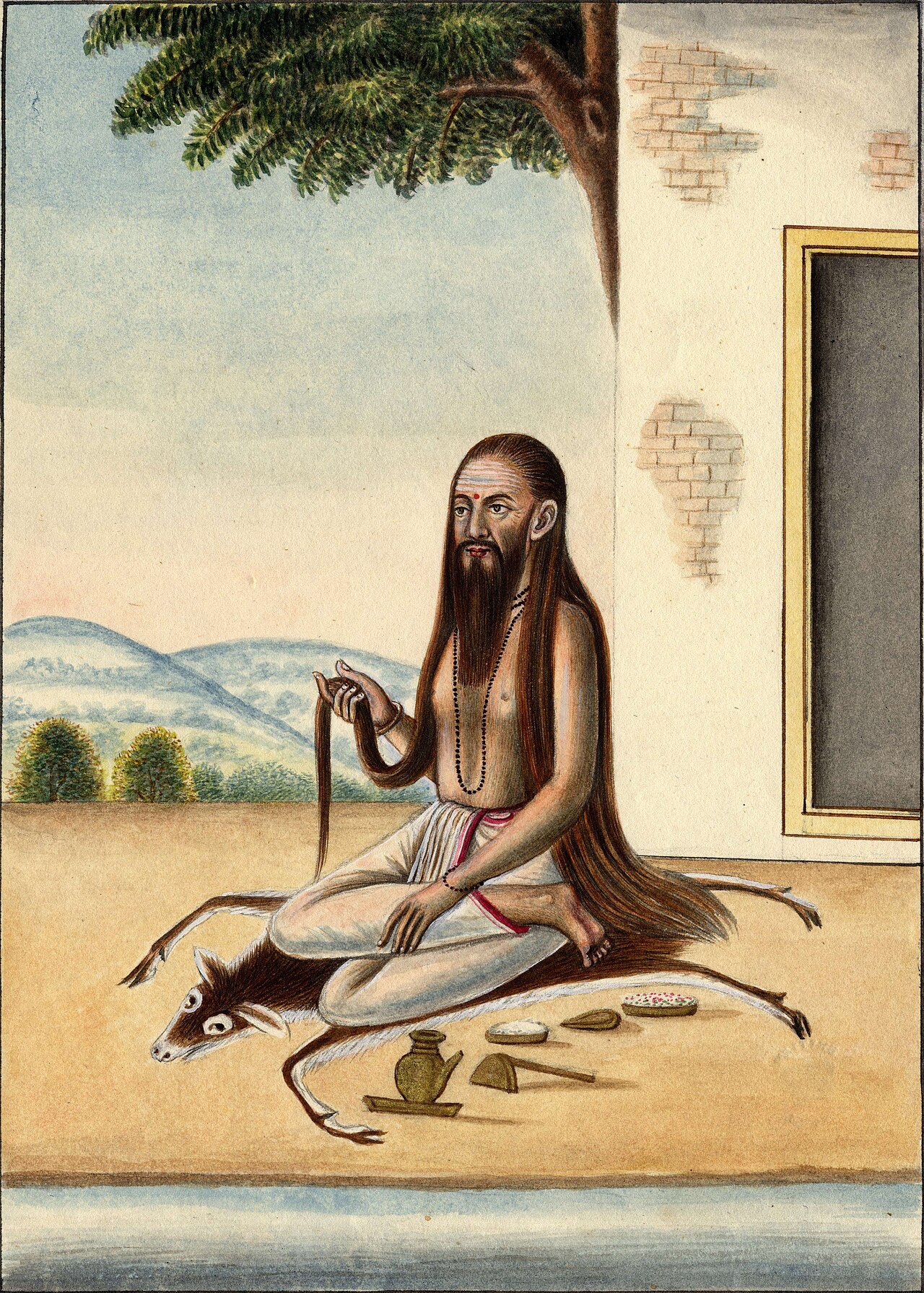
The Rigveda is arranged in ten books, or mandalas. Books two to seven are the "family books", each preserved by one lineage of seers. The sixth belongs to Bharadvaja and his descendants, the Bharadvajas: it contains some seventy-five hymns to Agni, Indra, the Ashvins, Pushan, Sarasvati and other deities. In the Vedic index of seers, many hymns are credited to Bharadvaja Barhaspatya — "Bharadvaja, son of Brihaspati" — and others to his sons and descendants such as Suhotra, Shunahotra, Garga and Payu.
अग्न आ याहि वीतये गृणानो हव्यदातये। नि होता सत्सि बर्हिषि॥"Come, O Agni, being praised, to the feast, to carry the offerings; sit as priest upon the sacred grass."Rigveda 6.16.10, a hymn of the Bharadvaja family — also the very first verse of the Samaveda
Later tradition counts him among the Saptarishis, the seven great sages, in the list for the present age of Manu: Kashyapa, Atri, Vasishtha, Vishvamitra, Gautama, Jamadagni and Bharadvaja. Many Hindu families today belong to the Bharadvaja gotra and name him in their daily rites.
The seer of the sixth mandala
The hymns of the Bharadvaja family are full of the life of early Vedic India — prayers for cattle, sons and victory, hymns to the fire on the household altar, to Indra as the breaker of obstacles, and to Pushan, the guardian of roads and travellers. The sixth mandala also contains the famous hymn to the river Sarasvati (6.61), praised as best of mothers, best of rivers and best of goddesses. Verse 6.16.10, quoted above, opens the Samaveda, so that every Samaveda recitation begins with words from Bharadvaja's family.
"The Vedas are endless"
The Taittiriya Brahmana (3.10.11) tells a well-known story about Bharadvaja. He spent three lifetimes as a celibate student, studying the Veda. When, old and weak, he lay down at the end of the third, Indra came to him and asked: if he were given a fourth life, what would he do with it? "I would spend it in the study of the Veda," he replied. Indra then showed him three mountains, and took a handful from each. "These are the Vedas," he said. "What you have learnt in three lives is these three handfuls. The Vedas are endless." Indra then taught him the fire rite by which he could attain the knowledge he sought.
In the epics and Puranas
In the Ramayana, Bharadvaja's ashram stands at Prayag, near the meeting of the Ganga and Yamuna. In the Ayodhya Kanda, Rama, Sita and Lakshmana stay with him on the way into exile, and he advises them to settle at Chitrakuta. When Bharata follows to bring Rama back, the sage entertains Bharata's whole army by his spiritual power. Rama visits him again on the return to Ayodhya.
In the Mahabharata, Bharadvaja is the father of Drona, the teacher of the Kauravas and Pandavas, who was born from a vessel (drona), as the epic tells it. The Puranas give an account of his own birth as the son of Brihaspati and Mamata, and of his adoption by King Bharata — from which, the Bhagavata and Vishnu Puranas say, his name is explained.
Teacher of the sciences
Bharadvaja is also linked with the sciences in later tradition. The Charaka Samhita (Sutrasthana, chapter 1) tells that when disease troubled living beings, the sages chose Bharadvaja to go to Indra and learn the science of life; he brought back Ayurveda and taught it to the rishis, beginning with Atreya. Grammarians, too, name a Bharadvaja among early teachers, and law books bear his name. These are traditions of later centuries attached to a revered name; they show how widely his authority was felt.
How they are remembered
Through the Rigveda and Samaveda, Bharadvaja's words are chanted every day, three thousand years after they were first composed, and the Bharadvaja gotra links countless families to him. He is honoured with the other Saptarishis on Rishi Panchami. For the Ekatmata Stotra he stands among Bharat's scientists and thinkers as the image of tireless learning — the student who wanted a fourth life only to go on studying.
Ekatmata Stotra · Stanza 26
Named in Stanza 26 of the Ekatmata Stotra — bridging the ancient and the modern.
नागार्जुनो भरद्वाजः आर्यभट्टो वसुस्तथा।
रमणो रामानुजश्च नवदीप्त्या विराजिताः॥
Sources: Wikipedia: Bharadwaja · Wikipedia: Mandala 6 · sacred-texts.com/hin/rigveda/rv06016.htm. Written afresh for The Hindu Book; corrections welcome at [email protected].