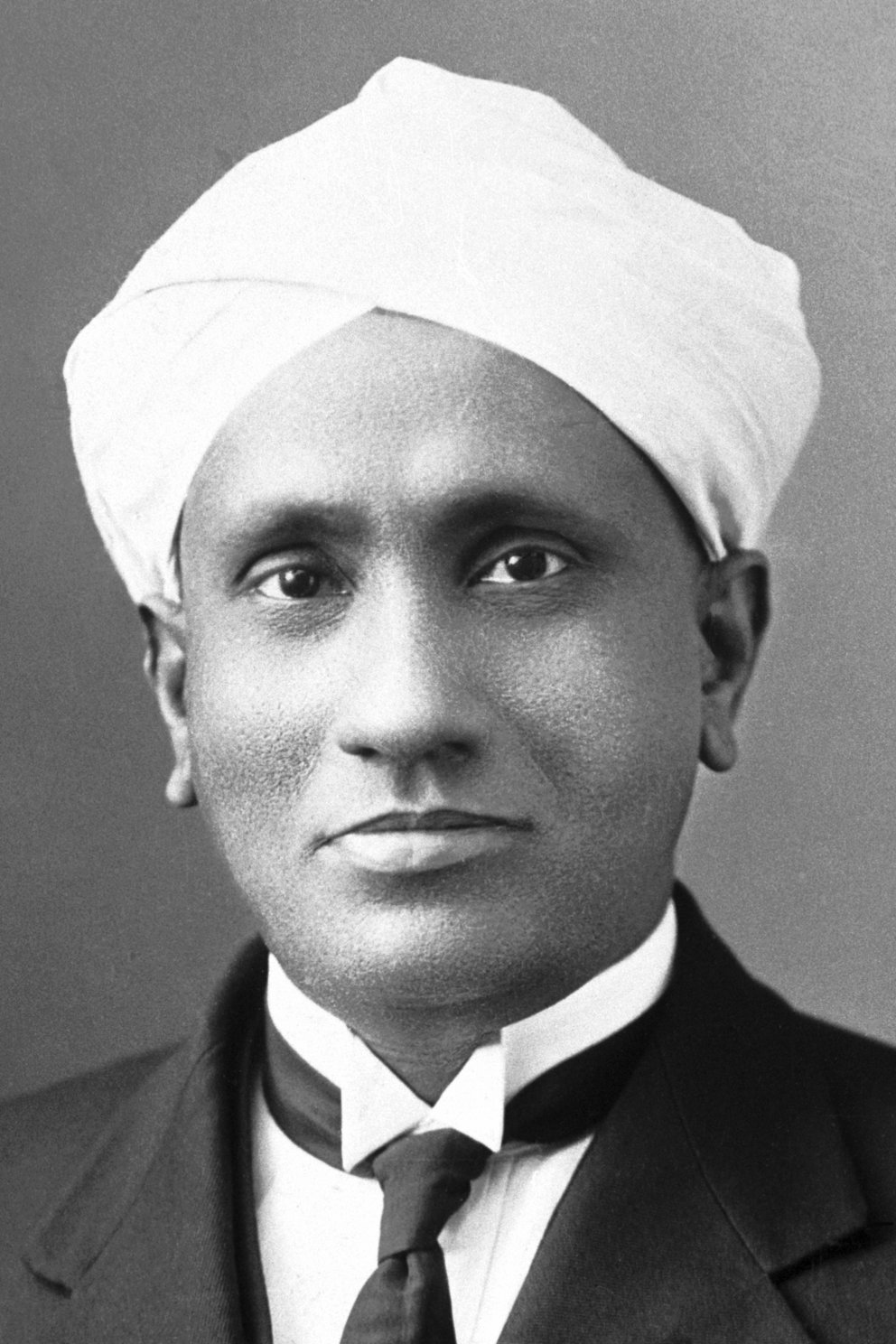
Chandrasekhara Venkata Raman was born in Tiruchirappalli, the son of a teacher of physics and mathematics. A prodigy, he finished school at eleven and took his master's degree from Presidency College, Madras, with top honours. With few research posts open to Indians, he joined the Indian Finance Department in Calcutta in 1907 — and spent his evenings experimenting at the Indian Association for the Cultivation of Science.
On a voyage to Europe in 1921, he looked at the deep blue of the Mediterranean and refused the accepted answer — that the sea merely reflects the sky.The question that led to his discovery
There, with simple and often home-made equipment, he built one of the great schools of physics of his time. In 1917 he left government service to become Palit Professor of Physics at the University of Calcutta, and in 1928 he made the discovery that bears his name.
The question of colour
Raman showed that the blue of the sea comes from the scattering of sunlight by water molecules themselves. That set him and his students studying how light scatters in liquids, gases and crystals. On 28 February 1928, working with K. S. Krishnan, he announced that when light passes through a transparent substance, a small part of the scattered light changes in colour — its wavelength shifted by the vibrations of the molecules.
The Raman effect and the Nobel Prize
The discovery gave scientists a new way to see inside molecules. He was knighted in 1929 and in 1930 received the Nobel Prize in Physics — the first Asian to win a Nobel Prize in the sciences, for work done entirely in India. Today Raman spectroscopy is used to identify materials in chemistry, medicine, forensic science and even on missions to Mars.
Builder of Indian science
In 1933 he became the first Indian director of the Indian Institute of Science, Bangalore. He founded the Indian Academy of Sciences in 1934 and, in 1948, the Raman Research Institute, where he worked on crystals, gems, sound and musical instruments — including the tabla and mridangam — until his death. He received the Bharat Ratna in 1954.
How they are remembered
India celebrates National Science Day every year on 28 February, the day he announced the Raman effect. The Raman Research Institute in Bengaluru continues his work, and his discovery is named an International Historic Chemical Landmark by the American Chemical Society. His nephew, Subrahmanyan Chandrasekhar, also went on to win the Nobel Prize in Physics.
Ekatmata Stotra · Stanza 26
Named in Stanza 26 of the Ekatmata Stotra — bridging the ancient and the modern.
नागार्जुनो भरद्वाजः आर्यभट्टो वसुस्तथा।
रमणो रामानुजश्च नवदीप्त्या विराजिताः॥
Sources: Wikipedia: C. V. Raman · nobelprize.org/prizes/physics/1930/raman/biographical. Written afresh for The Hindu Book; corrections welcome at [email protected].