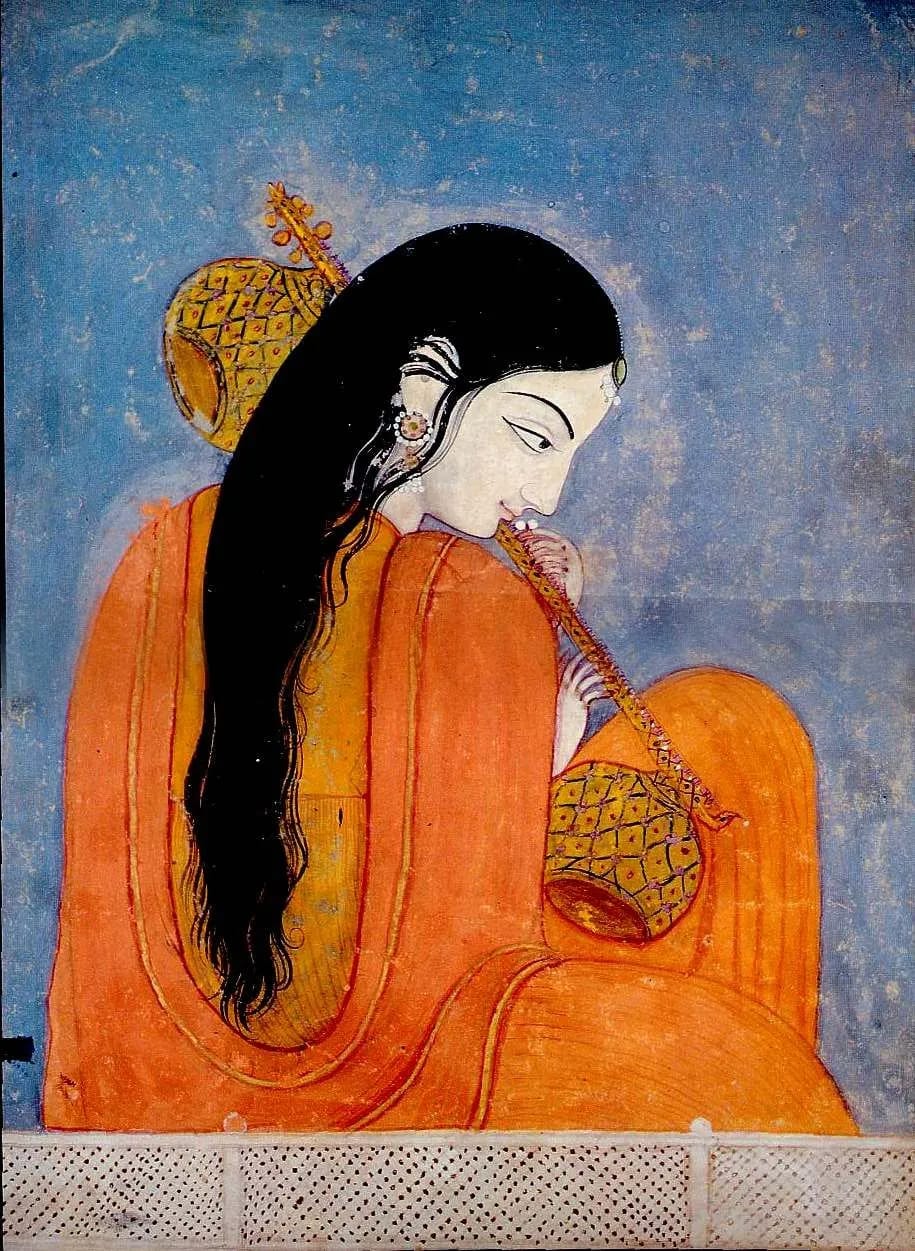
Mira was born around 1498 into the Rathore family of Merta in Marwar, granddaughter of Rao Duda. Tradition says that as a little girl she was given an image of Krishna and asked who her bridegroom would be; she took the Lord as her own and never let him go. Around 1516 she was married into the royal house of Mewar, to Bhoj Raj, the eldest son of Rana Sanga.
मेरे तो गिरधर गोपाल, दूसरो न कोई“Mine is Giridhar Gopal, and no one else.”Opening of one of her best-known padas
Widowed within a few years, she refused to live as a royal widow was expected to. She sang and danced before Krishna in the temple and kept company with sadhus of every caste. Her padas — short, intense songs in the language of the people — made her one of the best-loved voices of the Bhakti movement.
Trials at Chittor
After her husband's death and then Rana Sanga's, the court came to see her devotion as a scandal. The stories of what followed are told in every part of India: a cup of poison sent to her that she drank as Krishna's charanamrit and that did her no harm; a basket with a snake inside that opened to show a garland. Whatever the details, the meaning the tradition draws is clear — no power on earth could separate her from her Lord.
Pilgrim of Braj and Dwarka
Mira left Chittor and went first to Merta, then to Vrindavan, the land of Krishna's childhood, and finally to Dwarka on the western sea. Tradition names Sant Ravidas as her guru. At Dwarka, it is said, when messengers came from Mewar to bring her back, she went into the temple of Ranchhodrai to take leave of her Lord — and was never seen again, merged into his image.
The songs
Her padas, composed in a mix of Rajasthani and Braj with touches of Gujarati, speak to Krishna as lover, husband and master. Many songs in her name were added by later singers, but together they form one of the richest bodies of devotional song in India. Bhajans such as Payoji maine Ram ratan dhan payo are still sung in homes and temples daily.
How they are remembered
The Meera temple within the Kumbha Shyam temple complex at Chittorgarh and the Meera Mahal at Merta honour her memory, and her jayanti is traditionally observed on Sharad Purnima. Singers from M. S. Subbulakshmi to Lata Mangeshkar have carried her songs to new generations. For many, Mira remains the purest image of bhakti that cares nothing for what the world says.
Ekatmata Stotra · Stanza 10
Named in Stanza 10 of the Ekatmata Stotra — ten women of itihāsa and purāṇa.
अरुन्धती अनसूया च सावित्री जानकी सती।
द्रौपदी कण्णगी गार्गी मीरा दुर्गाश्च वन्दिताः॥
Sources: Wikipedia: Mirabai. Written afresh for The Hindu Book; corrections welcome at [email protected].