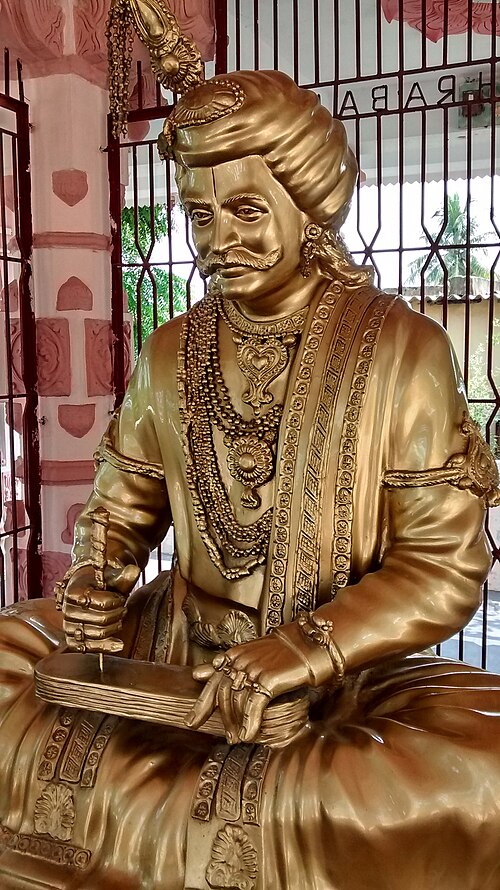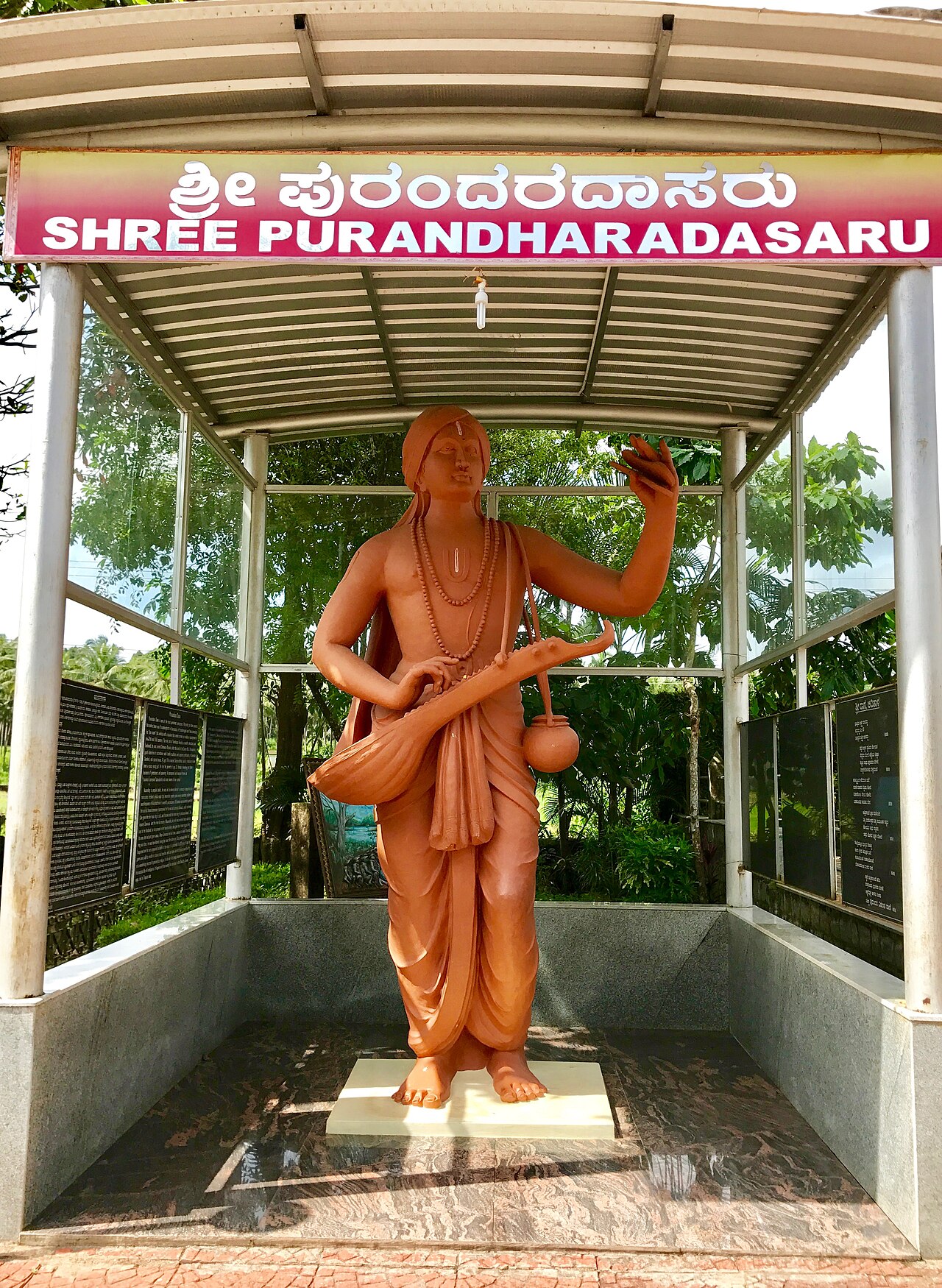
Purandaradasa was born Srinivasa Nayaka in 1484, the son of a wealthy dealer in precious stones; his birthplace is variously given as Kshemapura in Karnataka or Purandaragada near Pune. He took over the family business and became famous for his riches — and for his stinginess.
ಭಾಗ್ಯದ ಲಕ್ಷ್ಮೀ ಬಾರಮ್ಮ“Come, O Lakshmi, goddess of good fortune.”Opening of his devaranama "Bhagyada Lakshmi Baramma"
The story of his change is told everywhere in Karnataka. A poor brahmin begged him for help, and was turned away; the brahmin went to his wife Saraswati, who gave him her nose-ring. When the ring turned up in Srinivasa's own shop, he went home in fury; his frightened wife prayed, and found the ring miraculously back in her cup. Shaken, convinced that the beggar had been Vishnu himself, he gave away his wealth.
Disciple of Vyasatirtha
He went to Hampi, capital of the Vijayanagara empire, and became the disciple of the great Madhva teacher Vyasatirtha, who named him Purandaradasa. He lived as a wandering singer, a dasa — a servant of God — singing in Kannada, the language of ordinary people, rather than Sanskrit. Vyasatirtha is said to have praised him: "Among dasas, Purandaradasa is the greatest."
Songs of Vitthala
Tradition credits him with 475,000 songs; about a thousand survive. His devaranamas praise Vishnu as Vitthala of Pandharpur, but also mock hypocrisy, untouchability and empty ritual, and teach honest living in homely images. Each ends with his signature, "Purandara Vittala".
Father of Carnatic music
Purandaradasa organised music teaching into graded lessons that are still used: beginning in the raga Mayamalavagowla, the student learns sarali varisai, janta varisai, alankaras and simple songs called geetams. For this he is honoured as the Sangita Pitamaha, grandfather of Carnatic music; Tyagaraja himself revered him.
How they are remembered
The Purandara Dasa mantapa stands on the Tungabhadra at Hampi, and his aradhana is celebrated on Pushya Amavasya. Every Carnatic student's first lessons are his, and his devaranamas are sung in Karnataka homes daily.
Ekatmata Stotra · Stanza 17
Named in Stanza 17 of the Ekatmata Stotra — saints who gave their regional language a bhakti canon.
शङ्करदेव: सायण-माधवौ ज्ञानदेवस्तुकारामो।
रामदासश्च पुरन्दरदासश्च सम्भाव्या सदा हृदि॥
Sources: Wikipedia: Purandara Dasa · Wikipedia: Haridasa. Written afresh for The Hindu Book; corrections welcome at [email protected].